France dodges rerun of looting and riots at protests with tough security
Sign In or Create an Account
France avoided a repeat of large-scale violence and looting that marred nationwide protests a week ago, suggesting the government’s decision to boost police numbers and contain marches paid off.
About 110,000 people took part in a mostly peaceful demonstration confined to the edge of Paris on Saturday and another 300,000 turned out across the country, according to the Interior Ministry. The CGT union put the figure at 800,000.

Get a dash of perspective along with the trending news of the day in a very readable format.
By signing up you consent to receive the above newsletter from Postmedia Network Inc.
A welcome email is on its way. If you don't see it, please check your junk folder.
The next issue of NP Posted will soon be in your inbox.
We encountered an issue signing you up. Please try again
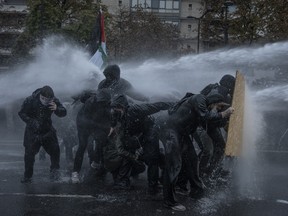
Some scuffles broke out, especially on the margins and at the end of processions, with hundreds of masked individuals dressed in black taking on security personnel, who used tear gas and water cannon to disperse crowds.
While the level of violence toward the police was again high, Interior Minister Laurent Nunez said authorities were able to prevent the looting of shops and damage to buildings seen on Oct. 17. He blamed the clashes on the ultra left, which he said was seeking to “start and finish the uprising.”
“All the warning signs were there so that we put in a place a significant presence,” he said late on Saturday. “We will of course remain fully focused in the days and weeks ahead to face up to this threat, because it is a threat.”
A total of 1,314 people had been arrested by Sunday morning, after a “calm night,” the Interior Ministry said in a statement, about half the number compared with last weekend.
The government deployed some 70,000 security officials, including elite anti-terror forces, after being caught flat-footed a week ago, when nationwide demonstrations drew more than half a million people and descended into violence and looting.
Rioters attacked public buildings and broke into stores across the country, including in the capital, as well as fighting with police and setting fire to cars. French President Emmanuel Macron, the target of much of the anger, on Thursday acknowledged “planning failings and elements of surprise.”
For the latest protests, soldiers were brought in to guard sensitive buildings, and helicopters and armored vehicles known as Centaurs were made available on Saturday. Some cities banned protests and extended curfews.
Museums including Paris’s Louvre were closed, while many shops were boarded up. A football match between Paris Saint-Germain and Olympique Lyonnais in Paris was postponed.
The protest movement began last month with high schoolers blockading establishments, calling for more teachers, repairs to buildings and an end to Parcoursup, a computerized college admissions system.
Nathanaël Combary, of the Renouveau Lycéen high school union, which is due to meet with Prime Minister Sébastien Lecornu on Monday, said students were ready to continue demonstrating in the absence of concrete measures.
“The period of dialogue has lasted long enough,” he told Sunday newspaper La Tribune Dimanche. “We now expect action.”
One site has already called for another round of protests on Oct. 31, while labor unions are calling for a major day of strikes and protests on Nov. 5. The CGT pledged to expand the movement until its demands are met.
“The anger is immense, and our determination is even greater,” the CGT said in a statement. “The government and employers must urgently respond to our social demands.”
Backed by a disparate group of social media figures, students, unions and left-wing parties, Saturday’s demonstrations were framed as an “Acte II,” or second round, of the movement, which still has majority support in polls.
An Ipsos-BVA-Cési École d’ingénieurs survey for Le Parisien published on Saturday showed that while far-right candidate Marine Le Pen is still firmly in the lead ahead of next April’s presidential election, the far-left France Unbowed leader, Jean-Luc Mélenchon, has also received a boost from the unrest and stands in second place, ahead of various centrist competitors. The poll of 1,500 adults was taken online on Oct. 21 and Oct. 22.
Mélenchon has been blamed by political rivals for stoking tensions, while he has accused the police of violence and called on Macron to give in to the movement’s demands or risk having to do so in much more hazardous conditions.
The unrest has come amid concerns about France’s public finances that has pushed a closely watched gauge of bond risk to levels last seen during the euro-area debt crisis.
The bloc’s second-biggest economy dodged a downgrade at Moody’s Ratings late on Friday, but the company warned that the widespread protests “could constrain fiscal consolidation efforts.”
Preliminary gross domestic product data for the quarter through Sept. 30 is due on Friday. Analysts expect expansion of just 0.1% after zero growth in the previous quarter, adding to the fiscal challenge faced by the government.
Protests continued elsewhere in Europe over the weekend too. About 100 people were arrested in Barcelona while thousands marched in cities across Italy amid a heavy police presence, with scattered clashes reported. Albania’s capital of Tirana continued to be rocked by demonstrations against its prime minister.
Protesters burned containers, vandalized shops, and threw stones at police in the area around Catalunya Square in central Barcelona. About one-quarter of those detained were minors, Nuria Parlon, the Catalan head of security, and Jaime Collboni, mayor of Spain’s second largest city, said at a joint press conference.
—With assistance from Rodrigo Orihuela.
Our website is the place for the latest breaking news, exclusive scoops, longreads and provocative commentary. Please bookmark nationalpost.com and sign up for our daily newsletter, Posted, here.
Join the Conversation
This website uses cookies to personalize your content (including ads), and allows us to analyze our traffic. Read more about cookies here. By continuing to use our site, you agree to our Terms of Use and Privacy Policy.
KioskNews shows a cleaned-up reading view extracted from the publisher’s page — the original always lives on their site, not ours.