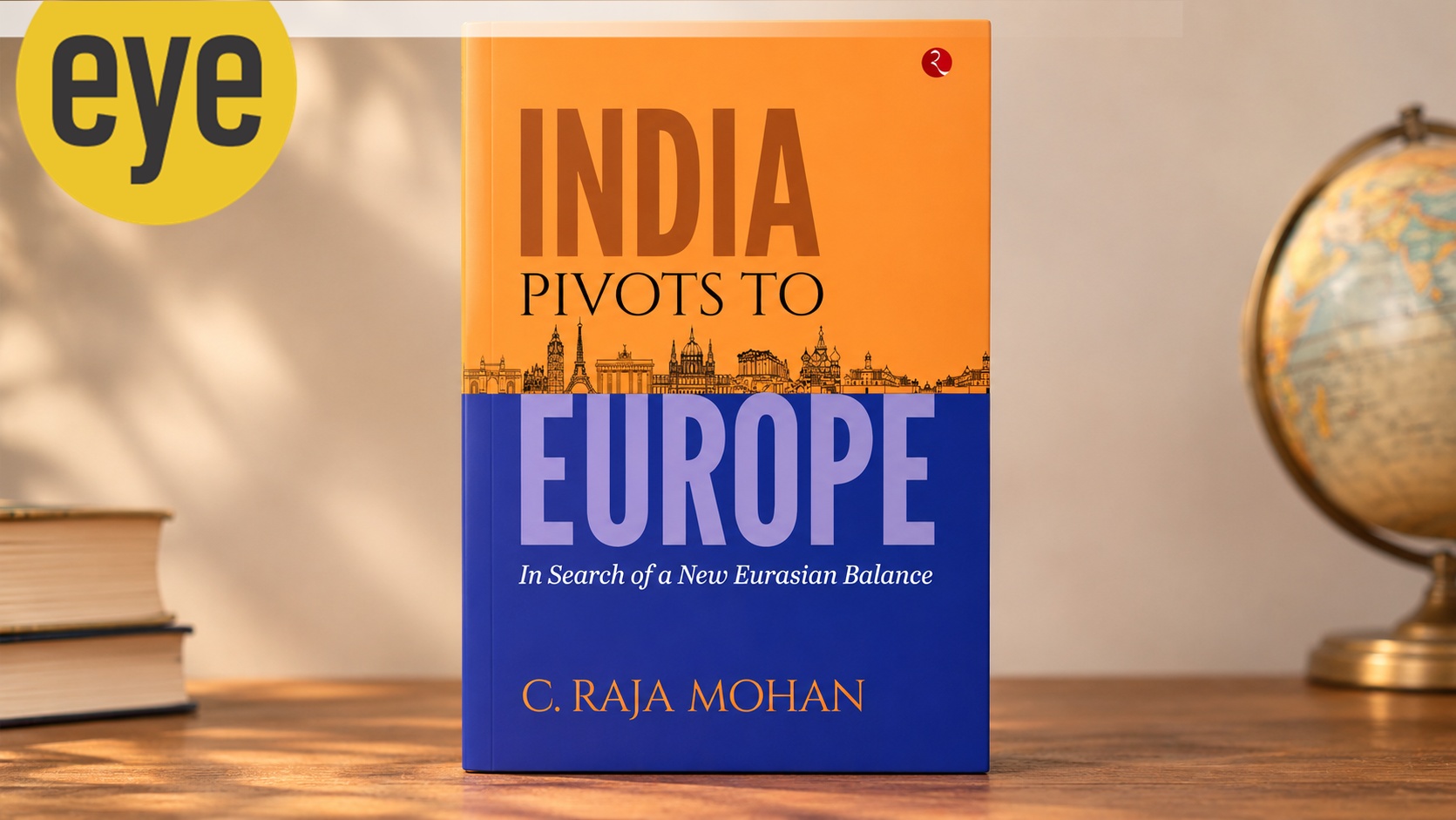
C Raja Mohan, in his latest book, India Pivots To Europe, examines a new axis in Eurasia
On a cold evening in January 1904, Sir Halford Mackinder, then director of the London School of Economics, addressing the Royal Geographical Society, introduced the idea of a “world island” consisting of the Eurasian landmass and defined its “heartland” as the pivot area stretching from the “Volga to the Yangtze”. He further pronounced that the one who rules the ‘heartland’ controls the ‘world island’ and the one who rules the ‘world island’ commands the world. Considering that in 1900 Great Britain was the predominant imperial power with its ring of bases stretching from the Mediterranean to the Indian Ocean backed by the largest naval force, it was an imaginative prediction.
Across the Atlantic, American thinking was shaped by Captain Alfred Mahan, president of the Naval War College, who highlighted the influence of sea power in shaping history. In his seminal The Influence of Sea Power (1890), the impact of maritime commerce “on the wealth and strength of countries” had long been visible and depended on sea power.
Bridging the two concepts came a Dutch-American Yale professor, Nicholas Spykman, who saw the beginnings of the Cold War and posited in The Geography of Peace (1944) that, as the USSR controlled the “heartland”, the US needed to control the “rimland” (coastal and border regions around Eurasia) as it was the key to global power. It is widely believed that Spykman’s reinterpretation of Mackinder’s “heartland” provided the strategic heft to George Kennan’s theory of “containment”.
C Raja Mohan brings back the importance of geography in India Pivots To Europe, as India seeks to come to terms with re-emerging old uncertainties of great-power rivalries and new uncertainties created by the proliferation of emerging technologies, aggravated by an eroding multilateral order. He analyses the push behind the growing comfort level between India and Europe. In doing so, he dwells on the layered past of India’s encounters with European powers from ancient times to Christian times, from the colonial period to the post-1947 Cold War period when Europe itself was divided, to the post-Cold War US-led unipolar world, to the present times.
As independent India sought to come to terms with the Cold War, it saw a divided Europe with West Europe increasingly preoccupied internally with its challenges of reconstruction under the Marshall Plan and seeking security under the NATO umbrella. The Western European world would remain under US hegemony even as it sought to open a new chapter in its history of old rivalries and conflicts.
Therefore, despite historical linkages that included intellectual inheritances of a nation-state, liberty and equality, nationalism and spirit of scientific enquiry, a non-aligned India could only build ties with individual countries (UK, France and Germany) but not West Europe as an entity. Meanwhile, as the Cold War came closer home and the Western tilt towards Pakistan became more pronounced, India developed new relationships with USSR and East European countries (Poland, Hungary and Czechoslovakia) and Yugoslavia.
With the end of the Cold War, India had to re-examine its geostrategic approaches. The collapse of the Soviet Union and the accompanying domestic economic challenges made a westward shift imperative to retain agency. As India sought to reform its economy by liberalising and catch the winds of globalisation by engaging with the West, it also embarked on a Look East policy.
A tentative dialogue with the US began in 1992 and, through many ups and downs, eventually began to yield results by the turn of the century. During the 1990s, unification of Germany, integration of former east European states and introduction of the Euro were Europe’s primary preoccupations. India’s efforts focused on individual countries. In 1998, India signed a strategic partnership agreement with France, followed by one with Germany in 2001. By 2010, sustained economic growth had enabled India to develop closer economic ties with both Europe and the US, enabling it to diversify its global linkages.
However, even before scholars found a better label for the post-Cold War era, changing power equations began to reflect the end of the short-lived US-dominated unipolar interval. Spykman’s ‘rimland’ hypothesis came under strain with Afghanistan and Iraq interventions. Close ties between China and Russia, coupled with the China-led BRI and institutional initiatives like the SCO and BRICS, have revived Mackinder’s ‘heartland’ thesis. In 1904, Mackinder’s ‘heartland’ was contested between European powers; today, Eurasian powers are in the game. Also, China’s naked ambitions are raising concerns in the Eurasian landmass and in the wider world.
This is the setting in which Raja Mohan highlights the reasons behind the growing ties between India and Europe, and feels it is a promise whose time has now come because structural shifts are driving it. Europe realises that China is no longer just a market but a competitor and even a challenger. It is true that a growing disenchantment with US is leading Europe to discover ‘strategic autonomy’ but how deep-rooted the disenchantment is, remains a question mark. Finally, India and Europe believe in multipolarity and realise that a multipolar world needs rules that emerge out of multilateralism or failing that, plurilateralism.
As Raja Mohan sums up in this thoughtful work, for India, engagement with Europe “expands its global role while preserving its strategic flexibility” and for Europe this engagement helps Europe’s “wider search for relevance in an Asian century.”
The writer is a retired diplomat and strategic affairs analyst
KioskNews shows a cleaned-up reading view extracted from the publisher’s page — the original always lives on their site, not ours.