The shame of a violent nation is laid bare in a failed execution
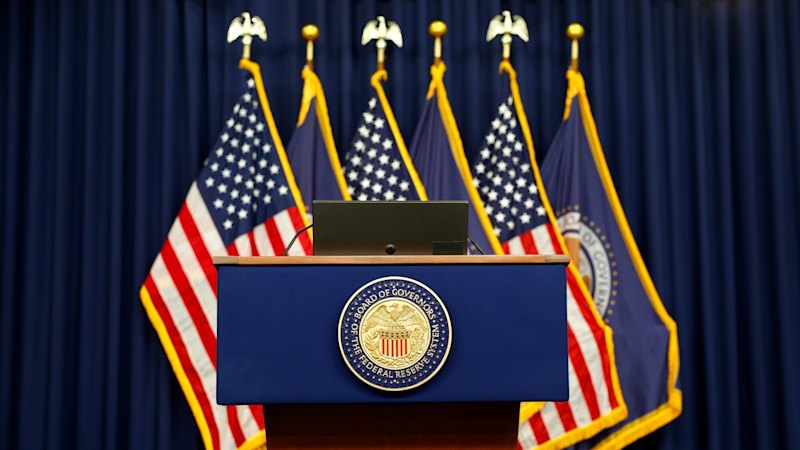
In keeping with its image of a violent nation, the planned execution in the US, and its failure, shows hardened officials eager to get the woman’s execution under way “to avoid having to reschedule” (“Inmate survives two lethal injections”, October 2). No consideration that she is a human being and that they might be able to avoid killing her. That a first world country still has the death penalty, and where convenience overrules mercy, says a lot about America’s lack of humanity and compassion. Even in earlier times, in British-run countries, if a hanging failed, the prisoner was usually granted freedom. Donald Hawes, Peel
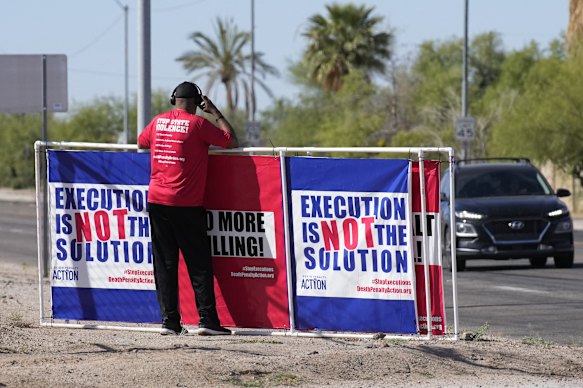
The “botched” execution in the US is yet another reason this barbaric practice should be banned. Australia does not have laws allowing judicial murder, nor does it extradite people to any country where it is a possible outcome. For that alone we should be thankful for our progressive government. Stephanie Edwards, Leichhardt
How can a nation call itself advanced when it indulges in the barbaric practice of lethal injection? The US must stand alone in the variety of methods of execution available in various states. By indulging in these practices, it only diminishes itself. Thank heavens we live in a country where even those convicted of the most heinous murders are allowed to serve their sentences in a civilised manner. Ian Adair, Hunters Hill
And the US purports to be a civilised country? Heather Johnson, West Pennant Hills
Negatives all around
Talk about “negative equity” is treating first home buyers just like property investors (“AI bubble threat to economy, warns RBA”, October 2). They aren’t. Investors might be worried if the value of their asset has fallen. But first home buyers have bought a home to live in. Does it really matter to them if the value of that shelter has fallen and they aren’t looking to sell any time soon? What is of more concern is that the rise in interest rates will make it harder for first home buyers to keep up their mortgage payments. If they don’t, the lender may foreclose on them. But then the concern would be more with the banks, who will have to sell and have an asset worth less than the mortgage. However, sensible lenders should be prepared for such eventualities. David Rush, Lawson
Trust in democracy
Matthew Knott is right (“Greens need to let the sunshine in”, October 2): economic populism does not give transparency. Nor does it promise democracy in the chamber. To promise only to improve some legislation mimics Pauline Hanson’s lazy participation. The Greens must work to improve government and restore trust in democracy. As Knott writes, the party lacks internal democracy, which seems to be evidence of a lack of trust in democracy. Let the light in. Anne Eagar, Epping
Greener pastures
Waleed Aly (“Green revolutionaries at the gates”, October 2) conjectures that “the Greens’ greatest challenge [is] that in an anti-establishment moment they come across as part of the establishment”. However, the Greens have arguably traditionally aimed to be a social conscience for the establishment regarding matters such as protecting the environment, making housing and healthcare affordable, taxing the ultra-wealthy appropriately, and caring for the disadvantaged. Because they prick consciences, they will never be universally liked. Given your correspondent’s argument that aiming to replace Labor is “a bridge too far” (Letters, October 1), realistically more can be achieved for Australia by the Greens targeting being a strong minority that calls out a government that has become weak-kneed. Paul Casey, Callala Bay
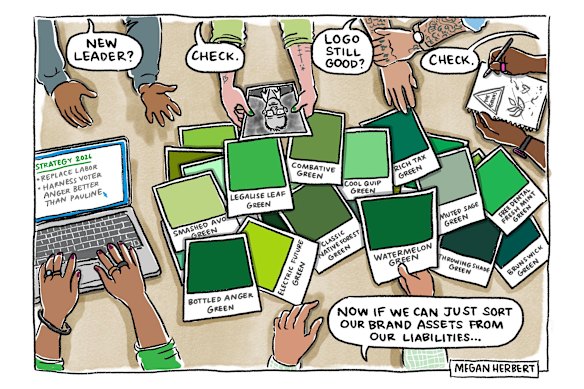
David Shoebridge needs to drop the “replace Labor” line – probably aimed more at his own rank and file – and get back to the Greens’ core issue: the environment. With One Nation and the Coalition proclaiming absurd and broadly unpopular anti-net zero and anti-renewable policies, this is the ground on which Shoebridge needs to make his stand. Phil Bradshaw, Naremburn
Visa issues
This is another example of taking too long to deal with an issue that has been widespread and obvious for too long (“Labor to crack down on rogue visa lawyers”, October 2). Assistant Minister for Citizenship Julian Hill should have been on this case years ago, firstly to deal with dodgy operators and secondly to give overwhelmed public servants a chance to deal with their responsibilities properly. Again, it is only pressure caused by voters changing to One Nation that has prompted this belated action. Government ministers should be on the front foot in dealing with these exploitation issues, not reacting to public pressure. Politicians need to wake up to their responsibilities or risk further erosion of the public’s belief in their value and that of our Westminster system. If they don’t get the message quickly, we will be at the mercy of a lemming-like vote for Pauline Hanson supporters. Ian Ferrier, Long Jetty
So, rogue lawyers are ripping off vulnerable applicants who have little chance of success in gaining a visa? No surprise here as it’s just another expensive legal rort having an impact on desperate clients. Not just a warning is needed from the Albanese government but strong changes, even penalties, to those exploiting these hopeful, optimistic clients. Denis Suttling, Newport Beach
Well, this is something you don’t see every day: replacing regulatory guidelines with century-old case law of reasonable conduct. The proposal to force rogue lawyers to relinquish the legal shield of client waiver and be subject to professional misconduct for knowingly lodging a futile visa application is a good move. I tip my hat to the government on this one. Michael Blissenden, Castle Hill
Price of relocation
The decision to move the public housing tenants from the freestanding homes where they have lived for more than 30 years is a perfect example of the human costs of relocation being ignored (“Cul-de-sac at heart of new housing row”, October 2). The area appears to be a strong community. Relocation will result in the community being obliterated; tenants’ capacity to age in place will be undermined; and the mental and physical health impacts are likely to be severe. The question that needs to be asked is why government cannot refurbish the homes (if necessary) and use one of the 300 publicly owned sites identified in the recent NSW government land audit to build new public housing? Alan Morris, Eastlakes
Flight safety revamp

The thwarted hijacking of a Dubai to Tel Aviv flight raises some interesting issues regarding flight safety (“Hero pilot ‘helped save hundreds of lives’ after midair stabbing”, October 2). The rescue of the stabbed pilot and the subduing of his attacker was made possible only by the wounded pilot’s pressing of the door release during the struggle in the cockpit. What if he hadn’t been able to press the release? The off-duty pilots couldn’t have got to the controls, and 174 passengers would have died. Maybe there needs to be a rethink about cockpit access. Perhaps there could be a keypad on the door for the flight staff, or a release switch in the steward’s section? Something to allow for the awful possibility of no one being able to reach a terrorist in the cockpit. Larry Woldenberg, Forest Lodge
E-bikes lethal in wrong hands
Not in my wildest dreams did I ever imagine that I would be threatened by 14-year-old children, without helmets or shoes, riding tandem down the footpath on motorcycles in my community (“Throsby faces new injuries after e-bike collision”, October 2). You can’t hear the bikes coming; I have never seen one peddled. The children zigzag across busy intersections, oblivious to any rules of the road. Increasingly, pedestrians are at risk of serious injury. Unfortunately, only more serious injuries and deaths, as well as multimillion dollar lawsuits, will speed up reform and make our sidewalks safe again. Mark Paskal, Austinmer
Another horror e-bike accident, this time involving the now elderly well-known Margaret Throsby. Beyond the immediate emotive responses to these incidents, it’s past time to look at some hard facts that need to drive what should be a national approach to the management of this fraught contemporary issue. Fragmented state-based rules, policies or local area blitzes don’t comprehensively capture the reality of the discrepancy between hardware, or motorised power, and software, being the immature child’s brain. Placing a child on a machine that can instantly travel up to 48km/h, supposedly controlled by a human with an immature prefrontal cortex, which remains so until about the mid-20s, is a constant potential accident. This should arguably be nationally illegal because, in this case, velocity will always outpace biology. Add to this the illusion that e-bikes are toys, and the reality of rule-compliance versus peer pressure, and the risk is constantly high.
Robyn Dalziell, Kellyville
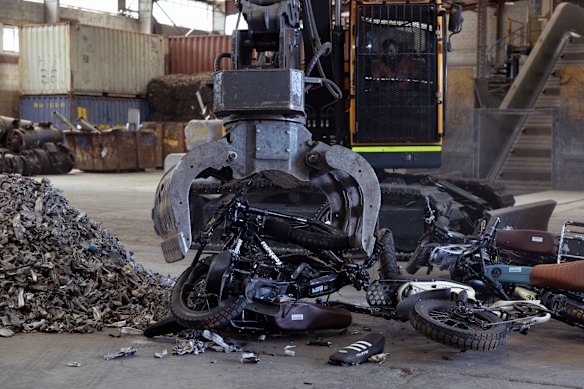
I saw, with dismay, on the news, that the e-bikes which have been confiscated because of modifications have now been destroyed. It seems to me that from an environmental point of view, there could be a better use of these bikes by sending them to struggling or war-ravaged countries. After all, the raw materials that were used to make them should not end up in landfill. There must be a better solution. Margaret Shipton, Balgowlah Heights
Card rage
On the first day of the card surcharge ban becoming effective (“Small shops ill-prepared for card surcharge ban”, October 2), yesterday I had the first-hand experience of it being openly flouted by small vendors at the Hornsby weekly market. Now many of the stall owners have started charging a fixed amount between 40c and 60c, irrespective of the amount of purchase. I bought some bananas at a stall which by the displayed price should have cost $2.80, however, without telling me, the shop added a surcharge and charged me $3.35 (a whopping 20 per cent), while another stall added a 40c surcharge, again, without letting me know. At another shop, the stall owner was upfront as he informed me beforehand that he will charge a 50c surcharge for card payment. Given that the RBA had given a long lead time so everyone was prepared before the effective date of October 1, I am not sure if it’s a lack of preparedness or profiteering by small businesses. Bipin Johri, Epping

I continue to be gobsmacked about small businesses complaining they might have to “lift prices” due to the end of credit card surcharges because customers are “more sensitive to price rises than ever”. When I pay $15 for something and my bank’s App immediately tells me my card has been charged $15.25, do I think the extra 25 cents somehow isn’t real or isn’t a higher price? Do they think the magic fairy is paying the surcharge? I suggest they embrace transparency, put the total (and true) price on their boards and signs, and move on. Brendan Jones, Annandale
I me mine
It was noticeable that the letters opposing the extension of coal mining in the Hunter Valley were mainly from city-centric correspondents’ (Letters, October 2). None offered a suggestion for acceptable income or industry retraining programs that would replace the economic benefits that currently contribute to state and federal coffers – money which enables the correspondents to enjoy their current lifestyle, as well as contributing to infrastructure. I would be interested to hear what miners and their families, and the local businesses, think about the prospect of long-term unemployment with the closure of the mines. Let’s also consider what the Minns government thinks of its prospects in the Labor held seats in the Hunter Valley if the extension to mine had been refused. Les Sisley, Kelso
AI OK
It seems a bit naive to suggest that politicians should not use AI to aid in the preparation of their speeches (Letters, October 2). Politicians, especially political leaders, have almost invariably used speechwriters: JFK described his speechwriter Ted Sorensen as his “intellectual blood bank”, Gough Whitlam had Graham Freudenberg, Paul Keating had Don Watson, John Howard had John Kunkel and Christopher Pearson. It is surely unreasonable to expect politicians, who rely on their staff to research and advise them on the wide range of issues that confront them daily, to then sit down and structure a speech that hopefully will satisfy their constituents.
AI is now another tool to aid them, and their staff, in that onerous, relentless obligation. John Ure, Mount Hutton
With so many politicians using AI for their speeches it will be a matter of time before they use it to make decisions that affect us. That is the real worry. Con Vaitsas, Ashbury
Contextually, the rise of AI coincides with the decline of reading, posing particular quandaries. The reading revolution, which began around the 1750s, coincided with major developments, including the Enlightenment. To grow up in a “reading home” remains a fortunate start to life. Yale University researchers found people who read books live almost two years longer than non-readers. A similar but weaker link was found with readers of newspapers and magazines. “A book holds a house of gold” says a Chinese proverb, and, based on UN data, if all students in low-income countries left school with reading skills, 171 million people could rise out of poverty. In 2016, Italian researchers found a year’s extra schooling increased male lifetime earnings by some 9 per cent, rising to 21 per cent for those from homes with many books. Bibliotherapy, or reading to aid psychological health, is an ancient practice, with “Medicine For The Soul” inscribed above the entry to the ancient library of Thebes. A pill that could increase longevity, improve academic performance, boost income, nurture empathy and enhance mental health would take stockmarkets by storm. However, reading is in steep decline here, as in the US and UK. As of 2025, a third of Australian children couldn’t read proficiently and a third of teenagers aren’t reading for pleasure. The consequences of these major changes, with the entry of AI, aren’t predictable but are likely to be immense. Barbara Chapman, South Yarra (Vic)
HSC advice
Thank you, Liz Nable, for your excellent opinion piece (“Tell your HSC kids: ‘Don’t do it for me, do it for yourself’” , October 2). You managed to express very helpful and insightful advice for anyone trying to get a student to apply themselves to achieve a satisfactory HSC result. The best I could advise a student was, “A good result will give you more options”, hoping a sense of increased freedom and more choice might influence them. I don’t know if it helped. These days, I’d show them your piece, knowing I’d done my best for them. Jennifer Fergus, Croydon
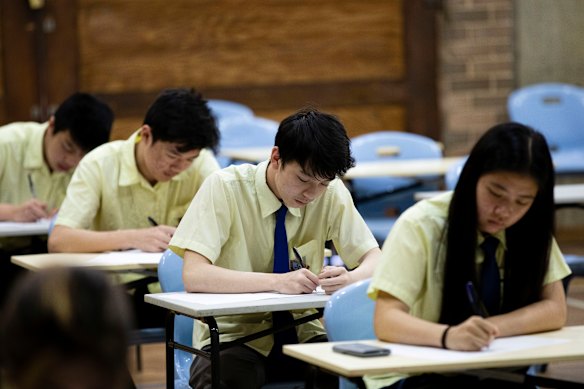
Liz Nable’s excellent advice to schoolchildren facing the HSC is almost an echo of advice I heard given at Oxford University when I was in England many years ago. They suggested that students planning to go to university should not narrowly specialise while in school. “Get as broad an education as possible; it will serve you much better than concentrating on just the subjects you think you will study at university, when it is time to plan your future. A good, rounded education prepares you for life.” Education should be valued for itself, not what it can do for you. Nola Tucker, Kiama
Word salad
Three new words spread across the Letters page (October 2) requiring me to do a dictionary dive. What a delightful coincidence that “perdure” and “fugacious” are direct opposites. And cognitive “consonance”. Wow! Hats off to the letter writers. Hugh Barrett, Sanctuary Point
Go Knights

The Newcastle Knights’ coach, Justin Holbrook, has lifted the spirits of Newcastle and the Hunter with his fabulous young team of fantastic and fearless talent (“Grand final will hinge on errors, so avoid making one”, October 2). And a few old hard nuts. The win has already happened. And better still, it means no one is talking about One Nation. And that’s “better than Lego”. Go Knights. Wendy Atkins, Cooks Hill
- To submit a letter to the Sydney Morning Herald, email letters@smh.com.au. Click here for tips on how to submit letters.
- The Opinion newsletter is a weekly wrap of views that will challenge, champion and inform. Sign up here.
KioskNews shows a cleaned-up reading view extracted from the publisher’s page — the original always lives on their site, not ours.