‘I saw the script and went: oooh!’ Olivia Colman and Alexander Skårsgard on their steamy folk-horror movie Wicker
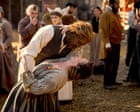
Another year, another raunchy comedy-drama in which Alexander Skarsgård is the answer to a social outcast’s erotic dreams. “I fucking loved Pillion so much!” says Olivia Colman, reliably sweary straight out of the gate, as she brings up last year’s British indie hit starring Skarsgård as a leather-clad dom with a timid traffic warden as his submissive. “And when they kissed at the end … Aww.” The 52-year-old Oscar-winner for The Favourite gives a mock-sniffle and a little shake of her frizzy grey locks, then pretends to dab her eyes.
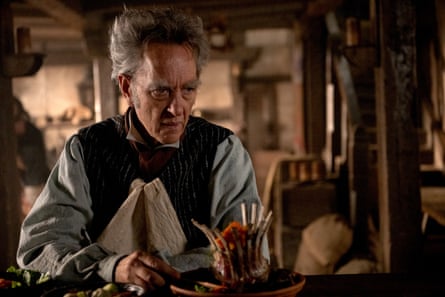
Seated beside her in a London hotel room and wearing a bright orange “I’m With Stupid” T-shirt, Skarsgård tilts his head appreciatively. In Pillion, it was Harry Melling who had the privilege of being ravaged by the 50-year-old Swedish actor. Now it is Colman’s turn in Wicker, an earthy adult fairytale filmed in Budapest and set in a medieval village populated almost exclusively by British comic actors who converse in language both archaically formal (“Happy to transact with you”) and bluntly colloquial (“I’d better fuck off”). Among them is Phil Daniels as a leering butcher and Richard E Grant as a doctor who is even more inept at his job than Grant was as a Celebrity Traitor.
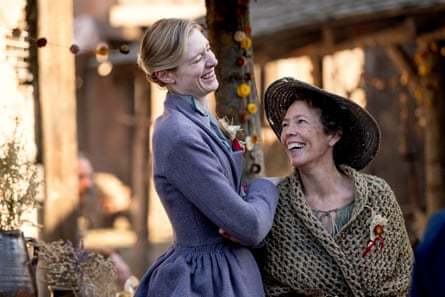
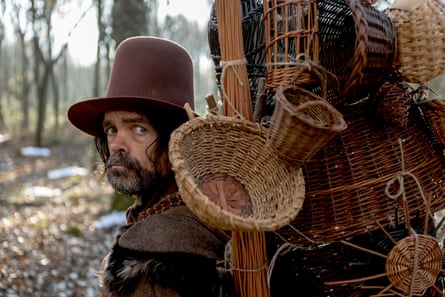
Colman plays the Fisherwoman, ridiculed by the other villagers for her pong and her general absence of allure. In the spirit of mocking the dominant patriarchal conventions, where men put metal collars on their wives when they get married, she asks the Basketmaker (Peter Dinklage) to fashion her a husband. A month later, she has a groom made entirely of wicker and dedicated solely to her pleasure and happiness. If the movie works, says Alex Huston Fischer, who wrote and directed Wicker with his wife, Eleanor Wilson, “you are essentially connecting emotionally to a basket”.
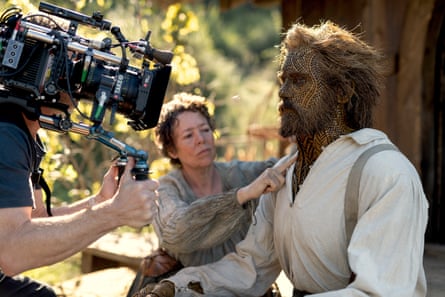
This is where Skarsgård comes in. His performance as the Wicker Husband was augmented by Weta Workshop, the New Zealand special-effects outfit behind the Lord of the Rings series. “I had a full bodysuit, a mask glued to my face, then added prosthetics for lips and eyelashes,” the actor says. “Oh, and hair made from flax. Highly flammable.” He tried out different accents but that felt “too removed from myself, what with the mask and everything else”. Colman gives an amused snort: “Might as well have got someone else in,” she says. Her co-star responds by puffing out his chest: “Hey, people pay big bucks to see Alexander Skarsgård on screen!”
In truth, he is humbler than all that. “Alex gets very awkward with compliments,” says Colman, then turns to him: “Well, tough. I don’t think there are many people who could have got quite so much across while acting within such restrictions. It’s a mark of how good you are. Sorry!” Is it fair to call his performance minimalist? “From my point of view, it was maximalist,” he says. “Because of the mask, I had to exaggerate everything and it felt like I was being hammy. Subtleties wouldn’t register. Underneath that beautifully crafted suit, I was like: ‘Aaah!’, ‘Grrr!’” His guttural sounds are accompanied by facial expressions which suggest a beginner’s guide to semaphore acting.
Skarsgård’s performance and the cross-hatched weave effect are magically textured. The impact of the creaking sound design should not be underestimated either, especially once the newlyweds get down to conjugal business. As one Letterboxd user put it: “Whoever chose the erection sound effect … you’re a genius and I love you.”
It turns out I’m not the only one amused by Wicker’s Letterboxd reviews. “As a director, you should never read the comments,” says Fischer. “But these ones are so entertaining.” Users have offered alternative titles (John Wicker, The Shape of Wicker, Fifty Shades of Hay), double entendres (“All my eggs are going in his basket”) and the witty suggestion that Etsy could become the new Hinge. One astute comment likened Elizabeth Debicki’s character, a jealous neighbour who tries to sabotage the Fisherwoman’s happiness, to the spiteful Emma, played by Mercedes McCambridge, in the classic western Johnny Guitar.
In any discussion of Wicker, the word “horny” is never far away. “We even included it when we pitched the movie,” says Fischer. “There’s something so human about it,” says Wilson. “We are these fleshy bodies with desires that are embarrassing and messy. It seemed like a great place for comedy.” Fischer notes that Colman’s goggle-eyed reactions were vital: “For someone to be surprised by incredible sex is very funny to us. Especially when it’s Olivia. She’s so good.”
Colman returns the compliment. “You get sent a lot of scripts that you feel you’ve seen before. But when I read this, I was like an octopus. I changed colour and went: ‘Oooh!’” A deft impression of a cephalopod follows, arms undulating. The Fisherwoman is the only female character with her own name, Colman points out, rather than being known as, say, The Bakerwoman or The Innkeeper’s Wife. “And she’s the only woman with agency. She’s perfectly happy with her life. It’s when pushed that she says, ‘I’m going to fuck this up and make a mockery of your beloved convention of marriage.’ Then she gets this kind, beautiful creature, and suddenly the world is even more joyous.”
Wicker is based on Ursula Wills’ short story The Wicker Husband, which has already been adapted as a stage musical combining actors and puppetry. Reviewing that version in 2020, the Guardian theatre critic Arifa Akbar saw it as a story about “insider parochialism, the demonising of outsiders and the tyranny of conformity” with “echoes of Brexit Britain”. All pertinent, the directors agree now. “Those things were in our heads when we were writing,” says Fischer. “Elizabeth’s character is trying to protect herself and the village from what she sees as this foreign element that is there to destroy them.”
Dev Patel was originally set to play Colman’s basket-case beau until a scheduling clash forced him to pull out. Never having quite shed his Slumdog Millionaire innocence, Patel seems a more natural choice for the part than Skarsgård, who even prior to Pillion was drawn to stone-cold alphas: a tech bro (Succession), a violent husband (Big Little Lies), a coke-snorting cop (War on Everyone). Even he admits that he is cast against type in Wicker. “I tend to play characters who are messed up or internally conflicted. That duality is something I’ve done a lot and still enjoy. That wasn’t there for this character: he has a purity to him that was different to what I’ve done in the past. It was about making him relatable and interesting without that inner struggle. So that was a bit of a departure, and slightly intimidating.” Wilson argues, though, that Skarsgård has “qualities that are very Wicker Husband: he has a stoicism, and such presence. We needed that. It’s the sweetness that is the big surprise.”
The Fisherwoman’s newfound fulfilment and her husband’s inherent goodness eventually have a destabilising effect on the other villagers, who realise how impoverished their own lives are by comparison. Trouble follows. Had the honeymoon period between the couple continued, however, would it not have got irritating eventually? Don’t relationships need a little creative friction to remain interesting? “Oh, I don’t know,” says Colman, thoroughly unconvinced. “I quite like a friction-free life. I don’t think I’d cope with a fighty relationship. I prefer to work things out gently.”
Her thoughts turn to her own marriage to writer and producer Ed Sinclair, with whom she has three children. “We’ve been together for 32 years and married for 25,” she says. They have also worked together several times, including on Wicker, which they co-produced. While their domestic life is harmonious, there have nevertheless been “moments with the odd little look” in a professional context. She gives an example of one such look. The narrowed eyes, the abrupt withdrawal of warmth: no one would want to be on the receiving end of that. All the cosy Olivia Colman-ness has drained away in an instant.
“But we’ve never had big fights,” she says, back in chirpy mode again. “Very early on, when we first started working together, there was a suggestion from him of an acting note.” Hearing this, Skarsgård lets out a wicked laugh, instantly spotting a taboo. “Strong side eye,” he says. She continues: “Or sometimes when I’ve needed to do a taped audition, I’d say: ‘Can you tape this for me?’ And he’d ask, ‘Have you thought of trying it like this … ?’” There’s that look again. “Then he’d say, ‘OK, point taken!’”
Where does she think Wicker ends up vis-a-vis marriage? “I’d say it’s pro equal relationships. It’s perfectly possible to do it nicely. If you’re planning to share your life with someone, be considerate. Ask yourself: Have I been a good partner this week?” She draws a tick in the air with her finger. “Check!”
KioskNews shows a cleaned-up reading view extracted from the publisher’s page — the original always lives on their site, not ours.