Akmal Nasrullah: Oil and gas here to stay even as Malaysia pushes for green energy
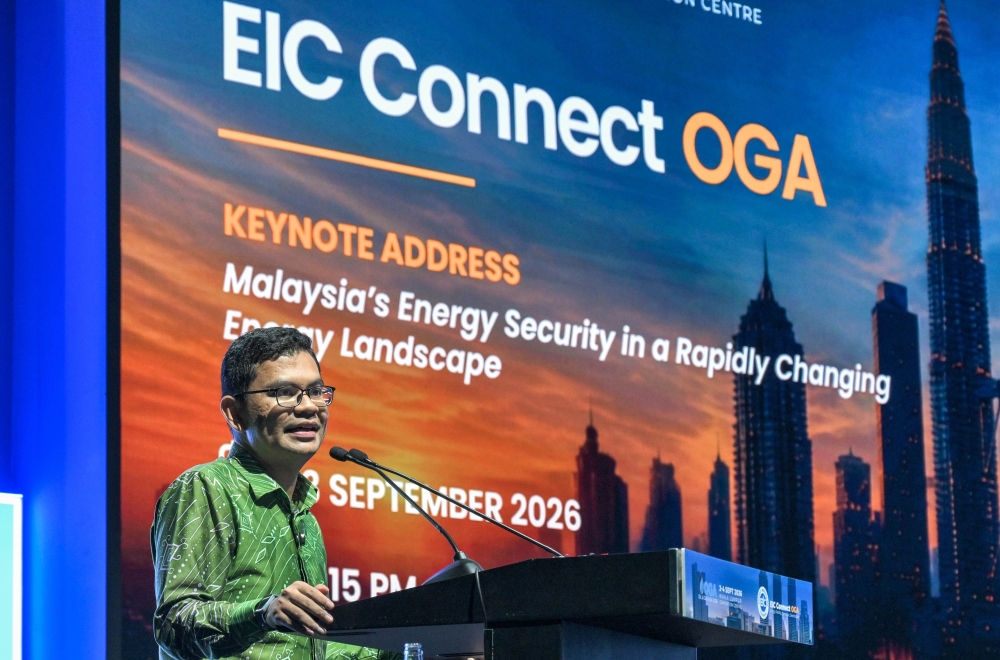

Economy Minister Akmal Nasrullah Mohd Nasir shares his insights at the EIC Connect OGA at Kuala Lumpur Conference Centee today. — Bernama pic
By Syed Jaymal Zahiid
First Published: Thursday, 03 Sep 2026 6:48 PM MYT
KUALA LUMPUR, Sept 3 — Oil and gas will continue to play a critical role in supporting Malaysia’s economic growth and safeguarding national energy security, even as the country accelerates its shift toward cleaner energy sources, Minister of Economy Akmal Nasrullah Mohd Nasir said today.
Speaking at the Oil and Gas Asia Convention, Akmal emphasised that natural gas will remain a major component of Malaysia’s primary energy mix through 2050.
“It is, in particular, a key transitional fuel that supports power generation, industry, and system reliability as renewables scale up, enabling higher renewable penetration while ensuring stability,” Akmal told attendees during a panel session at the event.
Malaysia currently has a relatively diversified energy mix, with natural gas accounting for 42 per cent of total primary energy supply in 2024, followed by crude oil and petroleum products at 33 per cent, coal and coke at 22 per cent, and hydropower and renewables at 4 per cent.
The Anwar administration launched the National Energy Transition Roadmap (NETR) a year after taking power, one of its hallmark policies that is said was designed to accelerate the country’s shift toward clean energy as part of Malaysia’s broader diversification push to secure its energy supply.
Akmal said the plan clearly outlines targeted investments and key flagship projects across areas like renewable energy, hydrogen, energy storage, and natural gas infrastructure through 2050, and the government would commit more investment in gas-related infrastructure.
Still, the minister cautioned against relying too heavily on any single energy source. Despite being oil and gas rich, Malaysia was still exposed to supply risks and market disruptions that followed the war in the Middle East.
“Excessive dependence on any single source creates vulnerability,” Akmal said.
“The objective is not simply to replace one energy source with another. It is to give Malaysia more options, reduce exposure to external shocks, and create new sources of economic value,” he added.
Most domestic gas is produced offshore in Sabah and Sarawak and exported primarily to East Asia.
Peninsular Malaysia, which consumes the majority of energy, uses regasification terminals in Malacca and Pengerang to import LNG primarily from Australia, Brunei, and the US alongside pipeline imports from Indonesia to meet domestic energy needs.
KioskNews shows a cleaned-up reading view extracted from the publisher’s page — the original always lives on their site, not ours.