Rancour, road trips and revival: tale of battle for Brighton’s future hits the stage
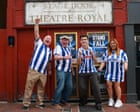
It was the tip-off that changed Ian Hart’s life for ever. The funeral director from Worthing was co-editor of the Brighton fanzine Gull’s Eye when he received a phone call from Gordon Lucking, a Crystal Palace director, in July 1995.
“Gordon always wanted to join the Brighton board, but they didn’t want him there,” Hart says. “Ron Noades [the Palace chair] welcomed him with open arms. One of his [Lucking’s] employees had been on this golf day and someone got pissed in the evening and said: ‘You’ll never guess what’s happened – Brighton have sold the Goldstone Ground and are moving to Portsmouth.’ Gordon loved it, because it was another nail in Brighton’s coffin.”
Hart initially struggled to believe that Brighton’s home since 1902 could be in danger, but decided to confront the chief executive, David Bellotti, at his office. “I parked the hearse outside, went in and asked him straight whether they had sold the ground and were moving to Portsmouth,” Hart writes in his book, Brighton & Hove Albion: From Every Angle, which was released last year. “All the colour drained from his face.”
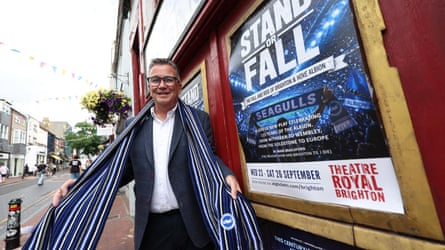
The subsequent battle between the supporters and owners was the start of a nomadic period in Brighton’s history that will be revisited this month in a new play to coincide with the club’s 125th anniversary. Stand or Fall, written by the Brighton fan Mark Brailsford, follows a group of fans from the last days at the Goldstone in 1997, their exile 70 miles away in Gillingham and then at the Withdean Stadium in Brighton before the club find a new home at the Amex Stadium.
Hart is a producer for the play that will run for four nights from 23 September at the city’s Theatre Royal. An exhibition, also entitled Stand or Fall, detailing what he describes as the club’s civil war, opened at the Brighton Museum in August and continues until the end of the year.
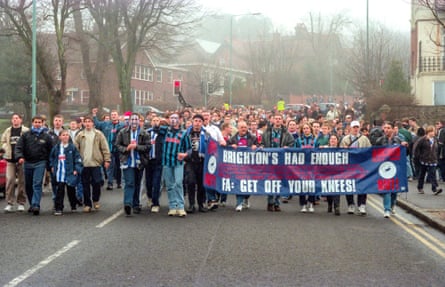
“We were all thrown together, all different demographics: a funeral director, a punk performance poet, a chartered accountant, plasterers and labourers,” Hart says of the action group that included the punk poet John Baine, better known as Attila the Stockbroker.
“A few days after everyone found out the Goldstone Ground was being sold, we had a fans’ meeting at [the pub] Chapman’s, which is now the Railway, in Worthing. There were probably 40 or 50 people from all walks of life and it grew from there.
“A year later, there were 500 people who couldn’t get inside listening on loudspeakers outside the Concorde [nightclub] when things were getting really serious.”
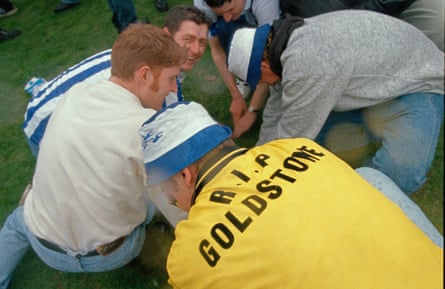
In April 1996, 600 spectators ran on to the Goldstone Ground pitch after a win against Carlisle, calling for Bellotti’s resignation. Some fans tore up seats in the directors’ box as attempts were made to storm the boardroom. Then came the meeting with York that has gone down in Brighton folklore, as fans waited until the 16th minute to invade the pitch, causing the game to be abandoned.
“It was not a riot, it was a legitimate protest,” Hart says. “The FA and the Football League were a bit like Neville Chamberlain at Munich, waving a piece of paper saying everything was going to be fine. They thought they could give us a load of bullshit and we would just take it.”
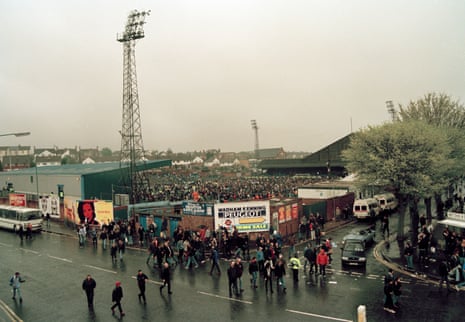
The Goldstone Ground was demolished a year later after Brighton came within 27 minutes of relegation from the Football League, only to be saved by Robbie Reinelt’s equaliser against Hereford. At one stage they had been 13 points adrift at the bottom of Division Three (now League Two). Brighton finished 91st in the Football League again the following year, playing home games in Gillingham after Portsmouth reneged on their offer to groundshare.
after newsletter promotion
“We lost a generation of fans, which we’ve got back now, but for years you used to be driving past parks in Worthing seeing football teams training on a Saturday morning with kits and no Brighton shirts. It was horrible,” Hart says. “I was a coach at Worthing United from under-six to under-16 and I banned anybody not wearing a Brighton or Worthing shirt.”
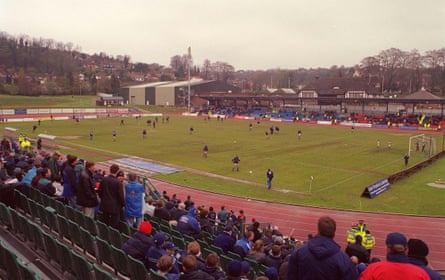
The local businessman Dick Knight paid £100 to take control of Brighton via a supporter‑led consortium and steadied the ship as they moved back to the city, albeit at the Withdean, primarily an athletics stadium. It was when Tony Bloom took over as chair in 2009 that Brighton really began to take flight, moving into the Amex Stadium two years later before being promoted to the Premier League in 2017.
The club reached the last 16 of the Europa League in their first European campaign in 2024 and will compete in the Conference League this season. Hart is hoping they could complete the quest for a major trophy.
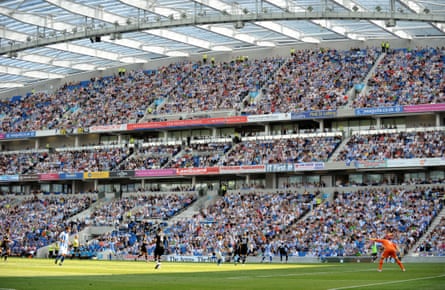
“It would be brilliant and Tony did promise us a trophy at the 1983 [FA Cup final] reunion dinner a few years ago,” he says. “We were having a drink with him in Tromsø [before the Conference League playoff in Norway last month] and as much as he promised us a trophy I don’t want to get weighed down by expectation.
“The great thing about the play is that there are highs and lows, but you can’t really celebrate the highs unless you have the lows. It makes the whole story even more incredible.”
KioskNews shows a cleaned-up reading view extracted from the publisher’s page — the original always lives on their site, not ours.