US, partners agree to safeguard key AI tech, infrastructure
The US and nine partner nations, including India, Singapore and the UK, have signed a pledge to safeguard sensitive technologies and critical infrastructure amid escalating strategic competition with China over the future of artificial intelligence (AI).
The “San Francisco Declaration on the Secure Foundations of Enduring Prosperity” establishes a framework for the protection of critical goods, software, knowledge materials and components essential to AI supply chains.
The pact targets those items “whose theft, illicit transfer, or acquisition by hostile actors would confer a meaningful military or intelligence advantage,” the US Department of State said in a statement.
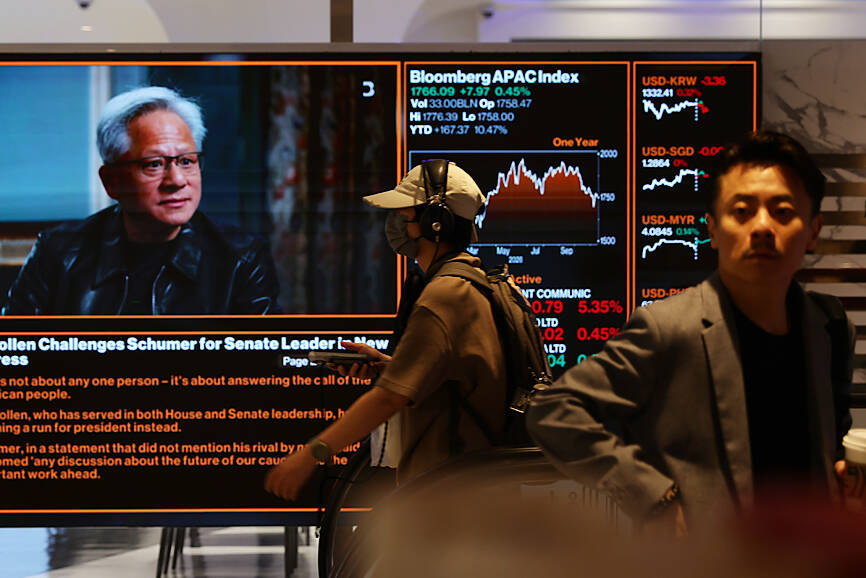
People walk past a television broadcast showing stock indexes and then-Nvidia CEO Jensen Huang in Taipei.
Photo: Ritchie B. Tongo, EPA
The joint actions comes amid an urgent reassessment in Washington over how to control the exports and use of top-tier accelerators by China.
The debate has been fueled by revelations that former Nvidia Corp CEO Jensen Huang (黃仁勳) had an affair with a former data center executive whom the US alleges is a Chinese spy.
It also comes days before US President Donald Trump is expected to meet Chinese President Xi Jinping (習近平) in Shenzhen.
Part of the broader US-led “Pax Silica” initiative, the agreement also covers vital physical and digital infrastructure including ports, transport systems, communications and logistics networks, “whose disruption, degradation, hostile control, or the unauthorized exposure of the data flowing through them would cause significant harm or dysfunction.”
The declaration underscores Washington’s broader push to institutionalize allied economic security architecture as competition with China over frontier technologies intensifies.
The other signatories are Australia, Israel, Japan, South Korea, Qatar and the United Arab Emirates.
Asked about the development at a regular press briefing yesterday, Chinese Ministry of Foreign Affairs spokeswoman Mao Ning (毛寧) said: “We should not draw ideological lines or form exclusive cliques” when it comes to AI.
“Parties should join hands in promoting development and governance of AI and make it serve the common well-being of humanity,” Mao said.
Asked if Xi and Trump would discuss they issue when they meet later this week, she said: “Both sides are in communication in this regard.”
South Korean Second Vice Minister of Foreign Affairs Kim Jina attended a Pax Silica retreat hosted by State Department in San Francisco on Sunday and signed the agreement, the foreign ministry said yesterday.
Kim discussed ways for “like-minded nations to cooperate in building a trustworthy AI ecosystem,” it said.
The Japanese Ministry of Foreign Affairs also confirmed that the government signed the declaration on Sunday.
The State Department said participating governments plan to establish joint working groups covering pro-innovation policy frameworks, AI adoption in key sectors, supply chain cooperation, safe harbors and supply chain security hubs, and AI security and resilience.
They also pledged coordinated efforts to address economic coercion and supply chain disruptions, while seeking to protect private investment and ensure “a level playing field for innovation and growth.”
Germany, the Netherlands and Sweden are also expected to sign the declaration in the coming days, said the Financial Times, which reported the agreement earlier.
KioskNews shows a cleaned-up reading view extracted from the publisher’s page — the original always lives on their site, not ours.