This is why Warner is the real villain in ruining Bancroft’s Test career
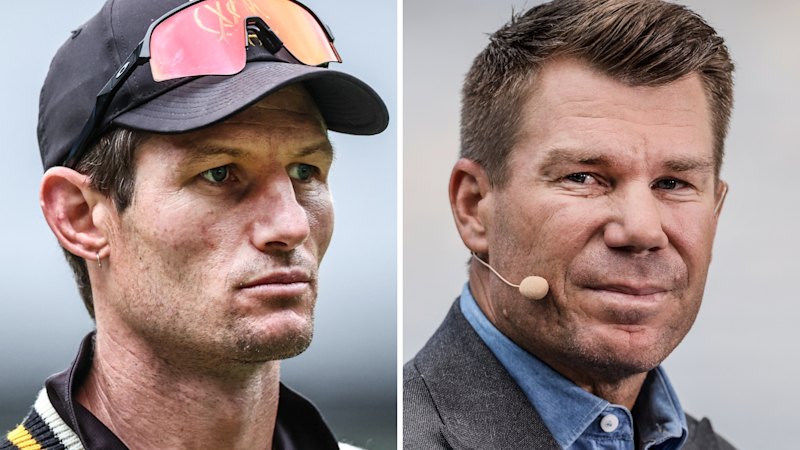
“My cricket career has been destroyed, and I have never been able to play for my country since Justin Langer was coach in 2019.”
The story of Cameron Bancroft’s Test cricket career, and how it intertwined with David Warner’s, is one of the most fascinating intrigues of the Sandpapergate saga.
In time, the mystery will be given due attention, and Bancroft’s what-if may be answered.
Bancroft came into the Australian Test team for the 2017-18 Ashes when, aged 25, he replaced Matthew Renshaw to partner Warner, who was then at his peak and vice-captain of the team.
Bancroft played every match until he was banned for using sandpaper on the ball in Cape Town in 2018, making two half-centuries, almost but not quite bedding down his spot.
After his ban, he returned for the first two Tests of the 2019 Ashes series in England, but after scores of 8, 7, 13 and 16 he was dropped for Marcus Harris.
He has never played Test cricket again.
After Warner’s retirement in 2024, Bancroft’s form did not warrant a recall.
The interesting period is between 2020 and 2024, when Bancroft dominated the Sheffield Shield, when Australia was desperate for regeneration at the top of the order, when Warner was continually failing, and yet Bancroft was not chosen.
When he talks about his cricket career being “destroyed”, this is the key period.
Across these seasons, Bancroft was the highest overall Shield run-scorer and easily the highest run-scorer among openers.
In the Australian team, Usman Khawaja was enjoying his late-career renaissance as an opener, and his selection was never in question.
At the other end, in these same four years, Warner played 28 matches for Australia, averaged 31.46 and scored two centuries. His highest Test average in any full season was 34.00. The only time he averaged 40 in a Test series was at home against South Africa in 2022-23 when his scores were 0, 3, 200 and 10.
Bancroft’s Sheffield Shield statistics over four seasons (2020-2024)
2020-21: 541 runs, 1 century, average 49.18
2021-22: 502 runs, 2 centuries, average 35.85
2022-23: 945 runs, 4 centuries, average 59.06
2023-24: 778 runs, 3 centuries, average 48.62
It looked strange.
Were the selectors not watching the Sheffield Shield? Did they have something against Bancroft?
George Bailey was a selector for the entire period, with Andrew McDonald replacing Langer in 2021 and Tony Dodemaide coming in that same year to replace Trevor Hohns. Greg Chappell had been a selector earlier in the period, before Warner’s form became a concern.
His dip seemed pressing by 2022, though, when Warner had gone nearly three years and 28 innings with no centuries and four 50s. After his 200 against South Africa in Melbourne that December, he went another year and 16 innings before another ton. His average nosedived.
There were widening calls for Warner to be dropped and for Australia to bring in new blood.
Bancroft seemed to be that option as he was the one piling on Shield runs.
It was an intriguing relationship. Bancroft had volunteered to cheat with sandpaper in South Africa when Warner thought he would be under too much scrutiny. He had followed Warner’s instructions on how to cheat. But now, when Bancroft was making century after century for Western Australia, Warner was saying there were no Test-quality openers around.
Throughout this period, Warner’s manager James Erskine repeatedly alluded to Warner knowing more about Sandpapergate than he’d let on. Warner never disputed or shut down Erskine’s veiled threats and Erskine remained his manager.
It has now turned out – via Khawaja and Bancroft – that these allusions contained more than a grain of truth.
Warner did have dirt on the Australian bowlers. And he had loyalists to dish it out for him.
Through 2023, even after he was injured and left the tour to India, after a moderate Ashes series in England (averaging 27.41), Warner was allowed to stay in the team until he decided to retire on his timetable, at the Sydney Test against Pakistan in 2024.
Selectors, with a chronic shortage of Test-fit openers and top-order batters, must still be regretting giving Warner his long period of grace. Or are they?
Warner was under no obligation to make way for Bancroft or anyone else in 2022 or 2023.
He was entitled to push for everything he got, and he was motivated by his grievance over the heavy punishment he received for the Newlands episode.
It wasn’t for him to retire; it was for the selectors to stop picking him.
Now the truth is coming out, the question I would like to see pursued is whether the threat posed by Warner’s knowledge of the sandpaper cover-up played any role in the selectors’ decisions to keep on picking him when he was ageing and failing and the batting needed regeneration.
Were there any communications between anyone at Cricket Australia and the selectors on this issue? Were there any communications between Warner and the selectors about it? Bailey, during his short Test career, had been an admiring minor teammate of Warner’s, and as a selector he chose to frequent the changing room and wear team apparel, almost as if he was still a member.
Were there any discussions among the selectors about Warner’s knowledge of the Sandpapergate cover-up, and did they have any impact on selections?
Selection discussions are meant to be confidential. But this is an issue directly related to Sandpapergate, and one which Bancroft has raised. It needs to be asked.
In time, it may be answered. Bancroft may or may not have had a successful Test career, but he never got a chance because, in a bitter irony, Warner stood in his way.
KioskNews shows a cleaned-up reading view extracted from the publisher’s page — the original always lives on their site, not ours.