Lam breaks ground on Miaoli facility
R&D EXPANSION: An executive told a ceremony that the lab, which is set to open in 2028, would increase its overall cleanroom capacity in Taiwan by over nine times
By Lisa Wang / Staff reporter, in Miaoli County


US chipmaking equipment supplier Lam Research Corp yesterday broke ground on a technology center in Miaoli County’s Jhunan Township (竹南), a facility set to play a key role in the company’s five-year, US$3 billion global research and development (R&D) expansion.
The investment — which would increase the firm’s cleanroom capacity in Taiwan more than ninefold — aims to improve the company’s R&D, testing and validation capabilities, enabling engineering teams to collaborate more closely with customers and accelerate the transition from technology development to fab adoption, Lam Research said.
“When this lab opens in 2028, it will have more than 40,000 square meters of office and cleanroom space, and increase our overall cleanroom capacity in this country by over nine times,” Lam Research chief operating officer Sesha Varadarajan said at the groundbreaking ceremony.
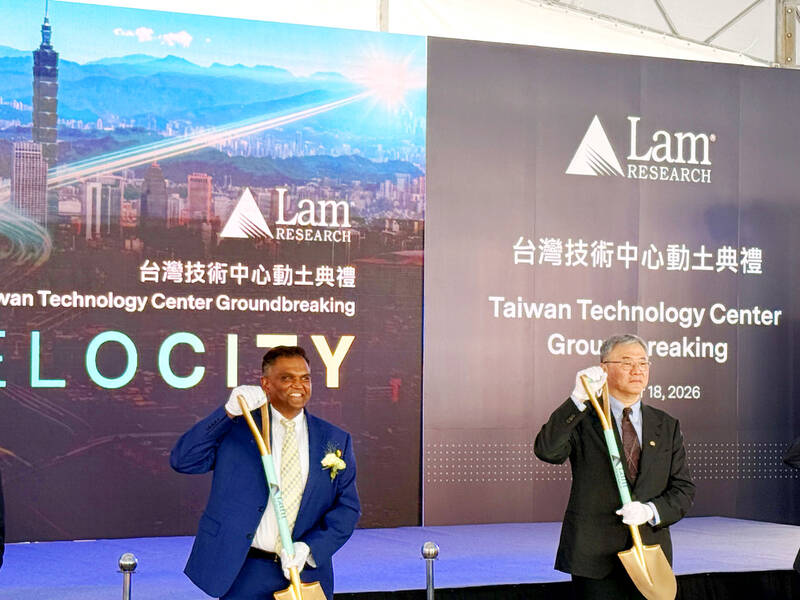
Lam Research Corp chief operating officer Sesha Varadarajan, left, and Taiwan Semiconductor Manufacturing Co cochief operating officer Y.J. Mii pose for a photograph at a groundbreaking ceremony in Miaoli County’s Jhunan Township yesterday.
Photo: Lin Yi-ju, Taipei Times
“It further adds specialized capabilities for deposition, etch and wet clean, and addresses logic, memory and advanced packaging,” Varadarajan said.
With the lab, Lam Research would bring the full spectrum of its Taiwan operations across R&D, manufacturing, supply chain and customer support, he said.
The company has been operating a manufacturing facility in Taoyuan since 2016, he said.
“The next generation of technologies — codeveloped with Taiwan Semiconductor Manufacturing Co (台積電), Nanya Technology Corp (南亞科技) and other major customers in Taiwan — will be done right here in this lab,” he said.
To accelerate customers’ process technology and product development, Lam Research’s global lab network connects specialized facilities in the US with labs in Taiwan, Varadarajan said.
To meet growing customer demand, the company said it aims to add about 1,200 employees to its Taiwan operations by the end of this year, on top of more than 2,000 existing employees.
As semiconductor architectures grow increasingly complex, no single company can drive innovation alone, TSMC cochief operating officer Y.J. Mii (米玉傑) said at the ceremony.
Close collaboration across the entire ecosystem — spanning wafer fabrication, equipment, materials, silicon intellectual property and chip design — has become more critical than ever, Mii said.
That requires deep collaboration with ecosystem partners to accelerate technology development and experimentation, flatten the learning curve and bring scalable technologies into production, he said.
For decades, the semiconductor industry has driven rapid technological progress through transistor architecture innovation, process scaling and system integration, Mii said.
Today, as artificial intelligence (AI) leads the next wave of technological revolution, and places ever-higher demands on computing and capacity, the industry must simultaneously advance leading-edge processes, next-generation transistor architectures, advanced packaging and 3D system integration to meet surging AI demand, he said.
TSMC looks forward to deepening its joint technology development with Lam Research through the new facility, aiming to accelerate next-generation gate-all-around semiconductor breakthroughs to support growing AI demand following decades of collaboration across multiple generations of technologies in etching, deposition and volume production, Mii said.
KioskNews shows a cleaned-up reading view extracted from the publisher’s page — the original always lives on their site, not ours.