Trump’s Fifa peace prize was a sham. A reimagined award can still have meaning | Leander Schaerlaeckens
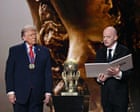
Poor Fifa peace prize. Unloved, unliked, mocked, tainted by association with its first winner. And now demoted, too, after Fifa president Gianni Infantino dumped the thing on the global governing body’s “social responsibility committee” to look after. To redeem it, rather than to ditch it, to spare Infantino the embarrassment of acknowledging that his fake prize was really just a fake prize all along.
Here is where we should probably acknowledge that, as fake prizes go, and in the context of what it was intended to accomplish, the first awarding of the Fifa peace prize was an unqualified success. It achieved exactly what it was meant to, made by Infantino to flatter Donald Trump, the man he needed to keep on his side to safeguard the riches to be extracted from the North American market in order to consolidate his power base within Fifa. Trump, the gullible buffoon, was pleased as punch – handed a big, golden bauble and a medal he placed around his own neck – and briefly forgot about the Nobel peace prize he desperately covets.
So now what?
The 22-person social responsibility committee is one of the dozens of standing committees Infantino has created to dole out generous per diems to his allies. It has been charged with recasting the prize into a recognition of social harmony and responsibility, as the Guardian has reported, and will probably seek to depoliticize it – or at least stop awarding it to politicians. There are no aspiring autocrats to placate for the foreseeable future, after all, since Saudi Arabia’s de-facto ruler and host of the 2034 World Cup, Mohammed bin Salman, doesn’t seem to go in for that kind of thing.
That first incarnation of the prize will stand as a monument to Infantino’s folly, as the apex of his hubris and his era of genuflecting to strongmen. That is, of course, assuming he survives the fallout of his attempt to privatize a chunk of the World Cup and re-emerges somewhat chastened and cautious, if either of those behaviors are still within his capacity. And if he makes it through another presidential election in March.
But a second version of the Fifa peace prize holds genuine potential to highlight some of the good the sport occasionally does, to platform and recognize those who leverage soccer’s vast cultural influence to improve the lives of others. The magic of soccer is that it transcends the field and reflects cultures and geopolitics; it becomes anthropological ritual, spoken as the world’s common language. Sometimes, it transforms into a vessel for virtue.
You could give the new prize to Afghan Women United for getting recognized as the official representatives of their country all while playing as refugees in exile. In June, they contested a pair of friendlies against the Cook Islands in New Zealand. They lost both matches, yes, but that’s beside the point. Their mere existence doubles as a towering protest against the Taliban, which has resumed its violent oppression of women since storming back into Kabul in 2021.
You could give it to Ukrainian club Shakhtar Donetsk, for persevering and even thriving in spite of Russia’s invasion – either through proxies or outright – of their Donbas region a dozen years ago, forcing the club to play elsewhere ever since.
Give it to former Spain international Juan Mata, for his work with Common Goal in convincing other players and managers to donate 1% of their earnings to charity; to Marcus Rashford, for shaming the Tory government into feeding children during a pandemic; to Sadio Mané, for bankrolling the construction of a hospital and other infrastructure projects in his native Senegal; to N’Golo Kanté for doing much the same in Mali.
Give it to Scotland’s Tartan Army, for raising money for children’s charities wherever they play. Hell, give it to the England players for donating their match fees to charity causes since 2007, adding up to more than $6.7m (£5m).
How would any of this relate to peace? Fair question. The peace prize could stand to be rebranded, the better to disassociate it from the least peaceful leader of a western nation in generations. It should probably have clearer qualifications and regulations, too, which is to say that it should have qualifications and regulations. And it’s probably best to shy away from the notion of steering entirely clear of politics. You can either have an award that acknowledges social good or you can be apolitical. You cannot do both.
But that needn’t be a bad thing, if this prize is sincere in rewarding one of the sport’s best citizens – and so long as it serves more than the Fifa president’s selfish interests.
-
Leander Schaerlaeckens is the author of The Long Game: US Men’s Soccer and Its Savage, Four-Decade Journey to the Top, or Thereabouts, which is out now. He teaches at Marist University.
KioskNews shows a cleaned-up reading view extracted from the publisher’s page — the original always lives on their site, not ours.