More families return to temporary ComCare support; stable jobs key to staying off aid
SINGAPORE – More households are returning to ComCare’s short-to-medium-term assistance after exiting the scheme, as patterns move back towards those seen before the Covid-19 pandemic.
More than half, or about 54%, of households that left the ComCare Short-to-Medium-Term Assistance (SMTA) scheme in 2022 returned for help within three years, up from 49% of those that left in 2021.
The return rate for the 2022 exit group was still below that of households which exited in 2019, when nearly two-thirds, or 63%, returned within three years.
Return rates within one and two years of leaving also rose.
The Ministry of Social and Family Development (MSF) said in response to queries that the upward trend likely reflects a shift back towards pre-pandemic patterns, which it expects to continue for some time.
Because of the financial disruption during the pandemic, a greater proportion of SMTA recipients in 2020 and 2021 were relatively resilient households that needed help only for a short period, MSF told The Straits Times.
Many were subsequently able to recover and regain self-reliance, contributing to lower return rates among households that exited the scheme during those two years, it added.
Despite these shifts, most households that returned across the 2019 to 2022 exit cohorts did so within the first year after leaving, suggesting that families are most vulnerable to changes in their financial circumstances during that period.
Employment emerged as a key factor separating households that stayed off assistance from those that returned.
Among the 2022 exit cohort, nearly half (46%) of households that did not return to SMTA had at least one household member in stable employment in 2023, compared with 35 per cent of households that returned.
Those that stayed off the scheme also had a higher median number of months worked over the following three years.
MSF said employment support remains important, as households that strengthened their employment after leaving SMTA were less likely to return for assistance.
Households that returned were also more likely to face caregiving or health constraints.
Among those that came back, 23 per cent had at least one beneficiary aged six or younger when they exited SMTA, compared with 16 per cent among households that did not return.
Eighteen per cent also had a primary beneficiary who was medically unfit for work, compared with 13 per cent among non-returners.
MSF said achieving sustained financial stability can take time, particularly when households face several overlapping challenges.
A household that was ready to exit the scheme could subsequently face a change in employment, health or caregiving responsibilities and need support again, it noted.
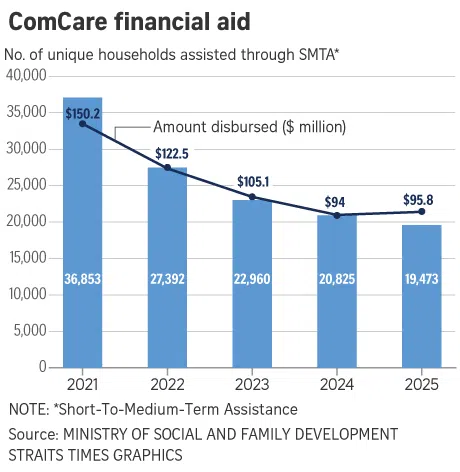
Fewer households received SMTA in 2025, even as the amount disbursed increased following an enhancement of assistance rates. About 19,473 households received the assistance in 2025, down from 20,825 in 2024. Total disbursements rose from about $94 million to $95.8 million over the same period.
A similar pattern was seen in ComCare Long-Term Assistance, which supports people who are permanently unable to work because of old age, illness or disability and have little or no family support.
The number of households receiving this aid fell from 3,240 in 2024 to 2,997 in 2025. The amount disbursed increased from about $21.4 million to $22.4 million after the enhanced assistance rates.
MSF said the overall number of households receiving assistance from both schemes remained below 2021 levels.
For SMTA, this may partly reflect increased support through other Government measures such as the Assurance Package, which provides cash and other forms of support to help households with living costs.
The ministry currently does not have readily available data on how many households return to SMTA multiple times.
It said the number and proportion of first-time SMTA recipients, measured by individuals rather than households, remained fairly constant between 2023 and 2025.
ComCare remains available as a social safety net, and households can return to a Social Service Office (SSO) to have their circumstances reassessed, MSF said.
Beyond financial assistance, SSO officers can connect families to employment support, preschool and student care fee assistance, help with medical expenses and other Government and community support.
The SSOs also work with other Government agencies, Family Service Centres and community partners to help families address barriers to work and stabilise their circumstances.
KioskNews shows a cleaned-up reading view extracted from the publisher’s page — the original always lives on their site, not ours.