Philippine village uses bamboo and oyster shells to stop floods for two years
For years, residents of Pamarawan, a small fishing village on the edge of Manila Bay in the Philippines, watched floodwaters enter their streets and threaten homes whenever strong monsoon winds or typhoons sent waves crashing towards the coast.
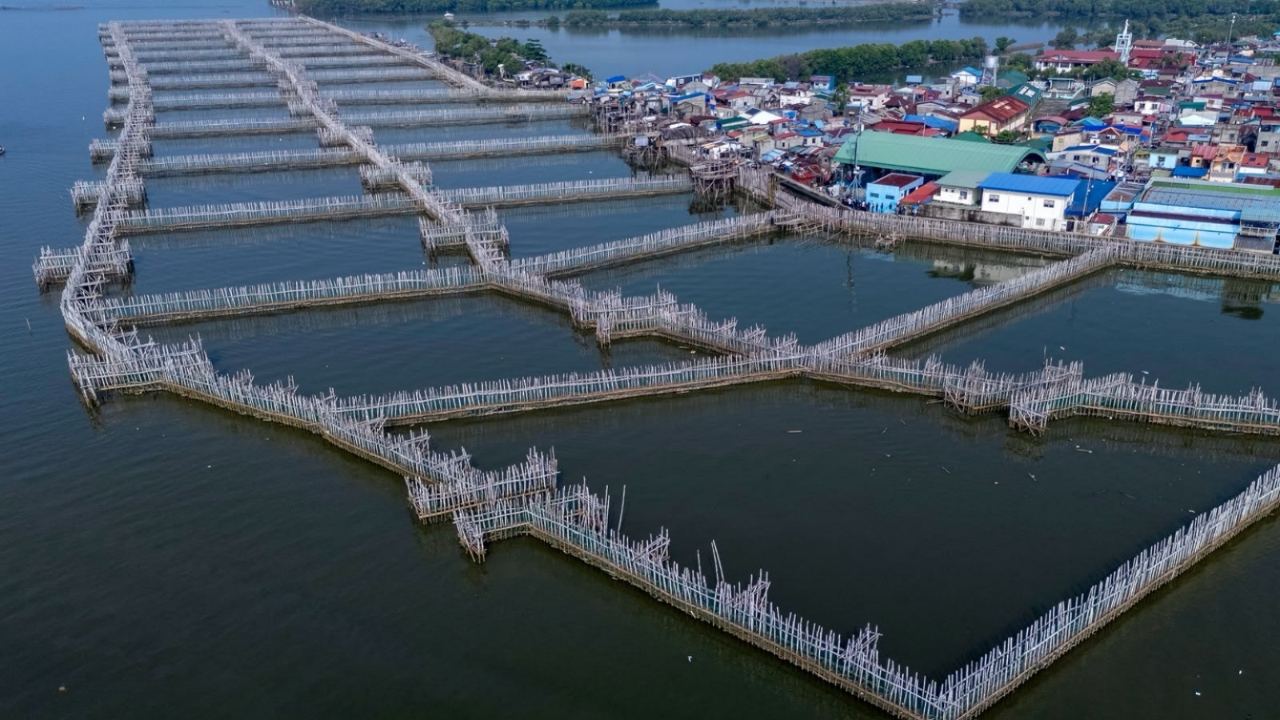
Even a concrete breakwater, standing up to four metres high, was not enough to keep the water out. During storms, waves would rise almost a metre above the barrier, directly hitting houses built beside it.But the village's approach to protecting itself has taken an unusual turn. Instead of depending only on more concrete walls, Pamarawan has begun using bamboo poles, discarded oyster shells and coconut husks to create a nature-based coastal defence system.
The initiative is designed not only to weaken incoming waves but also to trap sediment, encourage mangrove growth and help restore marine habitats.According to a report by Mongabay, local officials say the village has gone almost two years without flooding since the project began. They also say Pamarawan escaped the severe flooding that affected neighbouring communities in August this year, when several parts of Bulacan province were inundated for weeks.
Bamboo, oyster shells and coconut husks protecting the village
The project covers approximately 14 hectares (35 acres) of coastal waters around Pamarawan, a low-lying barangay, or village, in Malolos City, Bulacan province. Its central feature is a network of interconnected bamboo structures known as bamboo cribs. These structures work as breakwaters, reducing the energy of waves before they reach the shoreline. They also act as sediment traps, allowing mud and sand carried by the water to settle instead of being washed away.Discarded oyster shells have been placed inside coconut-husk mesh bags, locally referred to as cocomesh. These bags form another part of the coastal defence system, helping weaken waves while creating conditions that could support the restoration of oyster reefs.The project is designed to work with natural coastal processes rather than simply block the sea with a hard barrier. As sediment accumulates around the bamboo structures, the seabed is expected to rise gradually.
Once it reaches a suitable level, mangroves can be planted, creating another layer of natural protection against waves and storm surges.According to barangay councilor Ferdinand Cruz, sediment has already accumulated to approximately 0.3 metres (one foot) in some areas. Local officials expect that parts of the seabed could become suitable for mangrove planting within two years.
A village that lost its natural protection
Pamarawan's flooding problem is linked to several environmental pressures.
The area experiences strong waves during the southwest monsoon, locally known as habagat, while typhoons and high tides further increase the risk of coastal inundation. Rising sea levels and land subsidence, partly associated with excessive groundwater extraction, have also worsened flooding in low-lying parts of North Manila Bay.The village once had thick mangrove forests that helped absorb wave energy and protect homes.
But these natural barriers disappeared as coastal areas across Bulacan were converted for fishponds and land reclamation. Between 1990 and 2002, the province lost 52.9% of its mangrove forests, according to figures cited by Mongabay.Pamarawan barangay secretary Roldan Dayao recalled how the loss of mangroves changed the village's relationship with the sea. "They could block the big waves," he said, referring to the mangroves.
"But when our mangroves disappeared, the water began entering our barangay." The new project aims to restore some of that lost protection by creating conditions in which mangroves and oyster reefs can eventually return.
Almost two years without flooding
Dayao told Mongabay that Pamarawan had not experienced flooding for almost two years since the nature-based project began. Cruz also said the village escaped the severe flooding that affected nearby communities in August 2026.
According to the report, the flooding in Bulacan lasted for weeks, killed 15 people and prompted the provincial government to declare a state of calamity."It rained almost every day, and there was habagat, but we did not experience flooding," Cruz said. He added that some neighbouring communities at higher elevations were submerged, with water reaching halfway up houses and, in some cases, almost covering their roofs.Residents have also noticed that the bamboo structures are attracting marine life, including shrimps, crabs and oysters, which local fishers are allowed to collect. They have reported that less waste from Manila Bay is reaching the shoreline.
Could this approach work elsewhere?
The pilot project was developed by Dutch engineering firm Haskoning and approved by Malolos Mayor Christian Natividad in 2023. Construction began in 2024, with the city government allocating 130 million Philippine pesos (approximately $2 million) towards the initiative.
The Netherlands Enterprise Agency supported the detailed engineering design. The project has attracted attention from Philippine authorities as a possible model for other flood-prone coastal communities.
In September 2026, Department of Public Works and Highways Secretary Vince Dizon praised the initiative and discussed the possibility of replicating its approach in other parts of North Manila Bay.The Philippine Information Agency reported in October that the project was also being discussed as an example of nature-based flood protection during an ASEAN-Netherlands cross-learning workshop. However, Haskoning has cautioned against copying the design without considering local conditions. Each coastline has different ecological, geological and social characteristics, meaning flood protection measures must be adapted to the location.
KioskNews shows a cleaned-up reading view extracted from the publisher’s page — the original always lives on their site, not ours.