In Mexico City’s ‘Little LA,’ deportees find work and a community
Tabacalera, in Mexico City, is known for its wide streets, palm trees and colossal Monumento de la Revolución. Lately, the neighborhood has gained global recognition for its community of deportees, who have dubbed it “Little LA.”
A slew of recent articles — from the Guardian to Airmail Weekly — have celebrated the deportees finding new homes in Little LA after expulsion from the United States.
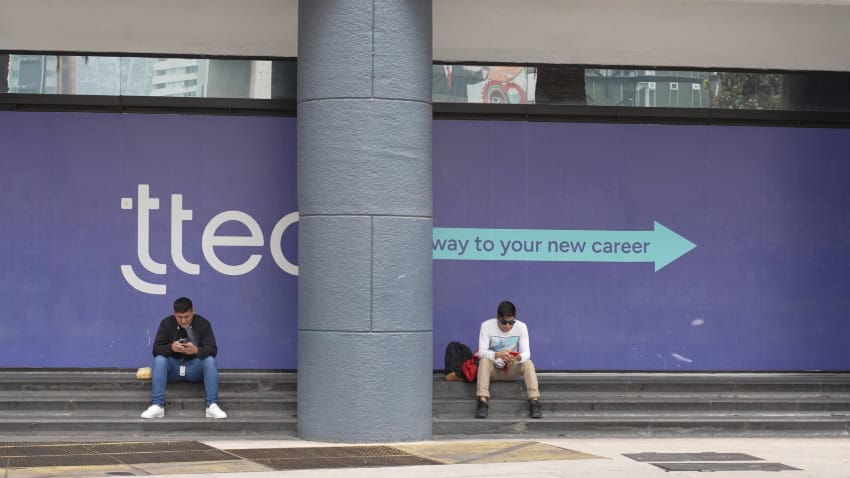
Yet, for most Tabacaleros, it’s just another day in the neighborhood.
“I didn’t even know they were calling it Little LA,” said David Jiménez, a Mexico City local, who laughed when I suggested the name.
David works at an English-language call center — one of five in the area — attracting some 2,000 deportees with decent wages and stable employment.
“Many (of the deportees) don’t actually live in Tabacalera,” Jiménez explained, “But because so many work here, Tabacalera is like their meeting place.”
For many of the 190,000 Mexican nationals deported since Trump’s re-election, deportation is just the start of building a new life. Often without Spanish skills, many struggle to find work, housing and the legal papers needed to establish themselves in Mexico.

Israel Concha was deported in 2014. After losing everything in the United States, he was violently kidnapped upon arrival in Mexico.
Eventually, he landed in Tabacalera, where he found work at a call center.
“Call centers,” Concha remembers realizing, “will hire anyone speaking English.” He shared the postings across his growing network of deportees in Mexico. Many of those joining him in Tabacalera were from Los Angeles.
“So we started calling it Little LA,” he told me over Zoom.
Though he now lives in Las Vegas, Concha today leads New Comienzos, an organization he started in Tabacalera to help deportees land in Mexico City.
Walking around Little LA, Concha’s story — of landing and leaving — seems common. Though Tabacalera’s call centers offer employment and stability, few settle permanently in Little LA.
The expected length of call center employment, Israel told me, is about eight months. Beyond this, Tabacalera’s handful of deportee-owned small businesses, like El Diablo and a giant burrito stand, have been sold or closed, per Shunaxi Estrada Guzman, New Comienzos’ Director of Volunteer Programs.
Jesús Daniel Sandoval Gallardo runs Shelter Constitución de 1917, a shelter for migrants and returnees. “Arriving here is often traumatic for them,” he explained. “The work they do here in Little LA, in Tabacalera, is a platform for them to find better opportunities or move elsewhere.”
Still, Little LA’s transience doesn’t change the power of its name.
“Little LA is a community,” said Estrada. “(It’s) a name that is helping returnees to identify a place they can gather and find help and see that, yes, we do have a community here.”
This brought one recently self-deported woman, who preferred to remain unnamed, to a “Little LA Tour” hosted by New Comienzos. “I saw all these videos and came here to check out what Little LA is.”
Though we learned much about New Comienzos’ impactful work on our tour — helping, by their count, over 100,000 deportees through wide-ranging programs — the bilingual, binational Little LA I had read about wasn’t visible during the tour or my other visits.
Apart from the call centers, the clearest glimpse I caught was a 10-year-old sign, hanging in a mini-mart, run by a woman who seemed used to the press.
Mexico rejects US decision to deport Mexicans to Central America: Friday’s mañanera recapped
Outside of the call center, I asked David if the name “Little LA” bothers him. “Of course not. The name’s for their community here. The neighborhood is still Tabacalera.”
Though his colleague debated him — how different is it from Trump renaming the Gulf of Mexico? — they both agreed that there’s no real tension here about Little LA.
“It’s not like gentrification in La Roma.” David continued, “I mean, (the deportees) are vulnerable and came here in difficult circumstances.”
For deportees stuck between worlds, the degree to which CDMX’s Little LA exists — in Tabacalera, its call centers and the media — is, perhaps, not the point, after all.
Logan J. Gardner is a writer, photographer and filmmaker based in Mexico City. His coverage includes culture, food and travel, and geoeconomics. He earned degrees from Wharton and the University of Cape Town and formerly worked at L.E.K. Consulting and Netflix. Sign up to receive his newsletter, Half-Baked, or follow him on Instagram for more.
KioskNews shows a cleaned-up reading view extracted from the publisher’s page — the original always lives on their site, not ours.