Singapore to put forward bid to host international tribunal for investment disputes: Edwin Tong
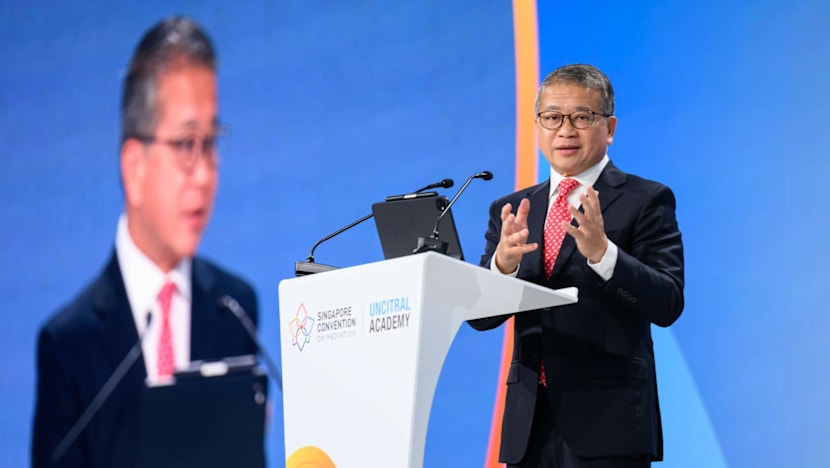
SINGAPORE: Singapore will be putting forward its bid to host an international tribunal to resolve investment disputes, given a global need for a "credible, trusted" institution to hear such cases, Law Minister Edwin Tong announced on Tuesday (Aug 25).
The proposed Multilateral Investment Tribunal, which is currently under discussion by member states of the United Nations Commission on International Trade Law (UNCITRAL), will be housed in a dedicated building for hearings if Singapore's bid is successful.
Separately, the National University of Singapore (NUS) and Ministry of Law (MinLaw) will establish a Centre for Arbitration and International Dispute Resolution to drive thought leadership and innovation in this area.
"We often say ... the world order is breaking down, trust in the system is eroding, countries are pulling away from multilateralism," Mr Tong said at the opening of the UNCITRAL Academy Conference in Singapore.
"There's 'friendshoring', 'reshoring'. People ignore the rules-based system. But I think we need to ask ourselves that second question as well: If this is happening, what are we doing about it?"
At a time when international institutions are under strain, Singapore's efforts strengthen the value proposition behind a rules-based, multilateral system to resolve international disputes, said Mr Tong.
The need for a trusted investment dispute settlement system has never been more acute, he said of the tribunal.
Even as treaty-based investor-state dispute settlement cases have risen in the last decade, the framework to resolve them has been tested by inconsistent decisions, concerns about regulatory interference, and questions about arbitrator independence and impartiality, he said.
"The legitimacy of this system is being strained at precisely the moment it is needed the most.
"The urgency is compounded by the fact that states today are intervening and regulating more actively than ever – in areas such as public health, energy security, climate change and national security."
The question is whether there is a credible and trusted institution to resolve disputes when they arise, he said.
Singapore offers a neutral and stable jurisdiction grounded in the rule of law, with a mature dispute resolution ecosystem and links to developed and developing economies alike, said Mr Tong, who is also second minister for home affairs.
He added that the country is prepared to house the tribunal in a building equipped for hearings, with room for tribunal members, the registry and supporting facilities.
This bid reflects Singapore's commitment to doing its part to build a credible, accessible and fit-for-purpose institution, and hence to strengthen the rules-based international order that countries around the world depend on, he said.
Investor-state dispute settlement allows foreign investors to bring claims directly against states if they believe there have been breaches, such as of fair and equitable treatment and protection against unlawful expropriation and discrimination.
There were 1,463 known treaty-based investor-state dispute settlement cases as of the end of 2025, according to a factsheet by MinLaw.
STRENGTHENING INTERNATIONAL RULES-BASED SYSTEM
Mr Tong said that even established institutions like the World Trade Organization (WTO), whose dispute settlement system used to be seen as the gold standard, are feeling the strain.
Appointments to the WTO's appellate body have been blocked since 2017, leading it to have insufficient judges to hear appeals. More than 30 appeals were pending as of the end of 2025.
There have also been questions about compliance with the decisions of international tribunals, and calls to reform international institutions so they remain fit for purpose, said Mr Tong.
As a small state whose prosperity depends on a stable, rules-based international order, Singapore has every interest in ensuring that this global system continues to command confidence and trust, he said.
"The alternative is a scenario where size and power make right, and that is completely untenable for a country like Singapore. Because if you measure it by size and might, then almost on every situation, we will lose."
This is why Singapore has long sought to actively contribute to a strong multilateral system, and believes it can be a "constructive and consistent" partner to the world, he said.
The new Centre for Arbitration and International Dispute Resolution at the NUS Faculty of Law is another way Singapore wants to contribute to maintaining the rules-based international system, which the country has greatly benefited from, he said.
The purpose of the centre is to build thought leadership and engage in forward-thinking research on how to sustain the rules-based framework, while reinventing and evolving to support the needs of tomorrow, said the minister.
The centre provides a dedicated platform for research, policy development, publications and international conventions on international dispute resolution, NUS and MinLaw said in a media release.
It will focus on issues shaping the future of international arbitration, including transparency and accountability, ethics and professional governance, and investor–state dispute settlement.
It will also launch a new and selective programme of advanced studies in international arbitration for serious practitioners.
The centre will be led by Professor Stavros Brekoulakis, who is presently the Michael and Laura Hwang Chair in International Arbitration at NUS.
KioskNews shows a cleaned-up reading view extracted from the publisher’s page — the original always lives on their site, not ours.