Taiwan needs balanced income distribution: expert
‘A MUST’: The government should allocate more funds for social welfare to create long-term benefits for social equality and economic stability, CIER’s president said
With GDP per capita forecast to rise to about US$45,000 this year and approach US$50,000 next year amid the artificial intelligence (AI) boom, how to ensure a more balanced distribution of income is becoming a concern, an economist said.
Although GDP per capita is rising rapidly, the benefits of strong exports driven by robust global demand for AI-related products have been concentrated in the information and communications technology sector, raising concerns about a “K-shaped” economic recovery.
K-shaped growth refers to a divergence in the performance of different sectors, with some moving higher while others decline, creating a pattern resembling the arms of the letter “K.”
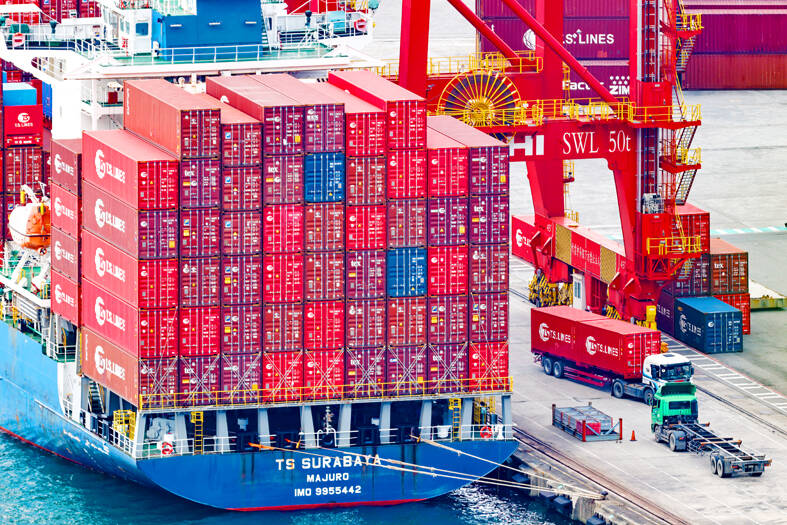
Shipping containers at the Port of Keelung are pictured on July 21.
Photo: Ritchie B. Tongo, EPA
Chung-Hua Institution for Economic Research (CIER) president Lien Hsien-ming (連賢明) is among the economists concerned about unbalanced economic development, as GDP is forecast to grow 11.05 percent this year and expand 6.04 percent next year.
The government should allocate more funds to social welfare programs, including labor insurance, civil servant insurance and national health insurance, to bolster their financial foundations, Lien said in an interview with CNA.
Injecting public funds into social welfare programs could improve wealth distribution and create long-term benefits for social equality and economic stability, Lien added.
“Fund allocations to social welfare will be a long-term task,” he said. “Although such efforts are unlikely to produce immediate effects, they are a must.”
Last week, President William Lai (賴清德) announced that the government would include NT$235.7 billion (US$7.40 billion) in its proposed central government budget for next year to fund a universal NT$10,000 cash handout so that “the AI dividend can be shared by all.”
Lien said the cash handout could be an effective way to put some of those benefits directly into people’s pockets, but improving social welfare would be a better approach to providing greater support for low-income families.
People with low income find it difficult to share in the benefits of Taiwan’s AI-driven economic growth, Lien said.
Directorate-General of Budget, Accounting and Statistics Department of Statistics head Tsai Yu-tai (蔡鈺泰) said Taiwanese manufacturers took advantage of trade tensions between the US and China, the global supply chain realignment during the COVID-19 pandemic and the surge in AI demand, which helped boost Taiwan’s income.
However, fluctuations in the New Taiwan dollar against the US dollar could affect GDP per capita calculations, Tsai said.
If the NT dollar depreciates against the greenback, GDP per capita measured in US dollars would fall, and vice versa, he said.
The agency’s GDP per capita estimate for next year was based on an exchange rate of about NT$32.35 per US$1.
KioskNews shows a cleaned-up reading view extracted from the publisher’s page — the original always lives on their site, not ours.