Will Xi, Trump, Putin meet at Apec? First, they must agree on an agenda
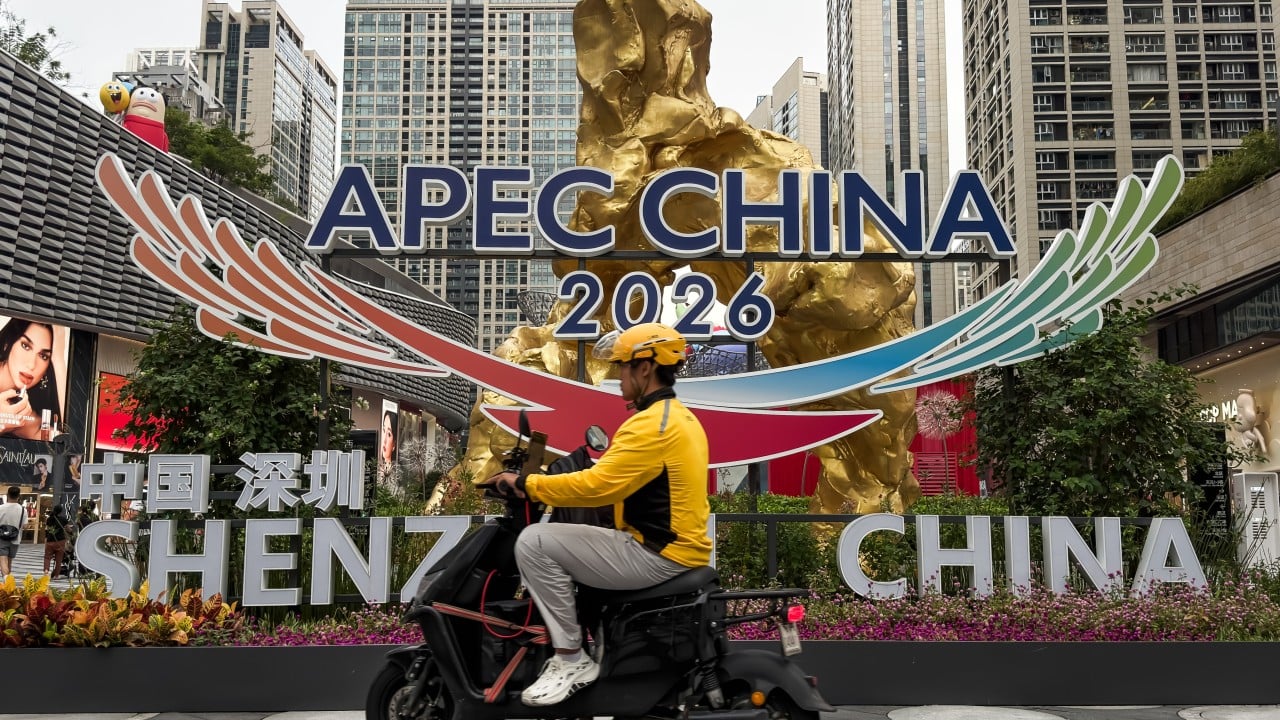
While US President Donald Trump has said he is open to sitting down with his Chinese and Russian counterparts Xi Jinping and Vladimir Putin at the Apec summit, it remains far from certain that the three leaders will actually meet in a few weeks.
Observers said much would depend on whether the countries could agree on an agenda, with one expert describing this as a “critical lever”.
Russia was set to gain most if the trilateral meeting took place, experts said, as the summit would be a potent symbol that the country’s international isolation was ending and of its great-power status. While Trump would get to show he could deal with the other powers, this could unsettle US allies.
Speculation has been building over whether the three leaders, who are all expected to attend the Asia-Pacific Economic Cooperation summit in the Chinese city of Shenzhen, will hold an unprecedented sit-down on the sidelines.
Putin earlier said he was “all for” a trilateral meeting but added that the agenda had to be clear. “[A trilateral meeting is] certainly possible. To a large extent, this will depend on China as the host of the event,” he said.
On Monday, Trump also signalled he was open to such talks. But he said it would be “not so much for Ukraine” and that such a meeting would have to be “based on denuclearisation”, an issue Beijing has long resisted negotiating.
His comments followed a Wall Street Journal report on Monday that said Putin floated the three-way talks as a way to negotiate an end to the Ukraine war, now in its fifth year.
The South China Morning Post understands that Chinese officials have privately welcomed the idea of three-way talks, but have not pushed aggressively for them. There has also been little substantive discussion of an agenda or preparations.
When asked on both Monday and Tuesday to comment on the possibility of a trilateral meeting, Chinese foreign ministry spokeswoman Mao Ning said she had no information to provide.
08:56
Why Xi Jinping is hosting world leaders in China instead of travelling abroad to see them
Wang Wen, dean of the Chongyang Institute for Financial Studies at Renmin University, said the agenda would set the tone for any summit and determine its success.
“The agenda is the critical lever for whether a meeting can actually take place,” Wang said.
“If the three parties harbour conflicting private agendas or if their proposed topics are fundamentally misaligned, the meeting is highly unlikely to happen.
“Only when the agenda focuses on areas of consensus while steering clear of ‘red lines’ … can a dialogue become a viable possibility.”
Denis Simon of the Quincy Institute, a Washington think tank, agreed, arguing that the three countries had “overlapping interests” but did not share a “common strategic vision”.
He added that while the nuclear issue offered the most obvious potential starting point, Ukraine, trade, Taiwan and the broader international order would inevitably enter any conversation.
Hemant Adlakha of Jawaharlal Nehru University in New Delhi said that “without a clearly agreed-upon agenda, the possibility of the trilateral [talks] happening in Shenzhen is rather remote”. He suggested that, in the absence of a formal meeting, the three leaders might instead opt for a more informal encounter, perhaps a “stroll together or a cup of tea”.
Lyle Goldstein of Defence Priorities, a Washington think tank, said the agenda might determine whether the potential gathering was “short and symbolic or alternatively lengthy or substantive”. He argued that Trump’s meetings with Xi and Putin had been “helpful overall in cooling world tensions”.
Wang said Beijing would be keen to discuss issues that were global, constructive and mutually beneficial, such as the risks inherent in major-power relations, the global economic recovery, food and energy security and climate change.
But Beijing would resist any pressure to align with a particular bloc as well as “unfair proposals” such as “forcing China into US-Russia nuclear arms control negotiations”.
“[China is] open to discussing mutually beneficial cooperation, but issues concerning [its] sovereign rights are off the table, and any demand to ‘take sides’ is a non-starter,” he added.
Beijing has long refused to join trilateral arms control talks with Washington and Moscow, arguing that its nuclear arsenal does not match up to those of the US and Russia. China is thought to have hundreds of warheads, while the Russian and American stockpiles are in the thousands.
Trump open to nuclear talks with Xi and Putin
Cui Hongjian, head of European Union studies at Beijing Foreign Studies University, said the thaw in Washington’s ties with both Beijing and Moscow had laid some groundwork for a meeting, but that stability would need to be maintained for talks to go ahead.
He pointed to uncertainty over the Ukraine war, which he said was weighing on the US-Russia relationship, and to the trade tensions between Washington and Beijing.
“To bring about a three-way meeting, I think an important precondition is that each of the bilateral relationships stays stable, with no major reversals or changes,” he said.
Cui said the political will of the three sides would also be decisive. The Trump administration, in particular, would first need to weigh how a meeting fitted its domestic politics, including the looming midterm elections, before committing fully to talks on the agenda, he said.
Sergey Radchenko, a Chinese and Russian foreign policy specialist at the Johns Hopkins School of Advanced International Studies, said a meeting of the three powers would give Russia a chance to “separate the US from its European allies” and hand the Kremlin political leverage while bolstering its status as a great power.
He expected Ukraine to be on the agenda if a meeting took place, with Russia pushing for an end to the war. He also said China’s presence could open the door to talks on security guarantees that would bind Beijing to any settlement. But he doubted that Xi “will necessarily be enthused by the idea of such a summit”.
“He and Putin have previously cooperated in trilateral formats. However, this is a proposition of a completely different order, and perhaps it is a format that Xi will find difficult to handle,” he said.
Simon offered a more granular reading of the three leaders’ incentives. Trump, he said, would see the meeting as “an opportunity to demonstrate his ability to deal directly with the world’s other two major powers, without being constrained by traditional alliances”.
For Putin, simply sitting at the table would be a diplomatic victory, ending Russia’s isolation and giving him a platform to discuss Ukraine, whereas Xi is likely to be the most cautious, according to the Quincy Institute’s Simon.
“Xi would welcome the recognition of China as an indispensable global power, but would be cautious about becoming part of an arrangement that legitimises American and Russian spheres of influence at China’s expense,” he said.
02:05
Emboldened EU readies China company ‘kill switch’ as Beijing warns Brussels not to ‘fantasise’
Cui suggested that if the meeting went ahead next month, it would send a positive signal that the three major powers shared a desire to promote global stability and development.
Beijing, as host, would stand to gain by showing its sense of international responsibility, he said.
“Objectively speaking, this meeting offers China primarily symbolic value, with substantive gains playing a secondary role,” Wang added.
“Symbolically, this is where its greatest value lies. It reaffirms China’s status as a global hub, demonstrating that no major international issue can be advanced without China’s participation. It underscores China’s role as a core force for balancing relations between major powers and stabilising the international order.”
But such a meeting could unsettle US allies, including European countries and Japan, according to Wang. He said a trilateral dialogue would deepen “strategic anxiety” in Europe and Japan since both had long shaped their foreign policies around the US’ stance in great-power rivalries.
If such talks became regular, he said, it would mark the end of a “global order defined by bloc-based confrontation” and could potentially leave US allies such as Europe and Japan in “a state of strategic disorientation, compelling them to re-evaluate their own positions on the global stage”.
However, Goldstein argued that seeing the trilateral as “bad news” for Japan and Europe amounted to a “zero-sum worldview”, and that having such meetings regularly could inspire other sets of three-way talks, including between Europe, Russia and the US or alternatively China, Japan and the US.
Also, Adlakha said, the trilateral meeting might “severely” test China’s efforts to maintain a careful balance between supporting Putin and preserving ties with Europe.
But Wang played down expectations, suggesting that a meeting would at most produce a crisis communication channel to prevent strategic miscalculation, a basic consensus on global issues and clearer “red lines” for each side.
“Any expectation that such a meeting could resolve the Russia-Ukraine conflict or fundamentally reshape the global order is entirely unrealistic,” he said.
KioskNews shows a cleaned-up reading view extracted from the publisher’s page — the original always lives on their site, not ours.