Winter of the Crow review – Lesley Manville magnificently on edge in intriguing cold war thriller
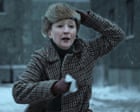
Part cold war thriller, part Kafkaesque reverie, this movie takes us back to the sinister drear of Poland in 1981, when General Jaruzelski has just introduced martial law in reaction to the dangerous new mood of freedom occasioned by the Solidarity trade unions. The director is Kasia Adamik, daughter of The Green Border’s Agnieszka Holland; the film is adapted from a story by Olga Tokarczuk, called Professor Andrews Goes to Warsaw.
Lesley Manville plays Professor Andrews, an academic clinical psychologist (like Tokarczuk) from Britain with testy, peremptory mannerisms; her indulgence is a fondness for taking Polaroid photos. She has attained a certain level of celebrity for a book on dreams, despite claiming that she never dreams herself. Andrews has been invited to give a lecture in Warsaw, during which she begins to outline views on mental illness not unlike those of Laing or Foucault; but her speech is chaotically disrupted by students shouting that Poland itself is an oppressive asylum.
The chief protester’s sister Alina (Zofia Wichlacz) happens to be the postgrad student tasked with showing Professor Andrews around, but from the very first, there is confusion. Andrews loses her bag, then has to give her passport to Alina so she can go back to the airport and look for it; she can’t go to a hotel and must stay at a flat in a sketchy area, belonging to relatives of Alina. And when she awakens the next morning, Andrews sees a tank in the wretched and surreally deserted tower block wasteland. The clampdown has begun, murderous secret police are everywhere and she has no passport. Perhaps Andrews had better get used to staying in Poland for the foreseeable future – or maybe for ever.
It is an intriguing and disquieting movie, though one whose storytelling impulse slows a little, and perhaps the film could have benefited from closer editing – although this might have meant losing some of the bizarre and surreal details, like the live carp that people queue up to buy for food and keep in the bath.
KioskNews shows a cleaned-up reading view extracted from the publisher’s page — the original always lives on their site, not ours.