Accused OpenAI spy had folder called “Saudi Gov Docs,” FBI says
On Monday, a court granted the US government’s request to deny release of a former OpenAI engineer accused of bugging a top-secret conference room to steal the frontier lab’s secrets.
In a court filing Sunday, US attorney Craig Missakian argued that Abdulrahman Alfozan must continue to be detained while the US makes its case that Alfozan brazenly spied on OpenAI, either for his own personal business gain or to benefit the Kingdom of Saudi Arabia.
Evidence showed that Alfozan had been chatting with a member of the KSA royal family on WhatsApp, while pursuing opportunities to permanently move back to Saudi Arabia during the country’s biggest AI push yet, the government argued. Shortly before his arrest, the FBI found he accessed a folder called “Saudi Gov Docs” on his iPhone, where he also allegedly stored photos of a second bug he planted in the offices.
With so much evidence against him, Alfozan—a Saudi national and US permanent legal resident—is a flight risk with seemingly endless support from the Saudi government, Missakian alleged.
The FBI arrested Alfozan days before he could hop a plane, Missakian said. The US attorney noted that Alfozan had already booked a one-way ticket for him, his wife, and their baby to Riyadh, Saudi Arabia’s capital. That ticket was allegedly “paid for by the Saudi government.” Following his arrest, his wife and son booked a sooner flight and immediately left the US without him. Once again, the US found “a member of the Saudi military booked and paid for yet another one-way ticket for the defendant’s wife and son, this one business class to Doha, Qatar.”
After receiving “significant compensation from a decade of high-tech employment in the Bay Area,” Alfozan has “ample resources” to run away to Saudi Arabia, the US government alleged. He also has “at least two bank accounts in Saudi Arabia,” the government said.
To support their request to detain Alfozan, the government pointed to a case where former Twitter employees were charged with spying for the Saudi government. Charges are still pending against one of the ex-Twitter staffers, Ali Alzabarah, the US said, partly because “a Saudi foreign official” helped “coordinate a next-day flight to Saudi Arabia” shortly after Twitter confronted him.
Because Alfozan would presumably have “little incentive to remain in the United States to see this case through,” Missakian asked the court to order his detention pending trial.
“Although FBI agents seized the defendant’s Saudi passport when they arrested him, there is nothing to stop the defendant, if he is released, from obtaining any necessary travel documents and fleeing the United States—with or without the help of a foreign government that has previously assisted its citizens depart the United States under similar circumstances,” Missakian’s filing argued.
On Monday, Magistrate Judge Alex G. Tse agreed at a hearing that Alfozan should remain detained while mounting his defense, Business Insider reported.
Alfozan’s alleged escape plan
When Alfozan was arrested, he was living at home with his family in California. Since moving to the US in 2009, he’d received technical degrees from MIT and UC Berkeley. After more than a decade working in Silicon Valley, OpenAI eventually hired him “as an engineer in or around July 2025 with an annual base salary of $325,000,” the government’s court filing said. He also got “a new hire equity grant of $2,200,000 in profit participation units.”
Allegedly, Alfozan’s scheming against OpenAI started in the months after his hiring. Without detecting anything was amiss, OpenAI was preparing to grant Alfozan parental leave. His wife’s student visa had expired, and he planned to use his two months of paid time off to help her permanently move back to Saudi Arabia with their baby, the US filing said.
But he didn’t make the flight. About two weeks prior to the booking, OpenAI found a recording device hidden in a conference room. That device, the US court filing confirmed, was there for “at least multiple days” and had been in place during a top-secret meeting with US government officials.
“In the days surrounding the time period that the device was installed, OpenAI executives met with government officials in that very room,” the filing said. “Defendant’s conduct could pose a danger to the national security of the United States.”
In their complaint, the US alleged that Alfozan used an OpenAI productivity agent to research which conference rooms might be best exploited for his spying. Logs suggested that he also used his wife’s personal ChatGPT account to research ways to modify his covert recording devices so they would auto-record when detecting speech and allow remote access controls.
After his arrest, Alfozan refused to speak to the FBI, requesting his attorney. However, his wife confirmed that she’d seen her ChatGPT account open on his laptop when asked about her plan to move back to Saudi Arabia, the government’s filing said.
FBI uncovers “Saudi Gov Docs” folder
The government’s motion for Alfozan’s detention included more details than previously reported from the search of Alfozan’s house.
In addition to finding recording devices similar to the ones planted in OpenAI offices, the FBI allegedly found evidence that Alfozan had planted at least one other bug. Photos on Alfozan’s iPhone depicted “at least one additional concealed recording device as well as what appear to be the input/output panels on televisions and other electronic devices in various locations in OpenAI buildings, including another conference room where sensitive meetings frequently occurred,” the filing said.
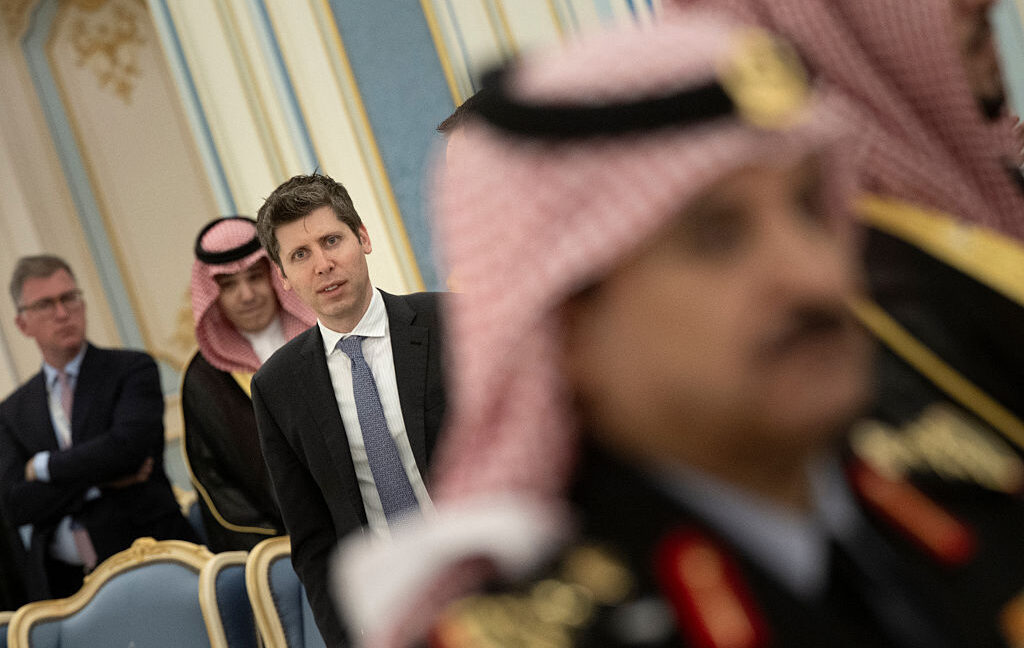
OpenAI and the US government are both aware that Saudi Arabia has dedicated this entire year to advancing its AI through an effort called “Vision 2030.” Sam Altman himself joined Donald Trump at a summit where the Saudi government’s AI push was celebrated.
However, the US is very guarded about American frontier labs. The FBI therefore found it particularly concerning that Alfozan’s phone showed WhatsApp logs where “a member of the Saudi Royal Family” seemed to be recruiting Alfozan. Those logs date back to 2025, the same year he started at OpenAI, and continued up until October 5. They included an exchange where Alfozan responded “100” to a message urging that “Saudi needs you more then [sic] the US!”
His iPhone browser activity was similarly revealing, the US alleged. On October 4, Alfozan accessed a folder called “Saudi Gov Docs,” the FBI found. The US did not make public what was in the folder, but they did explain what Alfozan did after accessing the folder, which suggests he may have been aiding the Saudi government. Logs showed that Alfozan used OpenAI’s productivity agent to find out “who from OpenAI could be suitable to attend a high level informal meeting with ministers in Saudi Arabia? List 10 people and why each. Ideally high levels.”
“Every incentive to flee”
Although Alfozan only faces a maximum sentence of five years for illegally recording OpenAI’s meetings, the government said that it expects it may raise more serious charges as evidence mounts.
“Here, the nature and circumstances of the offense are indisputably serious,” the filing said. “The defendant went to significant lengths to create customized, encrypted recording devices to secretly record highly sensitive meetings involving senior OpenAI personnel and executives, high-level business counterparts, and government officials, all while communicating with individuals of significance in Saudi Arabia and pursuing opportunities in—and making plans to travel to—Saudi Arabia.”
The US said it’s possible that Alfozan was acting on his own but suggested that it didn’t matter if the government could prove he planted the bugs while working for the Saudi government.
“Whether the defendant wanted to record OpenAI meetings to enrich himself by enhancing his own business prospects, or to provide aid [to] a foreign government, or both, his conduct is criminal and it presents a danger to innovation in the Silicon Valley and a concern for the national security of the United States,” the US argued.
Asking the court to deem Alfozan a flight risk, the US argued that Alfozan “has every incentive to flee” and use the information he allegedly stole at OpenAI to possibly emerge as a talent advancing Saudi Arabia’s AI goals.
“He faces prison time in the United States,” the filing said. “His wife and son are now in Saudi Arabia and have no plans to return. He has the resources to flee. He has the connections needed not only to flee, but to build a new life in Saudi Arabia.”
Ashley is a senior policy reporter for Ars Technica, dedicated to tracking social impacts of emerging policies and new technologies. She is a Chicago-based journalist with 20 years of experience.
KioskNews shows a cleaned-up reading view extracted from the publisher’s page — the original always lives on their site, not ours.