The unlikely hobby bringing young people back into nature
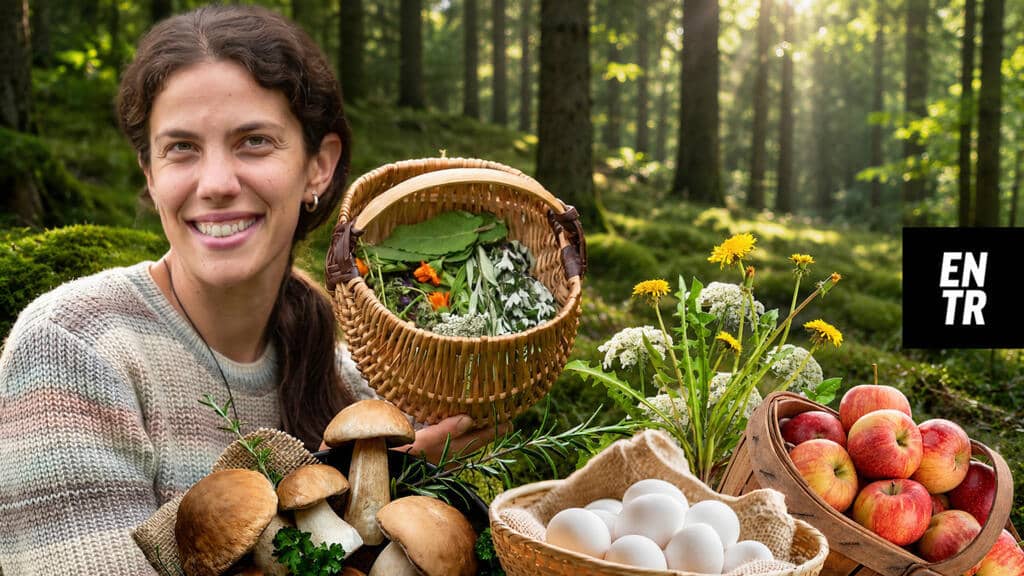
Basking in the warm October sunshine, standing among blackberry groves, Beatrice Bisaglia has a pretty clear view of what she wants her life to look like. “I will never go back to city life. I just want to spend my life outside in the sun, collecting wild plants,” she said.
Roughly two years ago, Bisaglia, 30, moved to Edolo, a village at the foot of the Italian Alps, to pursue her dream of foraging full-time. She already makes part of her income by teaching courses where participants can learn to recognise edible wild plants, and by producing foraging content on social media.
Her Instagram account is a collection of tips and tricks on the best way to recognise and use ingredients like raspberry leaves, rosehips, wild fennel seeds, or nettle, which she collects on her foraging walks.
And she’s not the only one. Just by typing #foraging on Instagram, hundreds of videos pop up, some of them amassing millions of views. Most of them show young people frolicking in fields and forests with wicker baskets, giving advice on how to safely identify wild plants, and sharing recipes made with foraged foods.
Indeed foraging is not just a social media phenomenon. According to a paper by the UN’s Food and Agriculture Organisation (FAO) “the trend of foraging for wild plants is gaining momentum across Europe".
A cure for modern urban living
Bisaglia lives by her practice, and most of what she eats comes either from the wild, or from the lush vegetable garden she grows with her partner, following the principles of permaculture.
“We haven’t really gone to the supermarket since one year, but of course we shop in small markets because we cannot produce everything,” she says while filling a tub with fresh water for her two geese, Malva and Altea.
“If you don't have the option, you have to go [to the supermarket] and it's not bad at all, you still can find something, but it's a way of distributing food I'm not in line with.”
Wanting to consume less ultraprocessed foods is one of the reasons people have gotten back into foraging, but it’s not the only one. Environmental and health concerns, and a need to reconnect with nature top the list. But some also do it out of an interest in self-reliance and survivalism.
Wateki Taliana Tobert, a forager and researcher who contributed to the FAO study, says foraging can be seen as an answer to the anxieties of our modern, often urban way of living – which is why the trend brings so many different people together.
“At my courses, I’ve had one person arrive by helicopter and another riding a donkey,” says Tobert, who also leads foraging walks. “The important thing is that they are there, and that their eyes light up when they learn about this practice,” she added.
The positive impact of foragers
Like most of the foragers ENTR spoke to, Tobert believes that, despite risks like accidental poisoning or damaging plants, growing interest in foraging is a good thing. “The more people from all backgrounds get into it, get to know plants, the more it will become a part of them, their world and their home, which they will want to take care of.”
Aesthetics and social media aside, on-the-ground foragers across Europe track native and invasive species, campaign to care for and protect natural spaces, and teach others to do the same.
“The most important thing is to have a good education in foraging and its good practice, because that is going to regulate how people pick plants,” said Sophie Treinen, another co-author of the FAO study, who also forages.
Treinen is referring to principles like not picking more than you need, always leaving some of the plant or berries you are picking behind, only picking a plant if you are 100 percent sure of what it is – and how you are going to use it, and being aware of endangered species in your area.
Of course, amassing all of this knowledge requires enormous amounts of time and practice.
A privileged pastime?
Megan Howlett, like Bisaglia, has built her life around foraging, teaching courses and sharing foraging content on social media to 160,000 followers. But even she acknowledged it’s not for everyone.
“People can lead such busy lives – if you've got a full family, if you’ve got a full-time job, it’s just not feasible to be picking and harvesting and cooking up all your foraged bits,” said Howlett over the phone.
On top of that, depending on where you’re based in Europe, foraging can be tightly regulated. Land to forage on can be difficult to access, as most land is privately owned.
Different countries have specific restrictions. For example, in Italy, some regions require a permit to go out and pick mushrooms. In England you are not allowed to uproot any plant, making tubers and roots off-limits.
On the other hand, places like Scotland and Norway have “freedom to roam” policies that include permission to forage for personal consumption.
There is also the question of sustainability.
“Our world today is not built for a society to be foragers,” said Howlett.
Bisaglia echoed this sentiment, saying that if everyone suddenly started foraging at the same time, our environment could not support it.
“With the little nature we have left, it's hard to say that everyone can start to collect plants,” she said. “We need more nature. And I think also a structural change of society.”
From lost practice to Michelin tables
Nevertheless, the attitude towards foraging has been changing over the past few decades. It went from being an uncommon practice, often associated with poverty and scarcity, to conquering tables of Michelin-star restaurants specialised in gastrobotany.
“The interest in foraging is growing,” said Bisaglia, sitting on an overturned bucket in her vegetable garden. “I was born in a small city in the Po Valley which is a really urbanised territory. When I was collecting herbs in Treviglio, everyone thought I was crazy,” she continued.
“Here in the mountains they are still foraging. So now it's more common, natural. I am normal here, finally,” she concluded.
ENTR is a digital space for open discussion about what really matters, what holds us back and what connects us all.
ENTR exists in 9 languages: English, Bulgarian, Dutch, French, German, Hungarian, Polish, Portuguese and Romanian.
KioskNews shows a cleaned-up reading view extracted from the publisher’s page — the original always lives on their site, not ours.