‘Bludgeoned with platitudes’: Australian politicians lead the English-speaking world in AI speeches
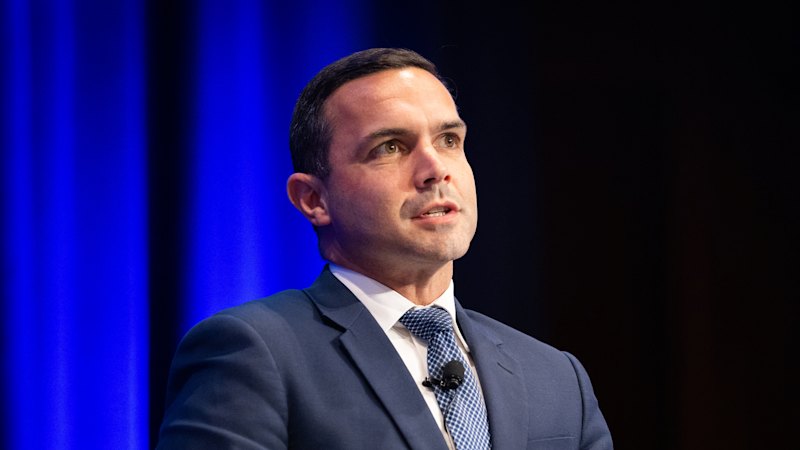
Just three years ago, Liberal MP Aaron Violi was the first Australian politician to publicly declare he had used AI to write a speech.
Today, Australian politicians lead the English-speaking world for AI use in speeches, according to analysis in The Economist.
As OpenAI apologises for its rogue agents that broke into a Medicare portal, the Albanese government races to attract billions of dollars in data centre investment, and tech leaders warn AI could pose an existential threat to humanity, the economic weekly’s findings have sparked a debate around how MPs should be using the technology.
A random sample of speeches made between September 2025-26 found that more than 20 per cent of those made in Australia’s House of Representatives were flagged by AI content detector Pangram for AI-generated or AI-assisted text. Just under 15 per cent of Senate speeches were flagged.
Australian MPs were the most prolific users compared to other English-speaking legislatures, just ahead of Canada but triple the rate of the British.
In July, a Canadian politician went viral after accidentally reciting AI editing prompts. Bill Oliver was making a speech in the chamber when he said: “Here’s a more natural flowing version of that section that reads like a legislator speech rather than a series of short points.”
In 2023, Violi declared that he had used AI to write a speech to highlight the technology’s power.
“Since that time, the tools have become more powerful, but the government has still been slow to act,” the opposition spokesman for the digital economy and cybersecurity said.
He said AI was a useful tool, but MPs had to be careful in how they used it to construct a speech.
“If an MP is putting a prompt into AI and then using the speech verbatim without checking the source documents, well, I think at some point they’re going to get themselves in trouble.”
Violi said he encouraged his staff to use AI, but had rules for fact-checking, protecting confidentiality through only entering information that could be made publicly available, and not using AI content word-for-word.
He said one of the problems with AI-generated content was that it was predictive, based on other content.
“It’ll give you the average of what everyone does – it’s not going to give you that that point of difference to really stand out,” he said. “Personally, most of my speeches, particularly those that are most impactful in parliament, are off the cuff with dot points.”
James Button, who was a speechwriter for former prime minister Kevin Rudd and previously a journalist at this masthead, said there was a place for using AI for research but something was lost when using it to write.
“The thing about a speech is that it’s a very human event, right? It’s a person standing up in a room, speaking to others, and seeking a connection with those people,” he said. “You add AI into that, and we are absolutely not getting the thoughts of the human being, the politician … so it’s troubling.”
Button said AI was capable of imitating an MP’s preferences and speaking style, but the question remained whether it should.
Another speechwriter for a former prime minister, who requested anonymity to speak freely, said AI was an efficient tool to generate the bulk of a speech that could then be finessed – a process that which could otherwise take days to shape a longer address. The tradeoff was potentially failing to develop the skill of forming and delivering an argument.
“The orators will get better, and those who use the tools appropriately will get sharper and better,” they said. “But there will be others who, maybe they’re using AI and all they did previously was just use the leader’s office talking points. They’ve just substituted one form of artificial intelligence for another.”
Independent senator David Pocock, who has published his own guidelines for using AI, encouraged MPs to disclose when they used the technology and justify its use to constituents.
He said increasing AI use meant a more homogenous output, and politicians “bludgeoning people with platitudes”.
“As an elected representative, you’re elected to represent, not to read out AI speech. It comes down to trust. I think Australians would expect you to be using it to become more efficient. But you can’t lose that human touch.”
Speaker Milton Dick said there were no rules for how members used AI in House speeches, but that MPs were responsible for what they said.
“In speaking, members are aware of their overriding duty to the national interest, and primary duty to represent the interests of their constituents,” he said.
Political speechwriters typically write major speeches for MPs on a senior staffer salary that starts at $140,000 before adding loadings for allowances and seniority. However, sometimes politicians will write their own or speak off the cuff, and their speechwriters do not always shape the speeches delivered in parliament that were measured by The Economist.
Cut through the noise of federal politics with news, views and expert analysis. Subscribers can sign up to our weekly Inside Politics newsletter.
KioskNews shows a cleaned-up reading view extracted from the publisher’s page — the original always lives on their site, not ours.