7 out of 10 human trafficking cases in Ghana never reach prosecution — JoyNews Research
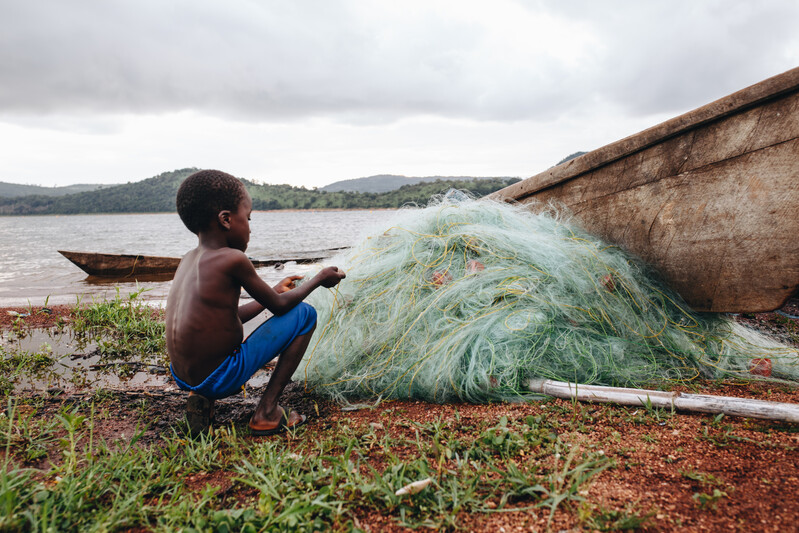
Every year, hundreds of human trafficking cases are reported across Ghana. Children are rescued from forced labour on Lake Volta, young women are exploited through deceptive recruitment schemes, and vulnerable people are trafficked across borders under promises of better opportunities.
Behind each case is a victim whose rights have been violated, and a criminal offence that demands justice.
Yet for many victims, justice appears to stall long before a judge ever hears their case.
A JoyNews Research analysis of official human trafficking data spanning 2017 to 2025 reveals a striking gap in Ghana's criminal justice process. Over the nine years, authorities recorded 1,264 human trafficking cases. Of these, only 361 progressed to prosecution, and just 158 resulted in convictions.
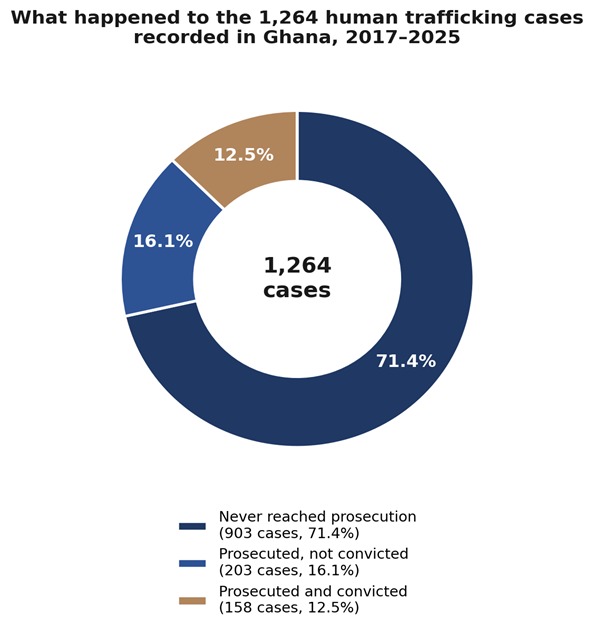
The figures mean fewer than three in every ten recorded cases proceeded to prosecution, the basis for this story's headline finding: seven out of every ten human trafficking cases reported in Ghana over the last nine years never reached a courtroom.
Notably, once a case does reach prosecution, the odds of conviction improve considerably: 158 of the 361 prosecuted cases — close to 44% — ended in a conviction. That pattern points to where the system's biggest leak really sits: not in the courtroom, but in the much earlier gap between a case being opened and a prosecutor deciding there is sufficient evidence to proceed.
Nine years, 7,407 victims
Behind the case numbers is a wider human toll: officials identified 7,407 human trafficking victims in Ghana between 2017 and 2025; an average of more than 800 a year, though the true number is almost certainly higher, since these figures capture only cases that came to the attention of investigators.
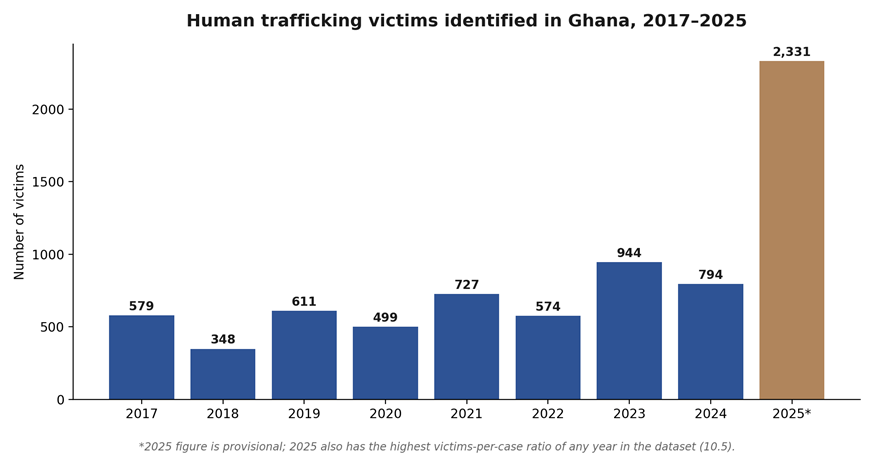
One year stands out sharply: 2025 alone accounts for 2,331 of the nine-year total — nearly a third of all victims identified since 2017, and almost three times the number recorded in 2024. It is also the year with by far the highest ratio of victims to cases: roughly 10.5 victims for every case recorded, more than double the ratio in any other year in the dataset. That combination, a record victim count alongside a relatively unremarkable case count of 222, hints at the discovery of one or more large-scale trafficking operations involving many victims at once, rather than simply more cases being reported.
A volatile nine-year pattern in prosecutions
Unlike the steady climb suggested by looking at only a handful of years, the full nine-year dataset shows prosecution rates have swung considerably from year to year, rather than following a clean upward trend.
The prosecution rate — the share of reported cases that proceeded to prosecution — bottomed out at 13.0% in 2021, when just 14 of 108 reported cases were prosecuted. It has ranged as high as 43.1% in 2023 (47 of 109 cases) and 47.7% in 2025, provisionally (106 of 222 cases). Notably, 2023's spike shows the 2025 improvement was not without precedent — both years suggest that prosecution rates above 40% are achievable within the current system, even if they have not yet been sustained.
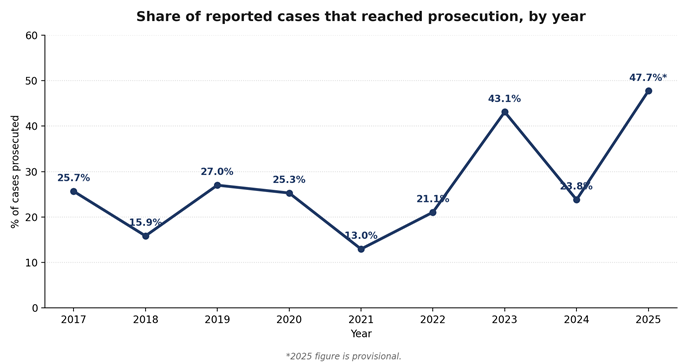
One further data point stands out for 2021: although only 14 of that year's cases were prosecuted, the lowest prosecution count in the dataset, all 14 ended in conviction, a 100% conviction rate among prosecuted cases unmatched in any other year. By contrast, 2018 saw only 13 prosecutions but a comparatively strong 53.8% conviction rate, while years with far more prosecutions, such as 2024 (65 prosecutions), converted a smaller share, 38.5%, into convictions.
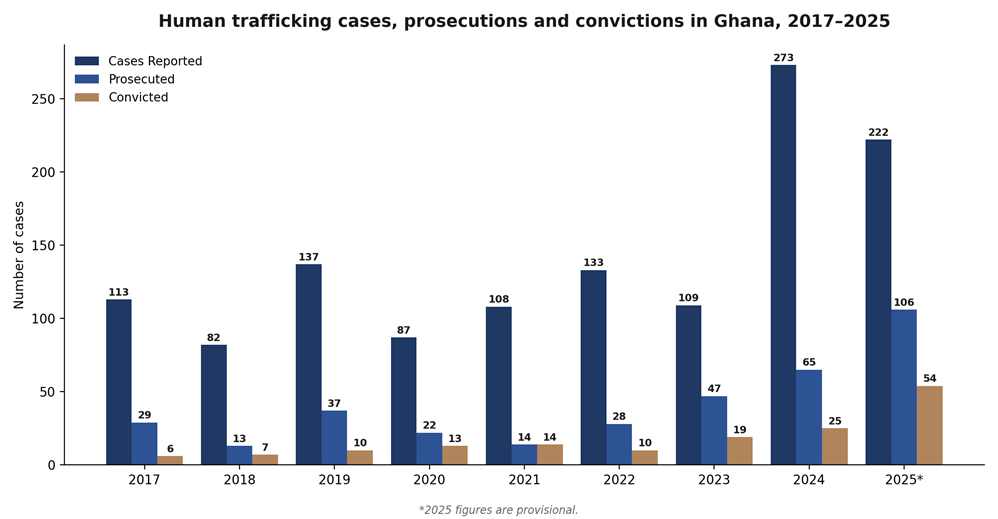
To track exactly where cases fall out of the system, JoyNews Research applied a stage-by-stage “justice funnel” framework, mapping each case from initial report through investigation, prosecution, and final verdict. Across all nine years, that mapping consistently points to the same conclusion: the system's biggest and most persistent leak sits between investigation and prosecution, not between prosecution and conviction, where outcomes, while variable, have generally been stronger.
Why cases stall before reaching court
For anti-trafficking experts, the numbers reflect challenges that extend beyond the willingness of prosecutors or the decisions of courts.
JoyNews put these questions to Nana Ama Doe Badu, a Justice System Associate with the International Justice Mission (IJM), which supports Ghana's criminal justice institutions, particularly in agricultural communities around Lake Volta, in combating human trafficking. According to Badu, the principal obstacles often arise during investigations.
“The biggest challenges are systemic. Investigators sometimes have to travel long distances to remote island communities where victims and suspected traffickers are located. Gathering evidence in those circumstances requires logistics, resources and time.” — Nana Ama Doe Badu, Justice System Associate, IJM.
Many trafficking cases occur in difficult-to-access communities around Lake Volta, where investigators may need boats and specialised logistical support to reach crime scenes. According to IJM, such practical constraints, compounded, in some cases, by jurisdictional complexities when victims, suspects, and evidence span multiple districts, can affect the speed and quality of investigations, and ultimately determine whether a case is considered strong enough for prosecution.
The organisation also points to evidence-gathering as a major hurdle. Successful prosecution depends on investigators gathering sufficient admissible evidence before a docket is submitted to prosecutors; where evidence is incomplete, prosecutors may struggle to meet the legal threshold required to bring criminal charges.
IJM is clear that its own role is not to gather evidence on the state's behalf, but to train investigators to do so effectively, alongside providing logistical support that helps cases move through the system more quickly.
“Effective investigations lead to effective prosecutions.” — Nana Ama Doe Badu, Justice System Associate, IJM.
Badu stressed that investigators and prosecutors, including those from the Attorney-General's Department, must work collaboratively from the earliest stages of a case to improve outcomes.
Delays don't end at the investigation stage
Bottlenecks are not confined to the investigative stage. IJM also identified delays within the court system itself, including staffing shortages and the transfer of judges as a further source of delay once cases do reach prosecution, even though these do not appear to be the dominant driver of case attrition in the aggregate data.
The trauma factor
Victim testimony presents another layer of complexity.
Survivors of human trafficking frequently endure severe psychological trauma, making it difficult for some to recall events in detail or participate fully in legal proceedings. However, IJM says trauma does not automatically prevent a successful prosecution: where a survivor is too traumatised to testify, cases can still proceed using other forms of evidence.
To address this, IJM has also worked to train prosecutors and court officials in trauma-informed approaches, helping the justice system secure reliable evidence and testimony while minimising further harm to survivors.
The data raises broader questions about the effectiveness of Ghana's anti-human trafficking response. Are investigators sufficiently resourced to build strong cases? Do prosecutors receive adequately prepared dockets? How many investigations remain pending, and how many are discontinued because they fail to meet evidentiary standards?
These are questions the statistics alone cannot answer.
JoyNews has requested responses from the relevant state institutions to better understand why a substantial proportion of recorded human trafficking cases do not progress to prosecution, what proportion of cases remain under investigation, and what reforms are being implemented to improve prosecution outcomes.
Their responses will help complete the picture of where cases are being lost within Ghana's criminal justice system, and what can be done to ensure more victims of human trafficking receive the justice they deserve.
DISCLAIMER: The Views, Comments, Opinions, Contributions and Statements made by Readers and Contributors on this platform do not necessarily represent the views or policy of Multimedia Group Limited.
Tags:
DISCLAIMER: The Views, Comments, Opinions, Contributions and Statements made by Readers and Contributors on this platform do not necessarily represent the views or policy of Multimedia Group Limited.
KioskNews shows a cleaned-up reading view extracted from the publisher’s page — the original always lives on their site, not ours.