China formally launches project to build aircraft carrier-sized ‘science island’
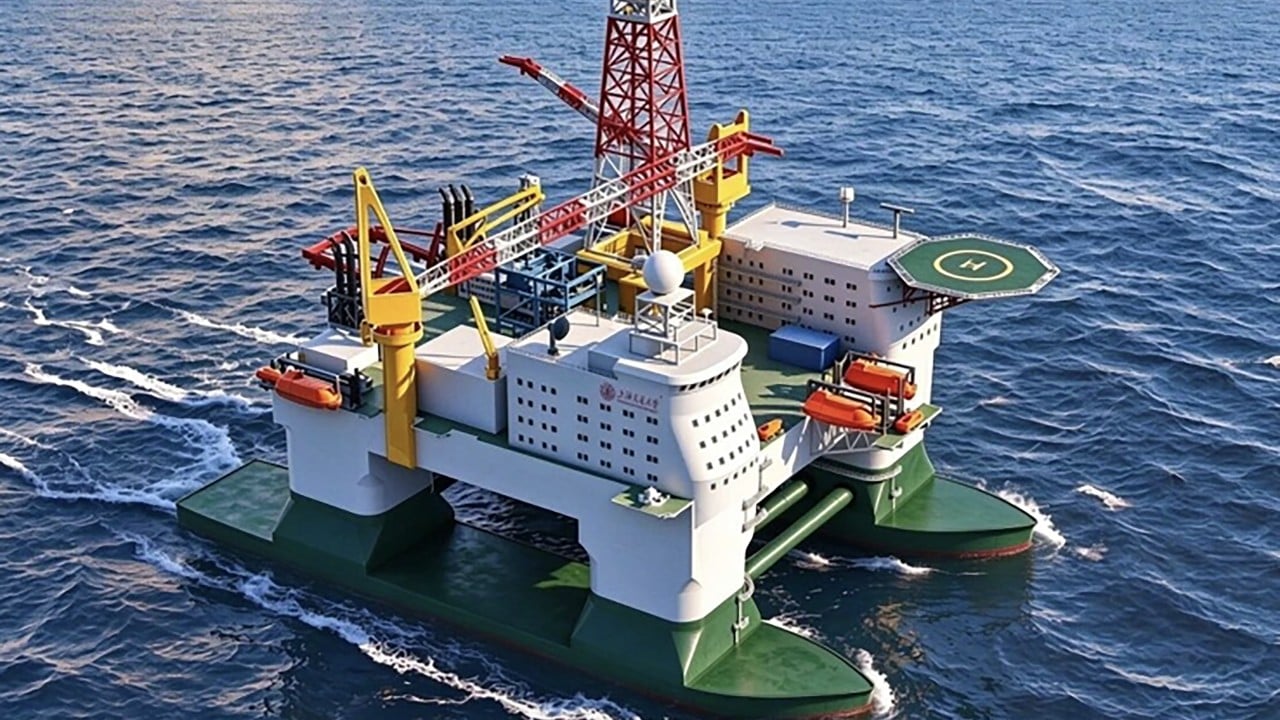
China’s massive maritime science infrastructure – an aircraft carrier-sized floating artificial island – has officially entered its engineering construction phase.
The semi-submersible twin-hull platform is the world’s first mobile, self-sustaining artificial island and is expected to be fully completed and delivered by June 2030, news outlet Shanghai Observer reported on October 21.
During deep-sea and far-ocean expeditions, traditional research vessels struggle to remain stationary in gale force winds and massive waves for extended periods. In such violently pitching environments, on-board precision optical instruments and analytical balances cannot function properly.
Conversely, while fixed offshore platforms are massive and highly resistant to wind and waves, they lack self-propulsion and cannot be relocated to suit changing research needs.
01:34
China’s most advanced aircraft carrier, the Fujian, enters service
The ultra large floating research platform therefore fills a unique need, and what makes it revolutionary is its combination of mobility and permanence.
Unlike fixed research stations or conventional vessels constrained by fuel and supplies, the floating island can cruise at 11 knots, or about 20 km/h (12.4pmh), while supporting more than 200 researchers.
Officially named the Deep-Sea All-Weather Resident Floating Research Facility and designated as a major national scientific infrastructure project in China’s 14th five-year plan, the facility – also dubbed a “far-sea floating mobile island” – is the culmination of a decade of research and planning, according to SJTU.
The structure measures 138 metres (453 feet) long and 85 metres wide, with its main deck sitting 45 metres above water – roughly the height of a 15-storey building.
This means that, even in extreme sea conditions churning up 20-metre waves, the swells would be unable to breach and flood the core laboratory zones and living quarters on the main deck.
The platform’s maximum displacement is about 74,000 tonnes, surpassing the vast majority of conventional destroyers and research vessels worldwide and approaching the scale of a large aircraft carrier. China’s newest aircraft carrier, the Fujian, has a displacement of more than 80,000 tonnes.
Its twin-hull design allows it to operate in sea state 7, namely “high” seas with six to nine-metre waves. And it can survive typhoons as intense as up to Force 17 on the Extended Beaufort Scale.
Notably, while it is officially a civilian research platform, engineers behind the project have proposed a nuclear-blast-proof design.
To support prolonged, high-intensity deep-sea research, the floating island features comprehensive architecture comprising a main platform system, a shipborne laboratory system and a shore-based support network.
The shipborne component features six laboratories dedicated to researching core fields such as heavy marine equipment and systems technology, marine disaster meteorological observation and the long-term observation of marine ecosystems.
According to China’s state news agency Xinhua in May, Zhou Meng, the project’s chief scientist and dean of SJTU’s School of Oceanography, said the facility would excel in scenarios such as sea trials for high-end equipment, close-range typhoon detection and marine scientific observation.
The mega facility would also be open to, and shared with, global research institutions and enterprises, Zhou added.
KioskNews shows a cleaned-up reading view extracted from the publisher’s page — the original always lives on their site, not ours.