How underwater internet cables are helping researchers listen to endangered whales
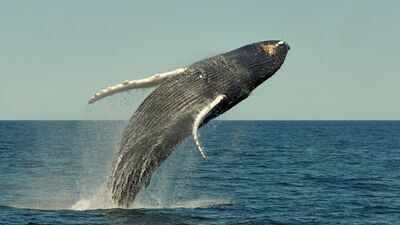
Representative image (credit: Canva)
Researchers are listening for whales through underwater internet cables. The technique has picked up calls from blue whales, the world’s largest animals, and fin whales, the second-largest.
Cornell University bioacoustics researcher Lea Bouffaut and her collaborators have now detected bowhead whale calls on a telecommunications cable off northern Alaska, showing that the method can pick up quieter, higher-frequency calls as well. “This is truly exciting, as this technology enables real-time data access over tens of [miles], and from land,” said Bouffaut. The ability to listen from shore could help researchers track where endangered whales spend time and how they move.
In a review published in ‘Methods in Ecology and Evolution’, Bouffaut and her colleagues called on scientists, cable operators and regulators to work together to make the technology part of routine whale monitoring.
How underwater internet cables pick up whale calls
The technique, called distributed acoustic sensing, sends laser pulses through an optical fibre and measures the light that scatters back. Sound waves passing through the water can cause tiny changes in the fibre.
By measuring where those changes occur, researchers can listen at many points along a single cable and estimate where a call came from.In 2022, Bouffaut and her colleagues used a 120-km underwater cable off the coast of Svalbard, Norway, to detect calls from blue and fin whales. The whales were calling loudly at frequencies below 100 hertz, the researcher observed. However, Bowhead whales and critically endangered North Atlantic right whales can make quieter, higher-frequency calls that travel shorter distances, making them more difficult to detect in cable recordings.
What the bowhead whale detection means for conservation
To see whether the technique could pick up those harder-to-hear calls, Bouffaut worked with the Barrow Whaling Captains Association and the North Slope Borough Department of Wildlife Management in Utqiaġvik, Alaska. Arctic broadband provider Quintillion supplied access to an existing cable. The team found bowhead whale calls among terabytes of recordings.
“Being able to detect bowhead whales on a telecommunication cable is the proof of concept we need to show that DAS can be used to monitor all baleen whales,” explained Bouffaut. Dedicated underwater microphones remain more sensitive.Cables could supplement them by letting researchers listen along long stretches of seabed and follow up on where and when whales are heard. Moving from a field trial to routine monitoring will require access to more cables and cooperation among the people who study whales, operate the infrastructure and oversee its use.“The review is also a call to action for scientists, industry partners and regulators to collaborate,” said Bouffaut. “We now have the technical blueprint to turn global undersea infrastructure into a global network for ocean conservation.”
KioskNews shows a cleaned-up reading view extracted from the publisher’s page — the original always lives on their site, not ours.