Salvadorans with TPS don’t know how long their protections will last
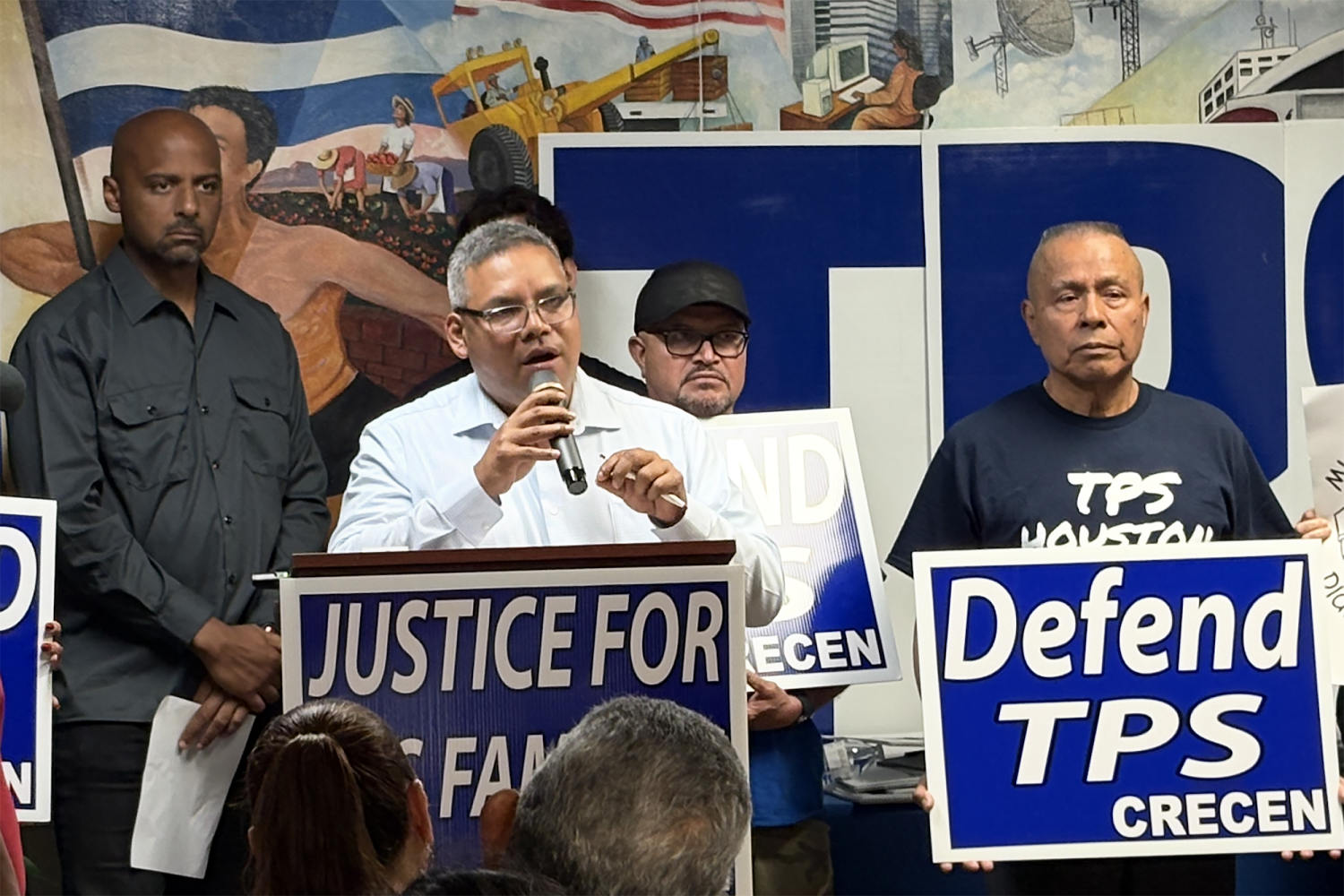
HOUSTON — José Palma’s face lights up when he remembers leaving El Salvador in 1998 at the age of 23 for the U.S., with the dream of working, learning English and building a family.
Twenty-eight years later, his life is divided between paperwork, community hearings, and a family full of love and varying immigration statuses: Palma, who lives in Houston, has U.S. citizen children — two of whom are still young — and a wife who’s a legal permanent resident, and he’s a beneficiary of Temporary Protected Status, which allows eligible immigrants from certain countries to live and work in the U.S. without fear of deportation.
As the national coordinator of the National TPS Alliance, Palma has been answering a lot of questions from Salvadorans with TPS: Their immigration protections were set to expire last week, but the Department of Homeland Security announced that Salvadorans will retain TPS protections — including work authorization — for now until an announcement is made at a later date.
But there’s uncertainty among Salvadoran TPS holders about what could come next and what happens now with work permits or driver’s licenses that have expired or are about to expire. Immigrants from countries that have lost their TPS designation, including Haiti and Nicaragua, have lost their work permits and ability to be in the U.S. legally, and they face deportation.
Palma has lived under TPS protection since 2001.
“Everything we’ve built is in danger of collapsing,” he said. “Twenty-five years is not a short time. It’s a lifetime.”
Palma said that amid the uncertainty, Salvadoran TPS holders and their families have been dealing with real consequences: People are being asked not to return to work by their employers, families fear the loss of their health insurance and parents are unsure if they will be able to continue driving vehicles in the United States.
Advising caution
Palma recommended one thing to Salvadoran TPS beneficiaries: “Don’t panic or make decisions based on rumors,” he said.
The Trump administration has said that until it announces a decision, Salvadorans with TPS still have protection, so Palma’s advice is “to rely only on official sources, credible community organizations and established media” for accurate information.
One of the biggest points of confusion, Palma acknowledged, is whether Salvadoran TPS holders can continue working.
“DHS has said that people retain protection, but USCIS guidance for employers indicated that certain automatic work permit extensions were valid until Sept. 9,” Palma said, referring to U.S. Citizenship and Immigration Services. “People should keep their USCIS letters, check their myUSCIS account and seek accredited legal advice before assuming which document applies to their case or employment.”

For those who have already received warnings from employers, Palma had this advice: “Do not resign or sign any documents you do not understand. Bring any official notifications you receive from USCIS to your employer and ask human resources to check the agency for updates regarding Form I-9. No one should decide the future of your immigration case based on an unverified comment, social media post or phone call.”
Unfortunately, some Salvadoran TPS holders have already been affected. Palma said that people who applied between January and March 2025 to renew their work permits haven’t received them. Some employers have told them not to return to work, and others have told them they can only work until a certain date.
“Driver’s licenses depend on immigration status, health insurance can be cut off and loans can be denied — the consequences go far beyond losing immigration protection or a work permit,” he said.
If the Trump administration decides to end TPS protections for Salvadorans, people don’t have to leave the country within 60 days, Palma emphasized.
“That period is the minimum protection period before a decision can take effect,” he said. “After that, each person must evaluate their case: There may be a family petition, asylum, another legal process or an immigration defense. The recommendation is to seek legal evaluation now and not wait for an emergency.”
What to do in the meantime
Salvadoran TPS holders should be gathering copies of their work permit, TPS certificate, passport, driver’s license, USCIS receipts, birth and marriage certificates, children’s medical and school records, proof of employment, and tax returns, Palma said.
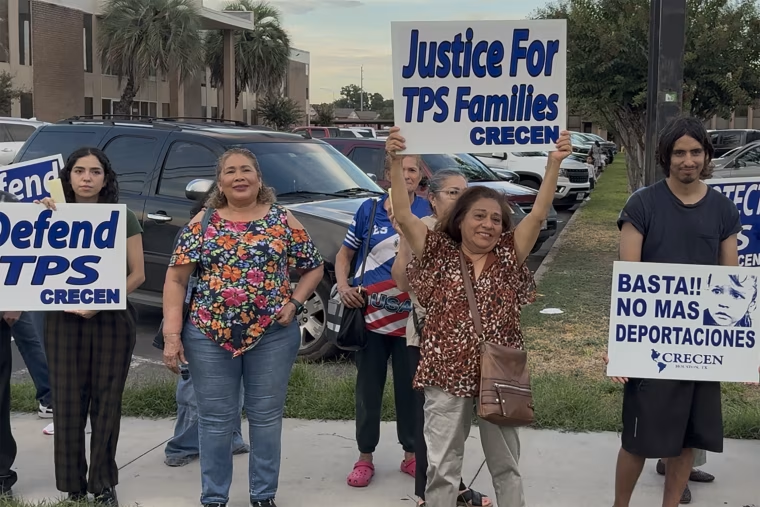
He also said it’s important to identify a licensed immigration attorney or accredited organization. He urged people not to lie on any forms or submit applications for which they don’t qualify or give money to people who promise to “fix” their immigration status.
Palma also warned against signing documents without understanding them, giving access to bank accounts or personal information to strangers, or trusting a notary as if they were an immigration lawyer.
TPS holders should also avoid any legal problems or issues such as driving under the influence of alcohol, using false documents or committing acts that could jeopardize any future immigration status.
When asked what TPS holders should do if they’re stopped or approached by authorities, Palma said the important thing to do is “stay calm.”
“Bringing a copy of your identification or immigration documents can be helpful. If it’s an immigration officer, don’t sign any papers without knowing what they contain or without speaking to a lawyer,” he said. “Every case is different, but a signature obtained under duress can have serious immigration consequences.”
Temporary status for decades becomes a ‘whole life’
The National TPS Alliance estimates that about 170,000 Salvadorans are directly protected by TPS. However, Palma explained that the actual number of people affected is much higher when one includes U.S. citizen children, spouses, employers, churches, businesses and entire communities.
If TPS for Salvadorans is ended, “the impact would be immediate in cleaning, hotels, restaurants, kitchens and construction; there are also Salvadorans with TPS working in transportation, healthcare and professional occupations,” he said.
Palma was asked what he tells people who say that TPS is temporary and beneficiaries should return to their countries.
He said it’s important to understand the history of the program.
“It’s been renewed every 18 months, under both Democratic and Republican administrations, for 25 years. After all this time, we haven’t been given an opportunity to apply for permanent status,” he said. “So, the question is legal, but also moral: If someone has lived in the United States for 25 years with immigration status, is that really temporary? For many, 25 years is a whole life.”
“The least we deserve is the opportunity to continue our lives, as we have done all these years, but with permanent immigration status,” Palma said. “I want Democrats and Republicans to take this issue seriously, reach an agreement and find a permanent solution.”
An earlier version of this story was first published in Noticias Telemundo.
KioskNews shows a cleaned-up reading view extracted from the publisher’s page — the original always lives on their site, not ours.