Sarfaroshi ki tamanna: The protest anthem once disowned by its writer
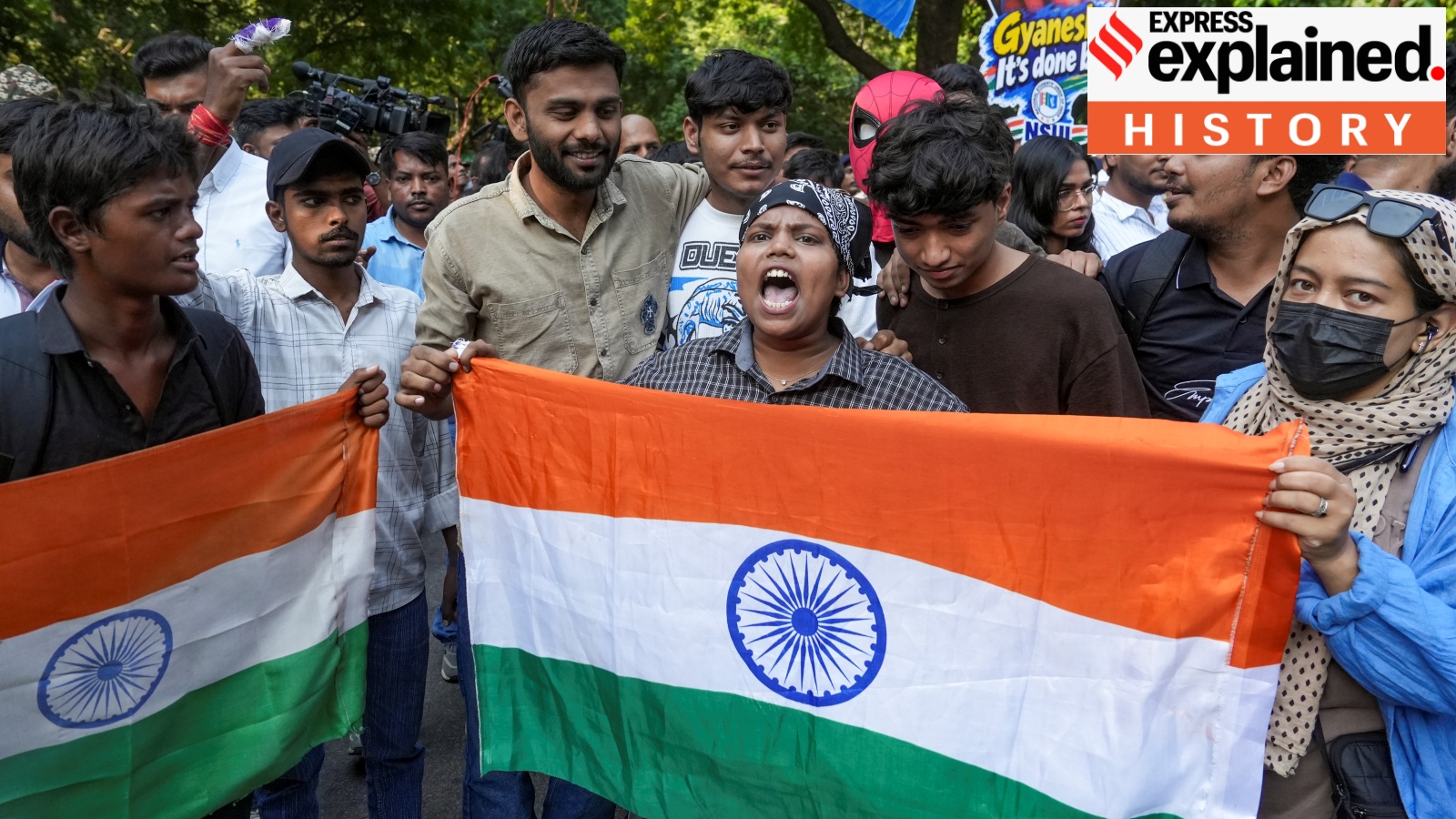
At the recent protests demanding the resignation of Chief Election Commissioner Gyanesh Kumar, student leader Neha Bora invoked a century-old patriotic ghazal: Sarfaroshi ki tamanna ab hamare dil mein hai/ Dekhna hai zor kitna baazu-e-qatil mein hai” (The desire to sacrifice our heads for a noble cause is now in our hearts; let us see how much strength exists in the arms of our executioner).
The iconic 11-verse ghazal was penned in 1920 by Bismil Azimabadi, an Urdu poet from Patna. Patna has also been known as Azimabad, thus the surname.
Born Syed Shah Mohammad Hasan in a zamindar family, Azimabadi chose Bismil (meaning wounded) as his pen name and was a disciple of the poet Shad Azimabadi, once the magistrate and municipal Commissioner of Patna.
Azimabadi spent his formative years amid a culturally vibrant atmosphere, with many eminent poets in the family, including his two grandfathers, Mubarak Azimabadi and Shah Mubarak Kakvi Azimabadi and his maternal uncle, Kamaal Azimabadi. Soon enough, Bismil developed an affection for Urdu poetry. His maternal grandfather Mubarak had learned under Waheed Allahabadi, a notable classical Urdu poet, who mentored many poets of note, including Akbar Allahabadi.
Azimabadi frequented the Anjuman Taraqqi Urdu library in Patna, where his passion for poetry thrived. This interest was also fostered by the city’s inherent Urdu literary culture and the spirit of staunch opposition to the British.
How did the poem ‘Sarfaroshi’ come about?
Bismil Azimabadi wrote the patriotic ghazal in 1920, in the aftermath of the Jallianwala Bagh massacre, where General Dyer opened fire at a large crowd gathered at a Baisakhi fair to protest the Rowlatt Act. Passed by the British, the Act indefinitely extended emergency measures, allowing detention and imprisonment without trial, among other provisions.
Azimabadi, a nationalist, was moved by the massacre. He took part in the freedom movement himself and in 1920 attended the Congress Session in Calcutta, where he recited the poem for the first time. The poem was published in 1921 in an influential Urdu journal from Delhi, named Sabah.
Story continues below this ad
Soon after its publication, its fiery and anti-imperialist tones were deemed offensive by the British, who issued a strict warning to Sabah’s editor and prominent nationalist literary figure Qazi Abdul Ghaffar. The edition carrying the poem was confiscated. Despite this, the nationalist machinery of the time made sure that the poem reached far and wide.
But while the poem became extremely popular, especially after freedom fighter Ram Prasad ‘Bismil’ began to recite it, the actual poet distanced himself from the poem after the British government began keeping an eye on him. Ghaffar also asked Azimabadi to remain cautious. After this, Bismil Azimabadi had approached his mentor, poet Shad Azimabadi, who corrected the manuscript, stripping it of its revolutionary edge. A copy preserved at the Khuda Bakhsh Oriental Public Library in Patna comprises these corrections. Azimabadi also stayed away from acknowledging the piece as his own due to fear of British crackdown.
Why is this poem commonly attributed to Ram Prasad ‘Bismil’?
The famed poem has been widely associated with Ram Prasad Bismil, the revolutionary who was executed by the British in 1927 for his involvement in the Kakori Conspiracy. The confusion was caused by a number of reasons. One of the reasons is that he used ‘Bismil’ as his pen name (besides Ram and Agyat); second, he was also a writer and poet; third, while Azimabadi wrote the actual poem, it was Ram Prasad who gave the poem mass popularity across India by singing it in various meetings.
The poem is known to have been recited by him while walking to the gallows in the Gorakhpur Jail. He was executed in 1927. But the piece continued to be a rallying cry in the struggle for Independence.
Story continues below this ad
Another prominent couplet often recited by Ram Prasad among others was, Waqt aane de bata denge tujhe aye aasamaan, hum abhi se kya bataayen kya hamaare dil mein hai (When the right time arrives, we shall show you, o heavens/ Why should we reveal right now what secrets lie in our hearts?)
Was the poem acknowledged by Bismil Azimabadi later?
It was only in 1957 that Azimabadi declared the poem to be his own in his autobiography Yaaran-e-Maikadah. By that time, most of the country thought the poem had been written by Ram Prasad ‘Bismil’. The mix-up led Azimabadi to feel a deep sorrow about his masterpiece not being acknowledged as his.
In his memoir Guftani Na Guftani, progressive urdu poet Wamiq Jaunpuri shares Bismil Azimabadi’s reflection on the poem’s loss, lamenting that while lost belongings often return to their owners, his own ghazal never found its way back to him.
Azimabadi died in 1978. While a lot of his poetry was lost, whatever was left was compiled under Hikayat-i-Hasti in 1980 with the help of Khuda Bakhsh Oriental Library in Patna.
Story continues below this ad
The poem of protest and its use in popular culture
While numerous Indian protests, including anti-CAA/NRC protests. have had the poem at the forefront, Sarfaroshi ki tamanna was also raised as a slogan in the recent PoK agitation, over political representation and cost of living issues.
The poem has also been popularised in Hindi cinema through films including Shaheed (1967) Sarfarosh (1999), The Legend of Bhagat Singh (2002), Rang De Basanti (2006), among others.
KioskNews shows a cleaned-up reading view extracted from the publisher’s page — the original always lives on their site, not ours.