HistoriCity| Jantar Mantar: A place to watch stars and a witness to history
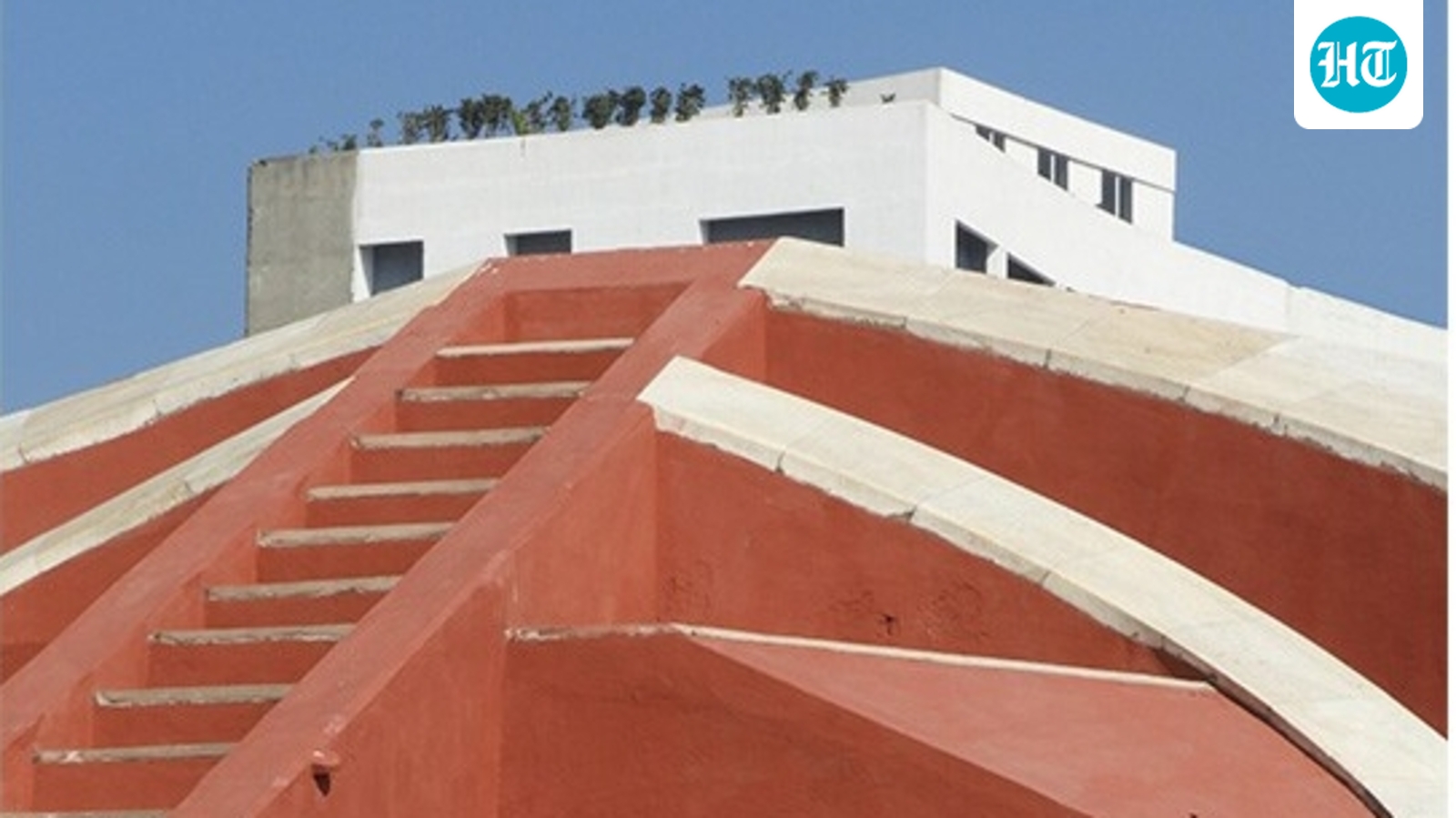
Jantar Mantar as a location in the heart of New Delhi has emerged as the embodiment of and defining symbol of protests over the last three decades. The observatory itself was built to monitor celestial bodies like the sun and different planets. Built of red sandstone, these clocks of pre-modern India brought together Indian, Persian and European expertise. Though no longer used to measure time or predict fortunes, observing today’s Jantar Mantar--both the physical and metaphorical—helps us detect signs of what lies in store.
History of the Jantar Mantar, Delhi
The Jantar Mantar in Delhi was built by Sawai Jai Singh II, the king of Amer and one of the Mughal empire’s most important allies, on the orders of Emperor Muhammad Shah (1702-1748 CE), popularly known as “Rangeela” for his indulgence in arts, wine and music. It was the first of the observatories Jai Singh built. Most key observations were made here, forming the foundation for his new set of astronomical tables, the Zij-i Muhammad Shahi, named after the emperor himself.
The Question of the Date
Historians do not agree on exactly when the observatory was built. According to Pandit Gokal Chand, its construction can be dated to 1710. Sayyid Ahmad Khan gave a later date of 1724, stating that the observatory was built on Muhammad Shah’s command in the seventh year of his reign, which corresponds to the Islamic year 1137 AH, or 1724-25 CE.
According to J.R. Kaye in his work, The Astronomical Observations of Jai Singh, Jai Singh’s own writings help resolve this disagreement. He sought “to accomplish the exalted command (of emperor Muhammad Shah) he had received, he (Jai Singh) bound the girdle of resolution about the loins of his soul and built here (at Delhi) several of the instruments of an observatory.” Kaye explains that Jai Singh was encouraged by the emperor when he proposed preparing new astronomical tables.
Determined to carry out this royal commission, he then built several observatory instruments in Delhi.
This, of course, suggests that work began only after Muhammad Shah came to the throne, which rules out the earlier date of 1710. Jai Singh also says that the tables took seven years to be completed. In 1719, the same year the emperor took the throne, Jai Singh was appointed the emperor’s lieutenant in Agra, showing how closely he was tied to the imperial court at this time.
A further clue comes from Jagannath, Jai Singh’s leading astronomer, who recorded observations taken in Delhi in 1729. Considering all this evidence, the most likely date for the founding of the Delhi observatory is around 1724.
The Instruments
The design of the observatory reflects Jai Singh’s search for greater accuracy. By his own account, he first built brass instruments like the astrolabe (an early instrument used to observe and calculate the position of celestial bodies), following the specific methods described in Islamic astronomical texts.
Kaye notes, this was similar to what “had been erected at Samarqand agreeable to the Mussalman books such as Zat al-Halqa of brass, in diameter three gaz of the measure now in use”. These, however, did not satisfy him. He therefore designed instruments of his own invention, including the Jai Prakash, the Ram Yantra and the Samrat Yantra. He built them out of stone and lime so that they would be completely stable and far more reliable than the metal versions.
During Jai Singh’s lifetime, the observatory most likely included the Samrat Yantra (a massive sundial providing relatively precise measurements of time), the Jai Prakash (an elaborate sundial), the Ram Yantra (to measure celestial alignment), a mural quadrant and a number of metal instruments. Of the structures that stand today, the Misra Yantra or mixed instrument, may have been a later addition. It was possibly built by his son, Madho Singh, who is said to have inherited a good deal of his father’s passion for science.
Early Accounts by Travellers
The Delhi observatory is mentioned quite often in the writings of travellers through the 18th and early 19th centuries, and several of these accounts are worth noting. In 1734, Father Claude Boudier and another priest passed through Delhi on their way to Jaipur. While there, they used the observatory to take readings of latitude and longitude. Unfortunately, they left no description of the observatory or its instruments during this trip.
Further, in 1795, Franklin wrote about the observatory in his account of the city of Delhi. According to him, it was built in the third year of Muhammad Shah’s reign by Raja Jai Singh, who was helped by many well-known astronomers from Persia, India and Europe. Franklin added that Jai Singh died before the project was finished, and that “it has since been plundered and almost destroyed by the Jeits under Juhwaher Singh”. The Jeits here refer to the Jat siege of Delhi in 1764-65.
In 1799, W. Hunter published a fairly detailed account of the observatory; his list and descriptions of the buildings reveal that a wall once stood just west of the Misra Yantra, aligned with the meridian. On this wall was marked a double quadrant, with its centres at the wall’s two upper corners, and each degree on these quadrants measured about 2.83 inches.
Interestingly, when describing the Misra Yantra, Hunter does not mention the third quadrant, known as the Agra Yantra, on its western side. This strongly suggests that it was added later. Writing about the Samrat Yantra, he noted that it was made of stone, but that the edges of its ‘gnomon’ (the part of a sundial that casts a shadow) and the arcs carrying its scale markings had been made of white marble. By his time, only a few small pieces of this marble survived.
In 1803, Major William Thorn visited Delhi and later published his own description of the observatory. However, his account simply repeats Hunter’s and adds no new information, even though later writers have sometimes cited him as an authority.
Shortly afterwards, the artists Thomas and William Daniell produced two illustrations of the observatory’s main structures. These images show that very little changed over the following hundred years, apart from a few small differences in detail.
KioskNews shows a cleaned-up reading view extracted from the publisher’s page — the original always lives on their site, not ours.