Wave to pay your train fare: Innovations showcased at transport summit in Suntec
SINGAPORE – Commuters could soon pay their train fares with just a wave of the hand if a new home-grown innovation is rolled out at MRT stations.
The mobile payment solution from ST Engineering uses a biometric reader to scan a user’s palm to trigger payment with, for instance, a registered credit card.
All commuters need to do is ensure they register at the ticketing counter to enable palm-scanning technology, and link the account to a registered payment method, like a credit card.
The tech tool is an improved version of a similar platform ST Engineering unveiled in 2024 at an event organised by the Land Transport Authority and the Brussels-based UITP or International Association of Public Transport.
Enhancements built into the latest version include faster palm scanning and the use of ultra-wideband (UWB) technology, which is a feature found in some higher-end smartphones.
When a registered UWB-enabled smartphone is within range, the fare gate opens and handles payment automatically, even if the device is kept in the bag or pocket.
Palm scanning to pay for public transport is not common, although it has been rolled out in China. As for ST Engineering’s UWB technology, it is still in the early phase of development, having started about three months ago.
ST Engineering, a home-grown technology, defence and engineering group, showcased the palm-scanning payment tech tool at the Singapore Urban Mobility Week, which ran from Nov 4 to 6.
The event – held at the Suntec Singapore Convention and Exhibition Centre – was organised by the Land Transport Authority (LTA) and partner organisations. It brought together 8,000 policymakers, transport operators and industry leaders from more than 50 countries.
Another innovation showcased at the event was a platform screen door that can be fitted into existing stations without the need for expensive upgrades to the train signalling system.
A key difference is that the new sensor-based screen door does not take its cue from the signalling system, which is the network of sensors and computers that controls train movement, including maintaining the distance between trains on the track.
Instead, it uses separate sensors installed at the station platform to detect when to open and close the screen door, based on the train’s position.
The set-up is compact as the components can be packed within the frame of the screen door structure.
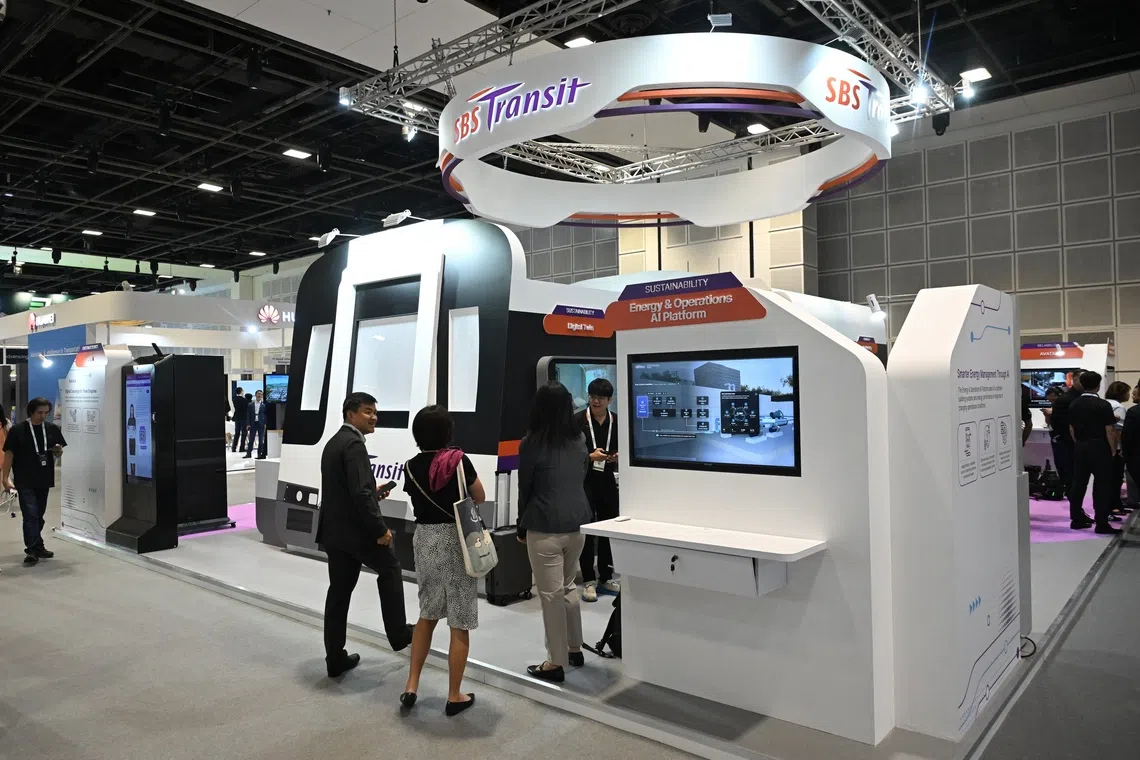
Exhibition booths at Singapore Urban Mobility Week 2026 on Nov 4.
ST PHOTO: AZMI ATHNI
Space constraints are often a key reason LRT stations in Singapore do not have platform screen doors, relying instead on fixed barriers and tactile warning studs along the station platforms to warn commuters that they are nearing the edge of the platform.
To work around not having screen doors, public transport operators use technologies like video analytics to spot track intrusions at LRT stations.
ST Engineering also unveiled an upgraded version of its smart junction technology, which helps give emergency vehicles like ambulances priority on the road.
The tool works by signalling a green wave to traffic lights along the ambulance route, making emergency responses swifter.
The technology is similar to the traffic priority system the Singapore Civil Defence Force unveiled in July 2024, and is limited to the junctions near hospitals.
It taps traffic congestion technology, which uses artificial intelligence to optimise traffic signal timings in real time.
A pilot in 2022 was found to have reduced traffic junction delays by up to 25% compared with traffic lights that use a fixed-time system or a 10% saving from a conventional adaptive system.
A piece of hardware is added to the existing power box at junctions to receive traffic data from existing sensors and control the traffic light timings, rather than requiring an extensive overhaul to put in new sensors and hardware.
The device communicates with the control centre, which has an overview of the traffic conditions, to optimise the traffic light timings.
The main source of traffic information at the junction now is the induction loop sensor, which is buried under the road to detect vehicles. ST Engineering’s system allows for upgrades to incorporate more sensors, like video camera feeds, in the way it tweaks the traffic light timings.
The system is already undergoing trials in the western part of Singapore to get more real-world data, and there are plans to have 60 traffic junctions in the area by 2027.
All traffic signal-controlled junctions in Singapore, covering about 2,700 intersections, have an adaptive timing feature, which prioritises heavier traffic flow, like city-bound traffic in the mornings, to maximise the number of vehicles passing through and minimise jams.
Other key themes at the Singapore Urban Mobility Week include the arrival of more electric bus brands and models, and autonomous vehicle (AV) technologies.
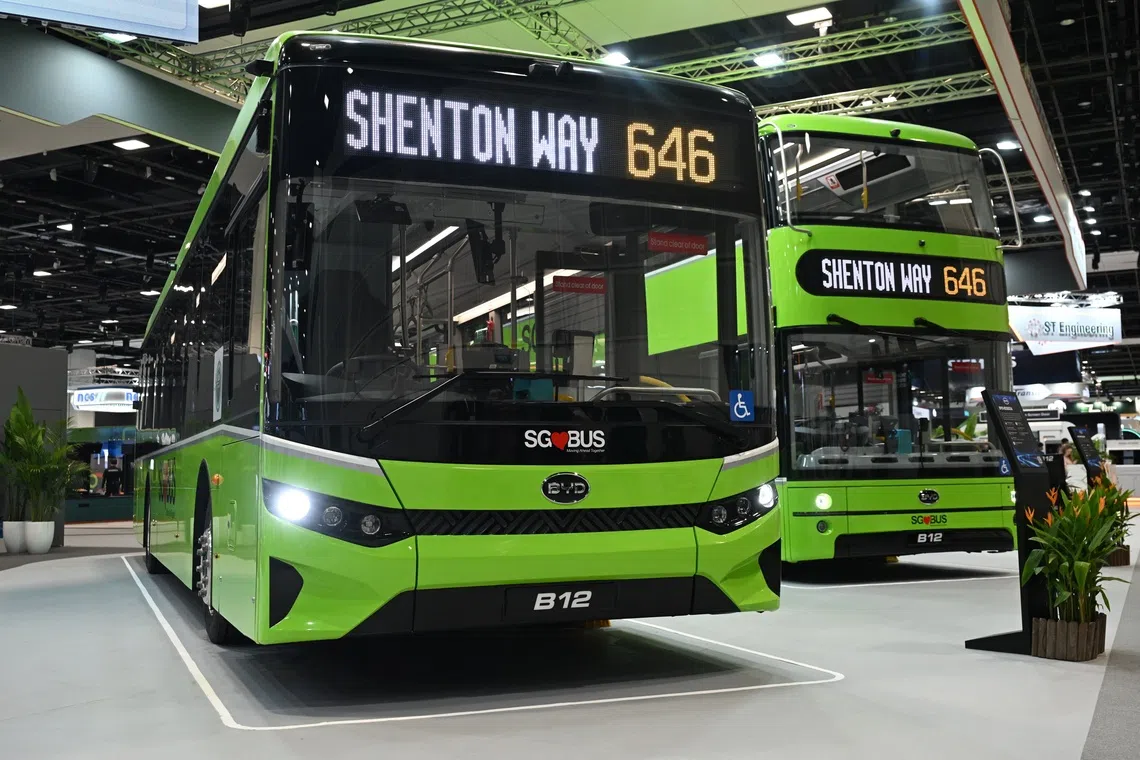
BYD buses on display at the Singapore Urban Mobility Week 2026 on Nov 4.
ST PHOTO: AZMI ATHNI
They include the debut of Sunwin, the electric bus arm of Chinese state-owned automotive giant SAIC Motor.
The brand is distributed by Eurokars Group as the multi-franchise motor dealer’s first commercial vehicle venture. Its arrival aligns with Singapore’s move to have the public bus fleet run on cleaner energy, which includes electric and hybrid technologies.
ComfortDelGro (CDG) launched its Autonomous Vehicle Academy at the event.
Through its partnership with firms in driverless technology, vehicle manufacturing and connectivity, the set-up will build up workforce and operation capabilities to support the company’s deployment of AV tech in Singapore and abroad.
Speaking to The Straits Times at the event, CDG group chief executive Cheng Siak Kian said training will be held on existing premises.
Its launch coincides with CDG’s ongoing autonomous shuttle trial in Punggol reaching its 10,000th passenger milestone.
Cheng said based on passenger feedback, CDG wants to work with LTA to increase the number of pick-up and drop-off points, evolving the service from the current fixed route format to a point-to-point one.
Public rides on CDG AVs began in June, as one of two operators with autonomous shuttle services in Punggol. Grab started its service in April. The services are currently free to book and use. The operators have not announced fares for their revenue services.
KioskNews shows a cleaned-up reading view extracted from the publisher’s page — the original always lives on their site, not ours.