Tighter National Bonus targets raise bar in areas that matter to S’poreans: Analysts
SINGAPORE – The tightened targets for the National Bonus – which forms part of ministers’ variable pay – will raise the performance bar for them in areas that matter to Singaporeans, analysts said.
Coordinating Minister for Public Services Chan Chun Sing had announced on Sept 8 that the Government will raise the target ranges for real income growth for both the median and lower-income earners in the 20th percentile, with the latter seeing the higher increase.
Analysts said the differentiated targets under the updated framework reflect a keener focus in ensuring that economic growth translates into gains for those at the lower end of the income distribution.
The unemployment target has also been tightened, while the gross domestic product growth target has been lowered to reflect the expectation that Singapore’s economy will grow more slowly as it matures.
These four indicators will determine the amount of the National Bonus, which ranges from zero to six months in total. Fully meeting the target level for all indicators results in a total National Bonus of three months.
Aaron Maniam, a professor in practice at the National University of Singapore’s Lee Kuan Yew School of Public Policy, said the tightened indicators strengthen the performance bar, holding ministers to high standards “not just on macro indicators but specifically to indicators linked to the welfare of lower-earning Singaporeans”.
The raised income-growth target for lower-income Singaporeans is one of the more significant changes to the National Bonus framework, analysts noted.
Under the updated framework, the real income-growth target for lower-income earners in the 20th percentile will be raised from the current 2 per cent to below 3 per cent, to 3 per cent to below 4 per cent.
This is compared with an increase from 2 per cent to below 3 per cent to 2.5 per cent to below 3.5 per cent for earners at the median.
Aslam Sardar, chief executive of the Institute for Human Resource Professionals, said from a reward and performance perspective, tightening the indicators is a positive step if it creates a clearer link between remuneration and outcomes that matter to Singapore.
“The National Bonus reflects more than economic performance alone,” he added. “Ministers hold responsibility for decisions that affect Singapore’s longer-term economic resilience, social outcomes and quality of life.”
Singapore Management University law professor Eugene Tan suggested that the National Bonus could incorporate some “stretch targets” at higher bands of the bonus range to make the indicators even more relevant.
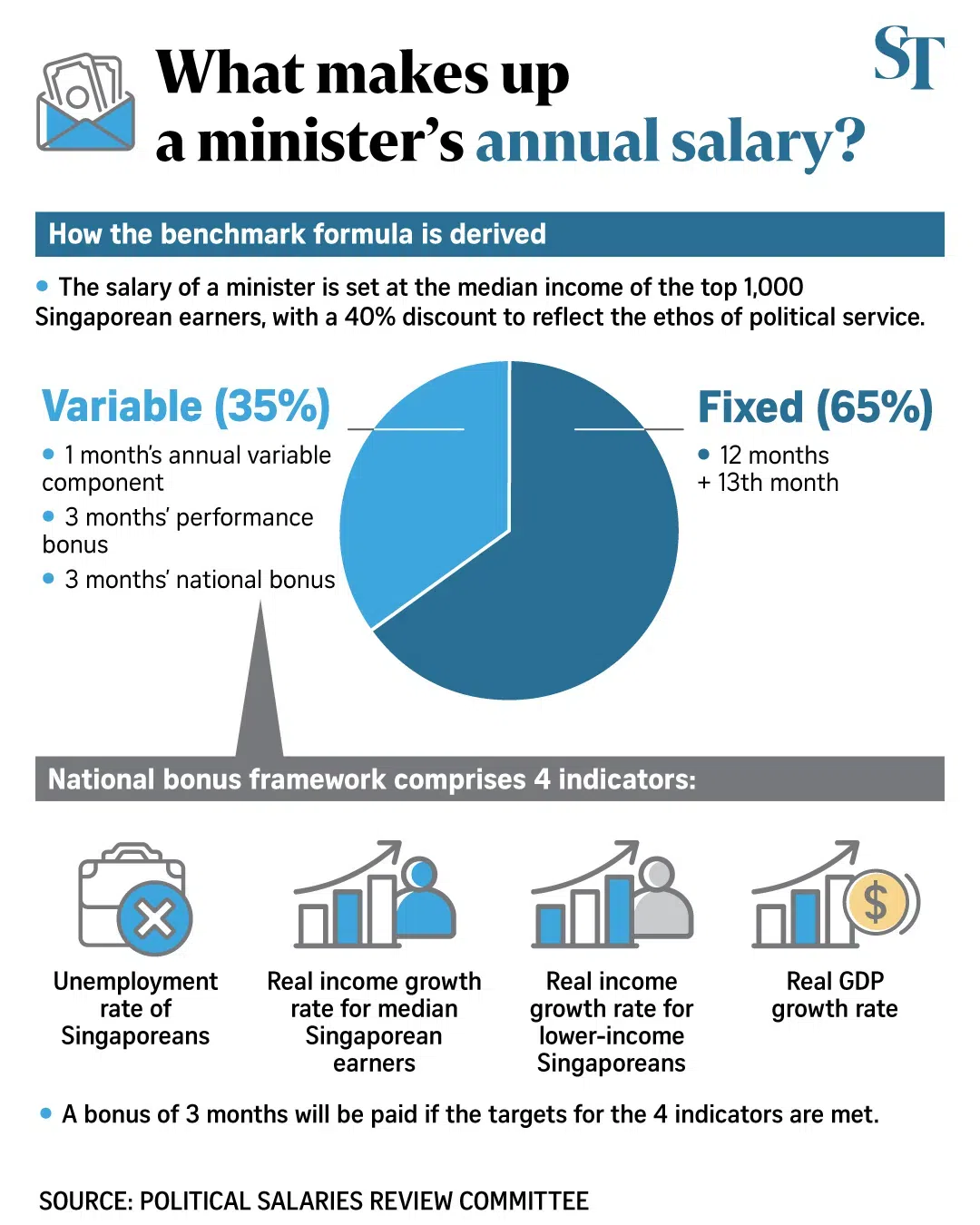
This is as the tightened targets were for indicators that have generally been met in recent years, he pointed out.
“Stretch targets must indeed be as such,” Tan said. “The targets for the national bonus payouts, especially at the 150 per cent and 200 per cent mark, should be higher than the figures that have been consistently attained in recent years.”
How to measure quality of life
The Government has also agreed to explore the inclusion of a robust quality of life measure in the National Bonus framework, when such a measure becomes available.
If this measure is eventually included, analysts said it could ultimately change the question the National Bonus is asking, from whether Singapore is doing well economically to whether Singaporeans are doing well more broadly.
The difficulty is that the latter is a much less straightforward thing to measure – and to attribute to the Government, they said.
Analysts imagined the quality of life measure as a basket of indicators covering outcomes such as health and well-being, housing affordability, social mobility, equality, access to essential services, leisure time and social cohesion.
“It may be more useful to look at a basket of indicators rather than trying to reduce quality of life to one number,” said Aslam.
The measures should also be objective, transparent and consistent enough to track over time, capturing whether economic progress is actually translating into better outcomes for Singaporeans, he added.
The breadth of the possible measures also raises questions about how such a concept could be incorporated into a performance-linked pay framework.
On this, Aslam said the indicators should be challenging, credible and measurable, while avoiding incentives for ministers to focus too narrowly on outcomes that may be outside the Government’s control.
Maniam said this is a complicated, multi-faceted issue that will benefit from further study.
“Countries often end up using composite indices, since no single indicator can capture all the nuances and details involved,” he said.
The Organisation for Economic Cooperation and Development’s Better Life Index is one example that captures how multifarious this issue can be, Maniam added.
The interactive tool shows how different combinations of multiple indicators – including housing, job quality, subjective well-being and work-life balance – can be combined in many different ways, he pointed out.
Norshahril Saat, a principal fellow at the ISEAS – Yusof Ishak Institute, said social scientists can work on some of the common matrices to measure a slew of indicators.
Indicators he suggested include life expectancy, educational attainment, crime rates, leisure time, the degree of religious diversity and social cohesion, and efficiency of public services.
Tan said the committee is right to highlight that non-material indicators of how Singapore is performing should be part of the matrix of indicators for the National Bonus.
“As society evolves, post-material concerns such as quality of life, fairness and justice take on greater importance, and these indicators can make for a more even-handed and balanced assessment of how well the Government is doing its job,” he said.
As a starting point, the Government could consider indicators such as income inequality – specifically, the Gini coefficient with and without government transfers – ecological sustainability and various measures of well-being, he said.
“We should not let the difficulty in measuring social progress prevent us from using them so long as such indicators are sufficiently robust and objective, and can be adequately measured across time,” he added.
KioskNews shows a cleaned-up reading view extracted from the publisher’s page — the original always lives on their site, not ours.