Seeing orange: Nationals under threat in regional Victoria as angry voters consider One Nation
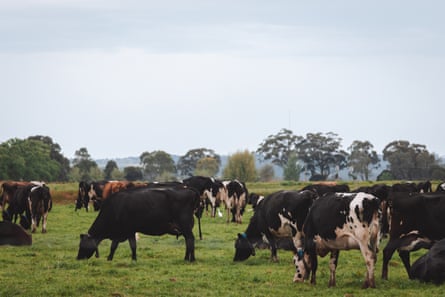
On a Friday afternoon last month, Victorian Nationals leader Danny O’Brien was driving around his electorate putting up corflutes when he came across a herd of cows blocking a road near Poowong.
As he waited for them to pass, O’Brien began talking politics with the woman herding them.
He says she told him she “liked orange” – a reference to One Nation – and that it was “time to shake things up”. O’Brien replied that voting for the party could risk giving Labor a path to victory “through the middle”. She mulled it over, then chased after the cows.
That night, an email arrived from the woman offering to host one of O’Brien’s signs on the family paddock beside a busy road.
It’s these sorts of conversations, O’Brien says, that are crucial for his party in countering One Nation’s rise in regional Victoria.
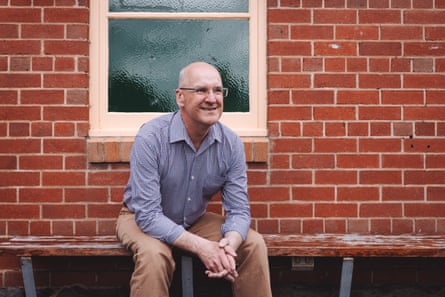
The Nationals currently hold nine seats in the Victorian parliament’s lower house – having picked up three seats off independents at the 2022 election – its best result since 1943.
O’Brien credits the result to its candidate selection – he says the Victorian branch of the party have become skilled at identifying “local champions” with a preexisting profile and “attaching the Nationals brand” to them.
“It’s often been said we’re a loose collection of independents that share that passion for rural and regional Victoria,” he says. “It’s not necessarily about left or right.”
At this election, the party hopes to hold it’s exisiting seats while targeting Jacinta Allan’s former seat of Bendigo East – where they’ve preselected popular local pub owner Andrew Lethlean – as well as Labor-held Bendigo West and Ripon.
But recently, the political landscape has been upended. Polls show One Nation’s vote is hovering about 20% statewide – with support even higher in regional areas.
Victorian Labor’s internal polling leaked in June showed the Nationals could face a wipeout at November’s state election. Another poll, commissioned by Trades Hall, showed the Nationals losing at least three seats to Pauline Hanson’s party.
Federally, One Nation won its first lower house seat from the Coalition at the Farrer byelection and has continued to ascend, with the latest Guardian Essential poll showing its primary vote had climbed to 25%. This was ahead of the Liberal-National Coalition on it’s lowest-ever primary vote of 22% and not far behind Labor’s 29%.
“There are no safe seats and frankly, they haven’t been for a long time,” O’Brien says.
The Nationals MP for Mildura, Jade Benham, is more blunt: “One Nation are 100% our biggest threat.
“It’s not even about the candidate. The candidate is kind of inconsequential. It’s the brand now.”
‘People want to be able to stay here’
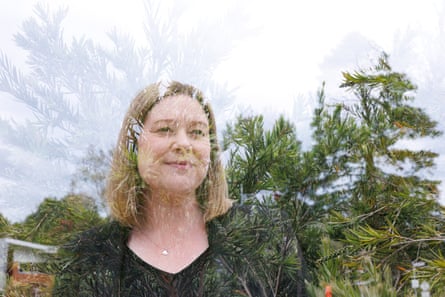
Cindy Madeley is the mayor of Wellington Shire, which overlaps with O’Brien’s electorate of Gippsland South. She says the region is in a “state of flux”, as industries its towns once relied on rapidly change.
She points to Sale, a town “that would not exist in the way it does without the oil and gas industry”, now watching Esso Australia decommission half its infrastructure hosted off the coast. In Yarram, a timber mill closed before Christmas, while others are importing Tasmanian timber as a consequence of Victoria’s native forest logging ban. There are plans for offshore wind, but it remains unclear how much the local community will benefit, she says.
“We’re worried about the things that everyone else is worried about – cost of living, interest rate rises, roads and hospitals – but when you add the regional lens to it, things become just that little bit harder,” Madeley says.
“People want to be able to stay here and for their kids to stay here. They just want things to get better.”
For Hanson, better means a return to a bygone era. Last month, she was in Morwell pledging to halt new transmission lines and renewable energy projects, keep Victoria’s largest coal plant operating and lift the ban on nuclear energy. Last week, the party also committed to bring back logging. It did not respond to a request to participate in this piece.
Guardian Australia didn’t spot any One Nation campaign material or evidence of a significant ground campaign during its visit to South Gippsland, with the exception of a seemingly AI-generated banner at Greenfield’s hotel on the Princes Highway in Traralgon, which featured a boxing kangaroo, Uluru and a smiling image of Hanson alongside the slogan “one flag, one voice”.
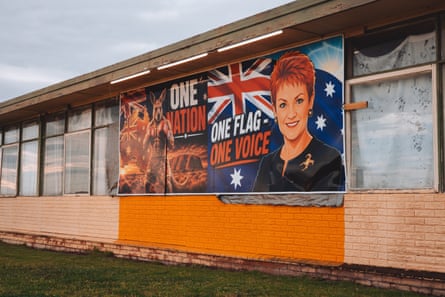
It was not clear who was responsible for the banner, which was illuminated by carefully placed lights, but one local resident spoke proudly of it, saying: “She has been taken down four times, but we keep putting her back up.”
Pearsondale cattle farmer Geoff Gooch says Hanson’s rhetoric has appealed to some of his friends.
“I’ve got a few friends that think she’s wonderful but they also listen to the Bolt Report – so there’s a direct correlation there,” Gooch says.
He says while Hanson might propose something that “sounds like a good idea”, her party’s policies aren’t practical. He says Australia cannot keep relying on coal and that “renewables are inevitable”, though the transition “has to be done sensibly”, while One Nation’s immigration plans would hurt the agricultural and dairy industries that rely on seasonal workers.
“If people vote for them, they’re not looking at the bigger picture,” Gooch says.
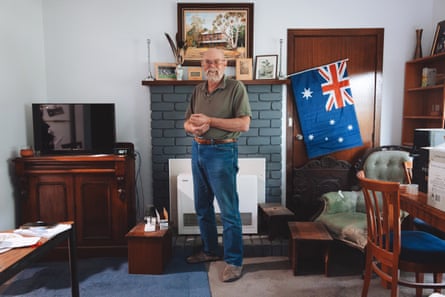
But for Con, a retiree who would not provide his surname and who migrated to Australia as a 10-pound pom and worked on major infrastructure projects including the high court of Australia, the West Gate Bridge and the Snowy Mountains scheme, One Nation’s immigration rhetoric resonates, even though he remains undecided on who to vote for in November.
“If I buy a farm to accommodate 500 cattle, I don’t go buying 1,000 of them,” he says.
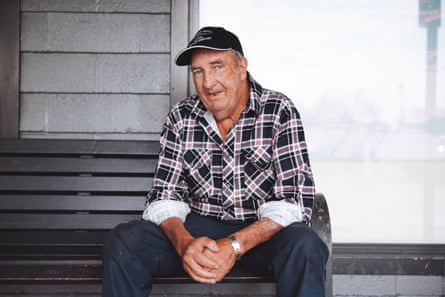
Con, speaking to the Guardian at a bus stop in Sale, says while he didn’t believe Hanson in the 1990s, “everything she was saying then has come true”.
‘It feels like a civil war regarding renewables’
Annabelle Cleeland is the Nationals MP for Euroa in Victoria’s north-east. She shot to prominence during January’s devastating bushfires, leading her community’s response as her own family lost 1,000 livestock.
She says people in the electorate remain “deeply angry” – and that it extends beyond the bushfires to a growing divide between the quality of life in Melbourne and regional Victoria.
“I know of people who have called for an ambulance and they never turned up … we can’t get a podiatrist, we can’t get a speech therapist, we can’t give birth in our communities. We have no protection through a disaster,” she says.
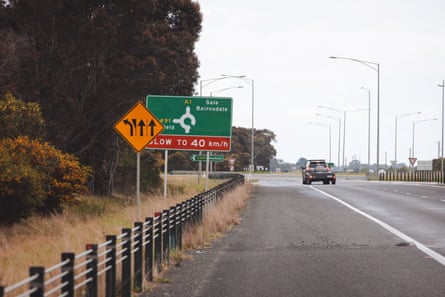
With Victoria’s deteriorating road system shaping up to be one of the defining issues of the upcoming election, Cleeland says the Nationals have “been banging on about potholes years before it became a hot topic”.
“In regional Victoria, we know the individuals that have had accidents and we know the lives that we’ve lost in our community because of the condition of the roads,” she says.
Then there’s the government’s fast-tracked renewable energy approvals and controversial laws that allow state body VicGrid and its contractors access to private land – without a landholder’s consent.
“In parts of the state it feels like a civil war regarding renewables,” Cleeland says.
But she says the answer to that anger is “not a protest vote, but voting in an alternative government” – a message opposition leader, Jess Wilson, has repeated in recent weeks.
O’Brien says it was this point that got the Poowong farmer on board.
“If you want change then you’ve got to support us,” he says.
Benham used M&Ms to demonstrate a similar message. She shared a video on social media last month warning that a split in the “conservative vote” could make it harder for the Coalition to win the 16 seats it needs to form government, potentially handing Labor a fourth term she says would be “catastrophic”.
“There’s been a lot of people that are angry that I took out all the orange ones, but there’s been more people that are saying this is such a simple, easy way to understand it,” she says.
Kos Samaras, a former Labor strategist turned pollster with Redbridge, earlier this year described the Victorian Nationals brand as the “strongest in the country”. He maintains the party is “well-poised to defend themselves” against One Nation.
“They are demonstrating if people want change – but not chaos – they are the ones to deliver it,” he says.
“It won’t convert every One Nation supporter but it’s potentially enough to allow the Coalition to win those three-way contests.”
KioskNews shows a cleaned-up reading view extracted from the publisher’s page — the original always lives on their site, not ours.