LNP going beyond Newman to squash public sector bargaining, unions say
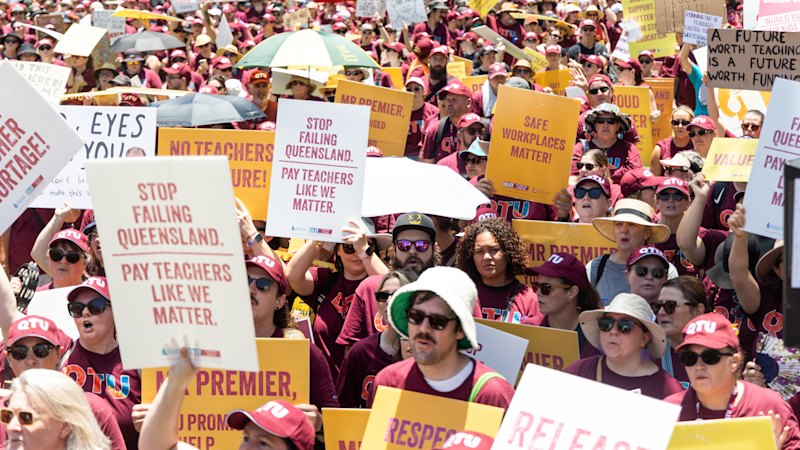
Queensland’s LNP is seeking to push beyond the efforts of its short-lived Newman-era state government to thwart industrial action by frontline public servants seeking to boost their pay and conditions, a series of unions and their peak body say.
Fronting parliamentary consideration of the Crisafulli government’s industrial relations system overhaul, the state’s teachers and nurses unions warned almost all action taken by their members last year – from wearing shirts to strikes – would have been outlawed.
Queensland Council of Unions legislation and policy officer Nate Tosh told Friday’s hearing that the proposal to allow the state or local governments to seek industrial umpire conciliation 28 days after the end of workplace deal went beyond previous laws.
As would powers for Industrial Relations Minister Jarrod Bleijie to terminate protected industrial action for grounds including disruption of public services or anything deemed to be contrary to public interest, and a ban on action while in conciliation.
The union peak’s general secretary Jacqueline King said while many of the changes sought in the bill were introduced under the Newman LNP government, “but they go further”.
“I think they’ve been clearly designed around trying to limit or thwart protected industrial action that various unions have been undertaking over the last 18 months,” King said. “Put simply, this bill risks silencing around 360,000 Queenslanders who deliver essential public services every day.”
“These reforms ... will begin to shift the balance back in Queenslanders’ favour ... while protecting important rights and entitlements.”
Deputy Premier Jarrod Bleijie introducing the bill to parliament last month
She noted that arbitration presently before the Industrial Relations Commission, a process that follows conciliation, has also seen the government seek to wind back award or existing enterprise agreement clauses citing productivity gains.
Bleijie, introducing the laws last month in response to a review he ordered of the state’s workers’ compensation and industrial relations scheme, said the bill would “begin to shift the balance back in Queenslanders’ favour” and align with the federal Fair Work Act.
The parliamentary committee running Friday’s hearing, after an earlier session with business groups and LNP-aligned worker bodies on Thursday, was told that despite this, the bill went further than the Commonwealth laws – particularly with the power to end industrial action.
Amid questions from government MPs seeking to tie the need to align with federal laws with alleged wrongdoing by the CFMEU, unions noted they are generally already subject to those rules and much behaviour in question was often carried out by those without those permits anyway.
Queensland Nurses and Midwives’ Union acting secretary Fridae King said her members never take industrial action that would harm patient safety, and a large portion of action taken by them last year to come to a deal with government would have been illegal.
This was because 40 of the 63 days of action – which included wearing campaign shirts or not emptying bins – was taken during conciliation. Under changes proposed to allow withholding a full day’s pay for any refusal to carry out duties, they could have also lost 63 days’ pay.
Queensland Teachers’ Union acting general secretary Brendan Crotty said the two strike days carried out by his members last year while negotiating workplace deal with government would have also been unlawful because they occurred during conciliation.
Public sector union Together secretary Alex Scott suggested the industrial commission be able to help with conciliation earlier, adding it already had powers to swiftly hear an argument and terminate an action if it risked the lives or safety of people.
Scott said because of this, the new power for the minister would only be needed for a situation where Bleijie may not like a decision by the commission, and would therefore want to effectively override the independent umpire.
Queensland Police Union president Shane Prior said his organisation would not accept the proposal to make it harder for first responders to make a PTSD-related workers’ compensation claim, something echoed by others including the Australian Workers’ Union.
AWU state secretary Stacey Schinnerl said a related move to raise the bar for psychological injury claims would disproportionately impact the public sector, and the government should not legislate its way out of responsibility to keep workers safe or address premium costs.
“It is diabolical in its proposition to make injured workers carry the cost of prevention failures while weakening their ability to bargain over the conditions affecting their safety,” Schinnerl said.
The government-controlled state development, infrastructure and works committee is due to report on the bill by the end of this month, ahead of the last parliamentary sitting of the year.
Start the day with a summary of the day’s most important and interesting stories, analysis and insights. Sign up for our Morning Edition newsletter.
KioskNews shows a cleaned-up reading view extracted from the publisher’s page — the original always lives on their site, not ours.