United Strings of Europe review – they’re the intersection in a Venn diagram of chamber music, string orchestra and jazz
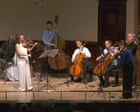
In this eclectic programme of mostly 21st-century music, the United Strings of Europe found the intersection in a Venn diagram of chamber music, string orchestra and jazz. At its centre, receiving its world premiere, was The Travelling Violin by the jazz bassist and composer Misha Mullov-Abbado. In four movements, it’s an almost-concerto on an intimate scale. The solo violin, deftly played here by Tamsin Waley-Cohen, has the narrating role, but the writing for the nine supporting string instruments is so intricately woven that it feels like an ensemble piece. It almost seemed strange for Waley-Cohen to give a solo encore at the end, mesmerising though her playing of Nicola Matteis Jr’s A minor Fantasia was.
Mullov-Abbado’s piece has a role for jazz bass, which he played himself, and for percussion, from soft-edged shimmering to driving, grooving drums, played by Fred Thomas; the jazz sensibility of both of these leaches into the rest. Led by the violinist Julian Azkoul, the ensemble was tight, churning over the tricksy rhythmic figures of the faster movements and radiating warmth in the third, which sounded like Cole Porter reflected in a slightly warped mirror. Mullov-Abbado’s violin writing is as gratifying as you’d hope for from the son of Viktoria Mullova, and his jazz-classical fusion hits an unusually effective sweet spot.
The programme had begun with the vibrant textural contrasts of Jessie Montgomery’s quintet Strum, followed by Last Round, Osvaldo Golijov’s tribute to the tango composer Astor Piazzolla famous for getting into fist fights: a tense, explosive piece with two quartets playing in clusters of pitches, as if wearing boxing gloves to a piano recital. Olli Mustonen’s Nonetto II was full of unabashed affection for the sound worlds of composers past, one movement coursing through Beethoven and Sibelius, another a glowing tribute to Schubert. Finally there was Boccherini’s Night Music of the Streets of Madrid. Starting with the cellos across the players’ knees, strummed like guitars, and taking in Azkoul’s own Arabic-inflected violin solo, this was a whistle-stop tour in which the presence again of Mullov-Abbado and Thomas gave the music character to spare.
KioskNews shows a cleaned-up reading view extracted from the publisher’s page — the original always lives on their site, not ours.