[Editorial] USFK commander must retract, apologize for denying Korea’s territorial sovereignty
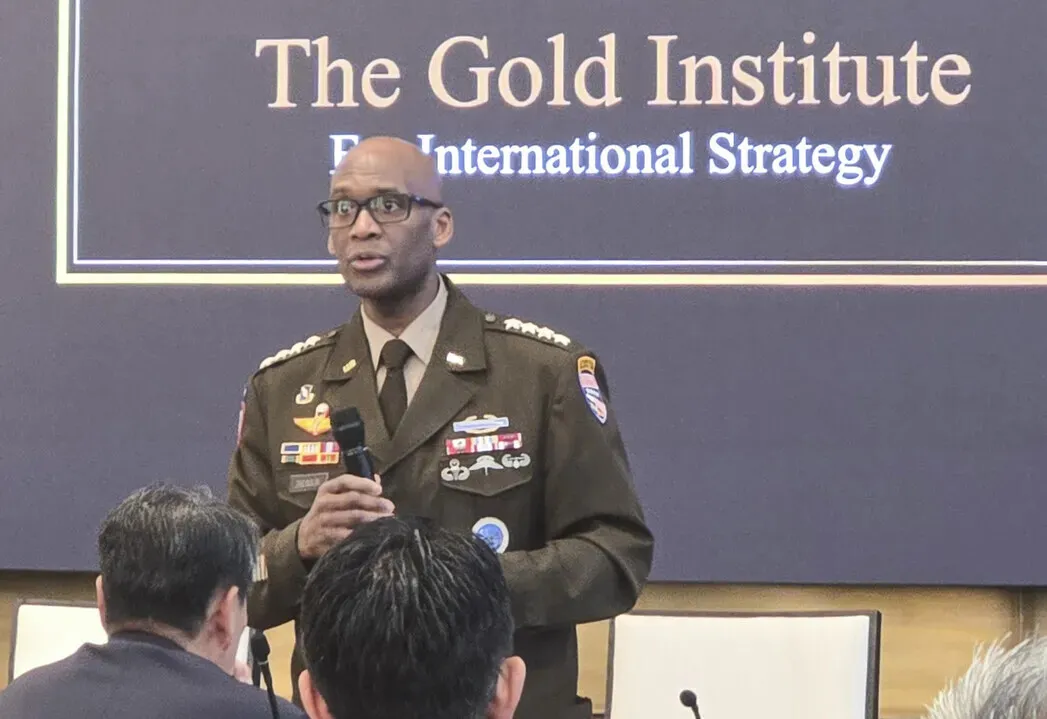
Gen. Xavier Brunson, the commander of US Forces Korea, speaks at the Indo-Pacific Regional Summit held in Washington, DC, on Oct. 14, 2026, by the Gold Institute for International Strategy. (Yonhap)
Gen. Xavier Brunson, the commander of US Forces Korea and the UN Command, has sparked controversy with his suggestion that the 2-kilometer-wide stretch of the Demilitarized Zone (DMZ) between the Military Demarcation Line (MDL) and the southern boundary fence cannot be considered sovereign South Korean territory because it is administered by the UN Command.
The idea is patently absurd, contradicting not only the Republic of Korea Constitution, which defines its territory as the Korean Peninsula and its surrounding islands, but also the 1953 Armistice Agreement signed by the US, North Korea and China.
Brunson made the remarks at a seminar hosted by the Gold Institute for International Strategy in Washington on Wednesday.
While referring to the southern portion of the DMZ administered by the UN Command, Brunson said, “We continue to have discussions about sovereignty and what does sovereignty really mean.”
“Where does the Republic of Korea begin and end? In my mind, looking at it through the lens of the United Nations Command, it begins at that southern fence line. That’s where the Republic of Korea begins because I administer that area in order to maintain a state of armistice.”
If the DMZ is not part of Korea, does that make some kind of extraterritorial enclave under US sovereignty, with Brunson presiding as colonial governor?
South Korea’s Constitution defines the country’s territory as encompassing not only the DMZ itself but also the area north of the MDL. Moreover, nothing in the Armistice Agreement designates the DMZ as a special zone beyond the reach of Korean sovereignty.
The “responsibility” assigned to the head of the UN Command under Article 1 of the agreement is limited to carrying out “civil administration and relief” intended to prevent military clashes and ensure the well-being of residents within the DMZ. It does not entail a transfer of sovereignty or confer extraterritorial rights.
This is not the first time Brunson has made problematic remarks. Last year, he described the Korean Peninsula’s geopolitical position as that of a “fixed aircraft carrier” between Japan and mainland China. He also likened Korea, as seen from China’s eastern coast, to a “dagger in the heart of Asia,” drawing a protest from Beijing.
More recently, he has created confusion over the long-discussed transfer of wartime operational control (OPCON) of the Korean military by declaring that “conditions have changed” and that there are “new standards,” taking a position at odds with that of the US government.
Brunson must retract his outrageous denial of an ally’s territorial sovereignty and apologize to the Korean government and people. How much longer will the US government tolerate an overseas military commander who undermines trust between allies and needlessly stokes regional tensions?
If Washington respects Korea as a sovereign equal, it must clarify its position to Brunson and take the necessary action.
KioskNews shows a cleaned-up reading view extracted from the publisher’s page — the original always lives on their site, not ours.