Defense company executives underscore autonomous capabilities at forum
Defense company executives at a forum yesterday touted the importance of Taiwan acquiring autonomous capabilities to reduce decision- making time during wartime and ensure the efficient use of resources in peacetime.
Speaking at the 2026 Aerospace and Defense Strategic Forum hosted by the Taiwan External Trade Development Council (TAITRA), Mira Resnick, a senior director at Saronic Technologies, noted that Taiwan could be vulnerable to China’s attrition-based tactics.
This vulnerability is based on the armed forces’ current approach which involves responding to daily harassment by Chinese navy and coast guard vessels, as well as maritime militia vessels operating in waters near Taiwan, by shadowing them with crewed navy and coast guard vessels.
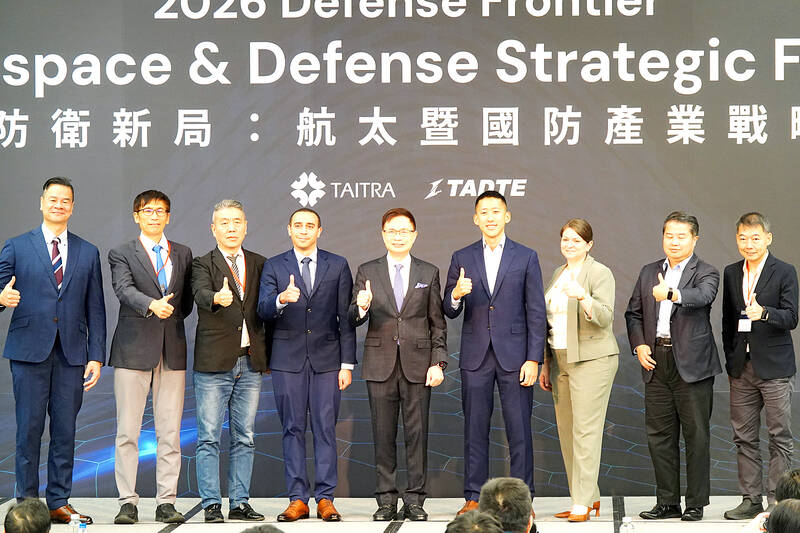
Mira Resnick, a senior director at Saronic Technologies, third right, poses for a photograph with Taiwan External Trade Development Council chairman James Huang, center, and other participants of 2026 Aerospace and Defense Strategic Forum yesterday.
Photo: CNA
“Every hour a corvette spends shadowing a militia trawler is an hour of hull life, fuel, and, scarcest of all, sailors,” said Resnick, a former United States deputy assistant secretary of state for Israeli and Palestinian affairs.
“Taiwan is spending its rarest resource on the least demanding mission. That is the attrition that is happening right now without a shot fired,” Resnick said, warning that China is attempting to fatigue the hulls and crews of Taiwan’s navy and coast guard by “normalizing its presence” in waters close to Taiwan.
Resnick noted that Taiwan faces a dilemma in deciding whether to acquire remotely controlled or autonomous unmanned surface vessels.
China has invested “enormously” in electronic warfare and counterspace capabilities and will target the datalinks of Taiwan’s forces in a war, she said.
“A remotely piloted vessel is a hostage to its link. Sever the link, and you have zero capability,” Resnick said.
She called for the deployment of multi-mission autonomous surface vessels with modular payloads alongside the approximately 1,300 one-way unmanned surface vessels (USVs) that Taiwan plans to procure.
Such vessels, Resnick said, can shadow China’s maritime militia instead of coast guard vessels, track the movements of Chinese vessels, and even provide targeting information for one-way USVs should China launch an amphibious invasion, offering Taiwan “a variety of options.”
Meanwhile, Alex Chang (張良治), head of Anduril Taiwan, said that on the future battlefield, commanders may have only seconds to understand an incoming attack and assign an appropriate weapon in response, yet “no headquarters can manually process every radar track, drone feed, electronic signal and targeting request moving across a contested battlespace at once.”
“This is why autonomy matters,” Chang said. “It can turn disparate systems into a coherent fighting force, one that is not paralyzed by missile strikes or electronic warfare.”
Autonomy would also distribute decision-making, enabling smaller units to operate independently and present an adversary with “more targets and more dilemmas than it can manage,” he said.
Chang said Taiwan should work to connect data across disparate systems so that it has an “integrated data layer” that can continue to inform decisions necessary to accomplish missions in degraded communications environments.
Chang said China is exploring ways to use artificial intelligence to “discipline, constrain, and replace” elements of human decision-making.
Taiwan should pursue the opposite model, giving commanders more options, junior leaders greater awareness, and individual units more freedom to innovate toward a shared mission, he said.
KioskNews shows a cleaned-up reading view extracted from the publisher’s page — the original always lives on their site, not ours.