Fuel surcharge to increase amid rising costs: CAA
By Shelley Shan / Staff Reporter


An international fuel surcharge for Taiwan-based carriers is to be raised for the third time this year due to the rising price of oil, the Civil Aviation Administration (CAA) said yesterday.
The surcharge for short-haul international routes is to increase from US$32.50 to US$37.50, while the surcharge for long-haul routes would rise from US$84.50 to US$97.50, the CAA said, adding that it has asked airlines to clearly disclose the changes to passengers.
The adjustment is based on a fuel surcharge mechanism established by the CAA and Taiwan-based airlines in 2005. The mechanism uses the international aviation fuel price announced by state-owned CPC Corp, Taiwan, as the benchmark.
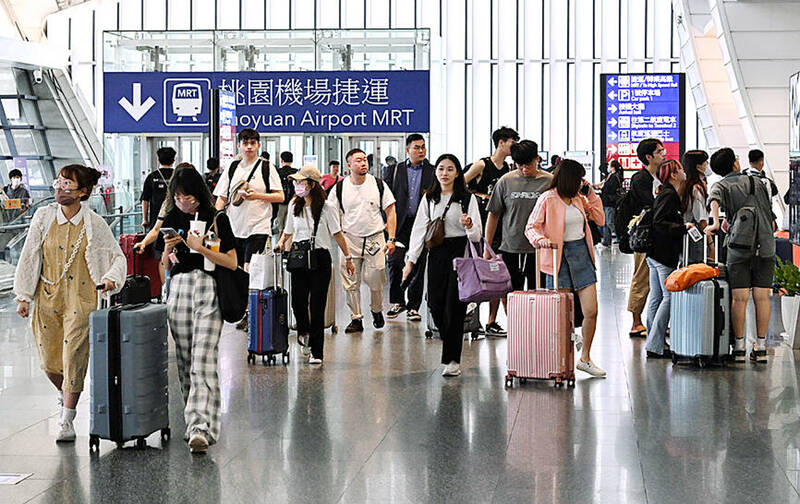
People walk from the Taiwan Taoyuan International Airport MRT line in an undated photograph.
Photo: Liu Hsin-de, Taipei Times
Under the mechanism, no surcharge is imposed when the fuel price is below US$40 per barrel. When the price reaches US$40, but remains below US$50, airlines may charge US$5 for short-haul routes and US$13 for long-haul routes.
For every additional US$10 increase in the benchmark fuel price, the surcharge rises by US$2.50 for short-haul routes and US$6.50 for long-haul routes.
CPC said its international aviation fuel price has risen from US$156.79 to US$177.89 per barrel, moving the benchmark from the 13th to the 15th pricing tier.
The latest increase follows two previous adjustments.
The first took effect on Aug. 9, when the benchmark price rose from US$133.29 to US$147.57 per barrel, moving from the 11th to the 12th tier. The surcharge was consequently raised to US$30 for short-haul routes and US$78 for long-haul routes.
The second took effect on Sept. 7, when the benchmark moved up another tier to the 13th, raising surcharges to US$32.50 for short-haul routes and US$84.50 for long-haul routes.
KioskNews shows a cleaned-up reading view extracted from the publisher’s page — the original always lives on their site, not ours.