‘Astonishing’: Music therapy ignites compensatory brain wiring in dementia
Mandy Noffs was many things. She was the mother of two boys, the chief operating officer of the Ted Noffs Foundation, a member of the Order of Australia for the youth health programs she established, and a right character.
“Mum had the most wonderful collection of sayings,” her son Rupert says.
There was: “You’ve gotta roll with the ponchos” and “We may be bohemians, but this time you’ve gone too far”, and Rupert’s favourite: “Do what you can and can’t what you can’t.”
But, before 2017, when Mandy was diagnosed with Alzheimer’s disease at 65, she was never a singer.
In the years that followed, she became less responsive and her memory deteriorated.
Rupert, 43, a cabaret singer, began singing to distract and soothe her when she became anxious and started asking the same questions repetitively.
To his surprise, Mandy lit up.
“She started singing things note for note, word for word, with harmonies, phrasing and an incredible musical memory,” he recalls. “It was quite astonishing. I realised there was this whole musical ability in Mum that we’d never really seen before.”
Music therapy is well known for providing comfort to people living with dementia, relieving common symptoms such as agitation, depression and anxiety.
But a new Australian study suggests it may have a more powerful impact in the brain than previously realised, altering neural wiring to compensate for dysfunction and even recruiting alternative pathways to help complete tasks.
Using a rare type of imaging called magnetoencephalography (MEG) to map activity in the brain, researchers from Swinburne University in Melbourne tested their hypothesis that targeted music therapy can improve cognitive function in people with dementia by targeting compensatory neural networks.
Lead author Dr Benjamin Slade reported participants improved their performance in tests after undergoing an eight-week music therapy program, which included singing tasks and playing individual tune bells as part of a group to the melody of Doggie in the Window as part of a performance.
“Broadly we saw there was a definite change in brain connectivity in each person after therapy,” he said.
“We found that change was directly linked to compensatory neural networks, where there was increased activity after therapy.
“We also found areas not associated with these networks were activated. We hypothesised these areas of the brain were recruited to help complete the task.”
While the study was small – with just six participants and a control group – and limited by health, recruitment and neuroimaging requirements, it’s important because it provides new clues into the mechanisms underpinning music therapy’s impact on cognitive symptoms of dementia.
The findings suggest music therapy could be used to awaken, and tap into, a person with dementia’s cognitive reserve, which is the brain’s accumulated ability to improvise, adapt and find alternative ways of solving problems when areas become damaged.
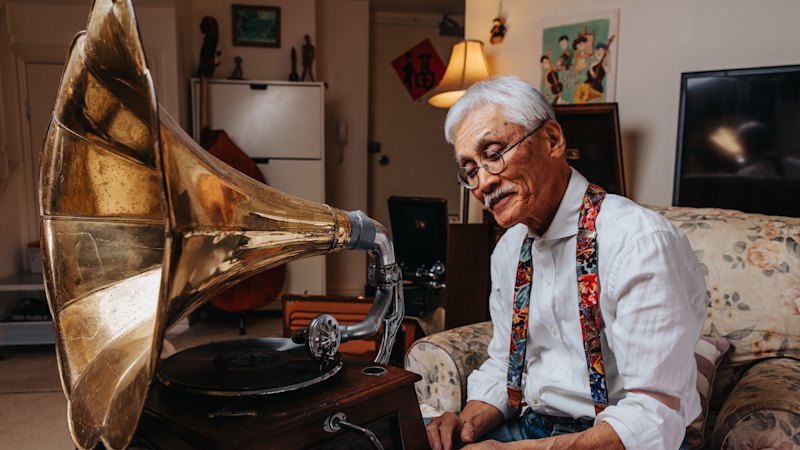
Musician Yoshi Masuda has seen first hand how patients with dementia respond when he plays them songs on his gramophone.
It can elicit “pure joy”.
For years, the 75-year-old has visited elderly residents in care homes on Sydney’s north shore.
He invites them to be physically involved with selecting a shellac record, winding the motor, replacing the needle and then watching the disc rotate.
“Surface noise, mechanical sounds and pauses for preparation form part of the listening experience,” says Masuda, a PhD student researching music and psychology.
Through this sensory ritual, he says residents often begin clapping or tapping along, laughing or responding to the lyrics such as You Are My Sunshine, Love Me Tender, and Que Sera, Sera.
Music, Masuda believes, taps into our emotional memory and is like speaking to our heart.
Active participation in music therapy is key to securing cognitive benefits for people living with dementia, according to the Swinburne study.
The research involved giving participants tasks, such as singing the lyrics of a known song but skipping words beginning with specific letters.
Delivered via a helmet fitted with sensors sitting in pools of helium within the scanner in a room with a vault-like heavy door, MEG imaging gives researchers an unparallelled view of electromagnetic activity in a brain.
Music therapist Dr Romy Engelbrecht, co-author of the study published in the journal biomedicines, expected positive results but said participants had also enjoyed the therapy.
“These people had real changes of behaviour,” she said. “If you go past the room and look in, it looks like everyone is happy and having fun but when you look underneath, what’s happening is quite scientific.”
Pharmaceutical options are usually first line treatments for dementia. Given music therapy can provide relief, improve quality of life and may have cognitive benefits at low cost and with no immediate side effects, Slade believes it should be considered as a frontline co-therapy.
“Music therapy is implemented a lot in aged care but it’s variable in how it’s delivered,” he said. “It needs to be targeted and active to be beneficial.”
Engelbrecht, who is also a clinical psychologist, said a challenge in therapy is prescribing music because it’s so personal. The study culminated in a handbell performance at an aged care facility.
“They learnt a handbell song – they had to remember the information, wait for their turn and then perform,” she said. “You could see their happiness and sense of accomplishment. On performance day, they kept performing over and over again, they were so happy.”
The study team is calling for further research to build on their findings and establish a stronger evidence base.
“There’s very little neuroimaging research relating to music or reminiscence therapy,” Engelbrecht added.
In Mandy Noffs’ bedroom, overlooking gum trees on the NSW Central Coast, the television plays music: George Michael, Tina Arena, the Beatles.
Her son sits by her bedside singing, and playing the part of the Vaudeville Dame. It’s a nod to his mother’s sense of humour and the Broadway shows they loved attending together when he lived in New York.
Even while he feels so much of his mother slipping away, music remains his way of connecting.
“Alzheimer’s changes so much about a person, but it doesn’t necessarily take away the essence of who they are,” he says.
“And perhaps that’s what music has shown us more than anything. Even when so much else has disappeared, there’s still something there.”
Make the most of your health, relationships, fitness and nutrition with our Live Well newsletter. Get it in your inbox every Monday.
KioskNews shows a cleaned-up reading view extracted from the publisher’s page — the original always lives on their site, not ours.