‘A win is a win’: Lapid claims opposition victory, urges patience in coalition talks
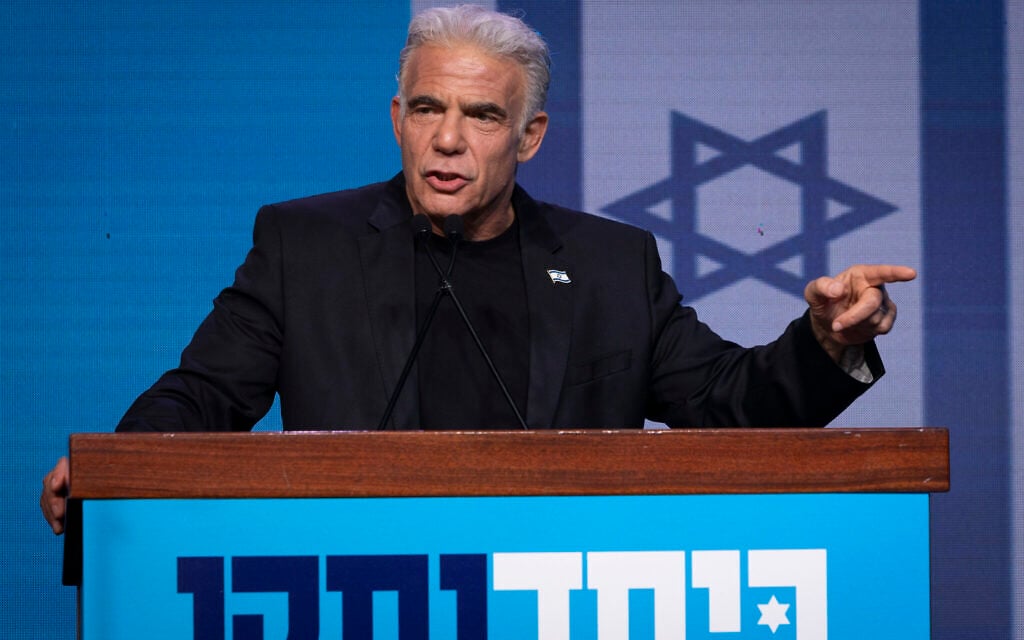
Outgoing opposition leader and B’Yachad No. 2 Yair Lapid declared Friday that the anti-Netanyahu bloc had secured “a win on points” in Tuesday’s election, despite not achieving a “knockout” victory, and he has asked the public for patience as it begins working to try and cobble together a government.
“On Tuesday at 22:00, we all stared at the screen and waited for one number. 61. It didn’t appear. Not for us, and certainly not for him,” Lapid wrote in a post on X Friday, referring to the number of seats needed for a clear majority in the 120-seat Knesset.
The anti-Netanyahu bloc received a combined 67 seats, which would be a comfortable majority if three of the four Jewish-led parties, Yashar, B’Yachad and Yisrael Beytenu, had not ruled out sitting in coalition with the predominantly Arab Joint List and Ra’am.
0:00 / 0:00
Promoted: Jewish Crossroads, Avi Issacharoff

Netanyahu’s bloc received 53 seats, and his Likud party is the largest one, with 27 seats, but he too has no clear path to a 61-seat majority.
Lapid acknowledged that Netanyahu’s opponents “wanted a clear, immediate victory, the kind you can go to sleep with. But that isn’t what we got.”
Get The Times of Israel's Daily Edition by email and never miss our top stories
By signing up, you agree to the terms
Still, he said the opposition bloc won in several ways.
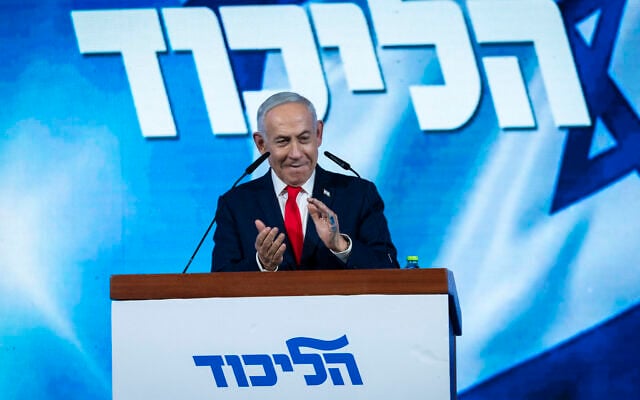
“Netanyahu received 53 seats. A collapse. And even within that low number, 13 of those seats belong to parties that consider themselves non-Zionist,” he wrote, referring to the ultra-Orthodox United Torah Judaism and Shas, which won seven and six seats, respectively.
“He is left with 40 [seats],” Lapid assessed. “That’s what he has. No matter what he does, he doesn’t have any way to form a government.” The parties in the pro-Netanyahu bloc, which comprise the current government, held 68 seats in the outgoing Knesset, so the results mark a significant drop.
“So we won,” he declared. “It wasn’t a knockout; it was a win on points. But points count too. A win is a win.”
The outgoing opposition leader said his bloc, led by Yashar chair Gadi Eisenkot, will do everything in its power to try and form a government, but said it will be “difficult,” and success is not guaranteed.
“So I need to ask you for something difficult to ask of Israelis: patience.”
Forming a government, he said, is the “exact opposite” of the election campaign process: “It takes place in small rooms, slowly, away from the cameras.”
“I know that human beings detest uncertainty, but consider how much you would hate to find out in a month from now that for the sake of a headline or a leak, we had failed to work smartly, quietly, or precisely.”
So, he said, “If you want to know whether anything is happening behind the silence you’re currently hearing, the answer is yes.”
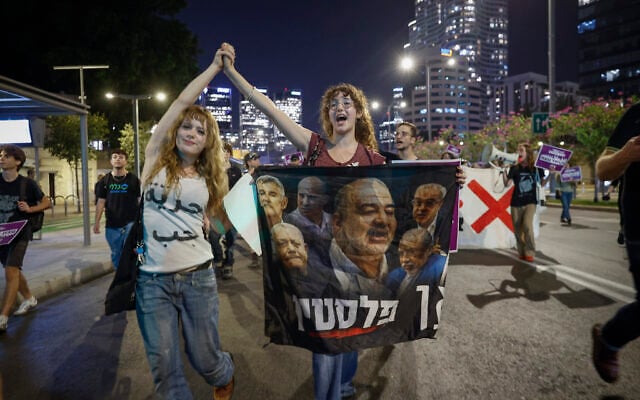
The Jewish-led anti-Netanyahu parties won 48 seats. The Arab-led parties — the Joint List and Ra’am — won 19 seats, an all-time high and almost double their current 10 seats in the outgoing Knesset.
Yair Golan, chair of the left-wing Democrats party, on Friday repeated his call for the Jewish-led opposition parties to work with the Arab-led parties and form a governing coalition, arguing that ignoring their combined 19 seats would be undemocratic.
“There are no conditional citizens in a democratic Israel,” Golan argued in an opinion piece for Haaretz. “A ballot cast on Tuesday by an Arab citizen in Sakhnin or in Rahat is worth exactly as much as a ballot cast by a Jewish citizen in Tel Aviv or Sderot.”
“Anyone who believes in democracy cannot fight for it in the morning only to then, in the evening, invalidate the voices of hundreds of thousands of citizens because of their origins or their names,” he wrote Friday.
Golan is the only head of a Jewish-led opposition party to express willingness to work with Ra’am and the Joint List. Yashar’s Gadi Eisenkot, B’Yachad’s Naftali Bennett, and Yisrael Beytenu’s Avigdor Liberman had all largely ruled out doing so.
Golan, whose party won eight seats in Tuesday’s election, met Thursday with Eisenkot, Lapid, and Ra’am chair Mansour Abbas.

The Knesset is slated to be sworn in on November 10, regardless of efforts to form the next government, which are predicted to be bumpy and could extend for more than two months.
Meanwhile, Netanyahu was also exploring his path forward.
The prime minister spoke this week with Finance Minister Bezalel Smotrich, leader of the far-right Religious Zionism-Zehut party, and National Security Minister Itamar Ben Gvir, leader of the far-right Otzma Yehudit party, as he weighs his options for forming a government, according to Ynet.
He reportedly sought to reassure them that he intended to keep the right-wing bloc together amid reports that Netanyahu could try to form a government with parties outside his current alliance.
“We are together and we are staying together,” the prime minister told them, according to the solidly pro-Netanyahu Channel 14.
Separately, Argentine President Javier Milei congratulated Netanyahu, whom he called his “dear friend,” on what he described as “the great victory” of the Likud party.
In a post on X Thursday, Milei wrote that the Likud “has once again become the leading force in Israel.”
While the Likud is the largest party coming out of the election, the bloc of coalition parties lost its Knesset majority.
“Once more, you have demonstrated the strength of your leadership, even in the face of polls and predictions against you,” Milei wrote. “Argentina and Israel will continue to be strategic allies against those who challenge our Western values.”
KioskNews shows a cleaned-up reading view extracted from the publisher’s page — the original always lives on their site, not ours.