Thousands protest crackdown on media in Turkey
Thousands on Saturday rallied in Istanbul and Ankara against what they described as growing pressure on journalists in Turkey, including arrests, media shutdowns and the appointment of state administrators.
Press freedom has been increasingly constrained in Turkey since a failed coup attempt in 2016, with sweeping prosecutions, digital censorship and accusations by the authorities that journalists are spreading fake news.
“Enough,” shouted marchers in the crowds, composed mainly of journalists, rights activists and opposition party representatives. “We can no longer breathe.”
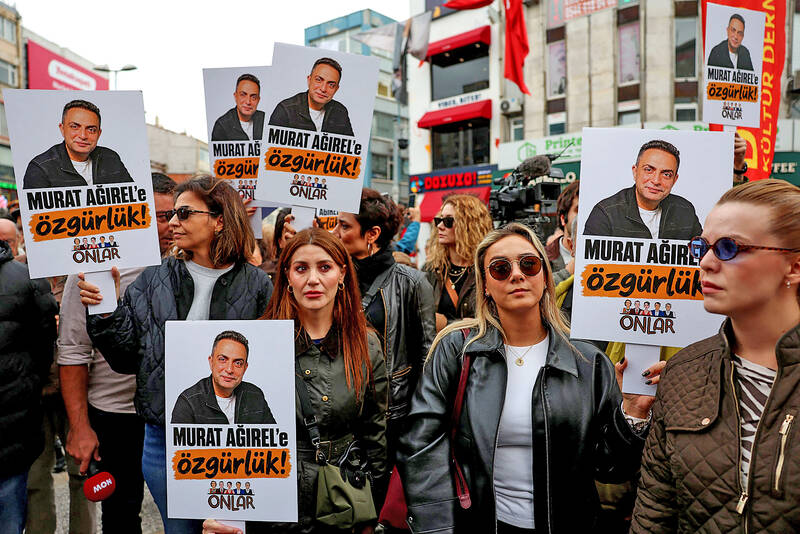
Demonstrators hold placards showing investigative journalist Murat Agirel, reading: “Freedom for Murat Agirel!” during a rally in Istanbul, Turkey, on Saturday.
Photo: Reuters
On the Asian side of Istanbul, protesters held up photos of jailed journalists, chanting: “We will not be silenced. Enough is enough,” and “We will not bow to pressure.”
Police said at least 3,000 participated in the Istanbul protest.
In Ankara, at least 3,000 protesters gathered, police said.
Past few weeks have seen what rights advocates say is mounting pressure on independent journalism.
The authorities have jailed 11 journalists in the past two months and shut down several media outlets, the Turkish Journalists’ Union said.
Earlier this month, police raided Turkey’s most-watched news channel, Halk TV, halting broadcasts and installing a government-appointed administrator.
The move was the latest against media outlets that are widely seen as critical of Turkish President Recep Tayyip Erdogan and his government.
It followed the closure of the Web site and social media accounts belonging to leading digital news outlet T24 over what authorities described as “LGBT propaganda.”
“This gathering is not simply about standing up for journalists,” veteran journalist Zafer Arapkirli said after the Istanbul protest.
“It is also about defending respect for society’s right to access information and news through journalists and independent media,” the BirGun columnist said.
For Arapkirli — who himself faces lawsuits — the more intense the pressure becomes, the stronger the response and the determination to stand against it must be.
“What the regime wants is to intimidate, silence and frighten society through such pressure — by arresting individual journalists, seizing media outlets, banning news coverage and blocking access to social media,” he said. “We must show that we will not allow this to happen.”
“We have done so up to now. I believe we are now moving towards demonstrating this determination on a much larger scale,” he added.
Turkish Journalists Union president Gokhan Durmus said there had been a change in the nature of “the government’s attacks” aimed at the media.
“If we look at the recent restrictions, access bans and trustee appointments, they have targeted some of the most widely followed and watched broadcasters, news channels and media platforms,” he said. “We are seeing a system emerge in which everything is uniform: one voice, one source of news, one centralized operation.”
KioskNews shows a cleaned-up reading view extracted from the publisher’s page — the original always lives on their site, not ours.