‘I can’t be the mum I want to be’: why does parenthood feel so impossible for millennial mothers?

Early one morning, feeling desperate, Katherine went on to her phone and asked ChatGPT how to make her life work.
She plugged in her work hours, her husband’s work schedule, the days she had childcare for her three-year-old, the school hours – plus before- and after-school care times – for her six-year-old; the flexibility her job offered her, the supports she had from grandparents, and asked AI if it could make things feel a bit better.
She told the chatbot that she wakes up between 5am and 5.30am, so she can “get the jump on the kids”. She might use this time to shower in peace, or start preparing her daughter’s lunchbox, or, if she’s really doing well, get a quick workout in. The children wake between 5.30 and 6am and from that time it is a mad scramble to get them ready to leave for school and daycare by 7am.
It is not the gentle start to the day that any of them would like.
“They come down and they want to have a cuddle on the couch, and I’m constantly like, I’m really sorry, I have to get lunch boxes packed,” Katherine says.
After the frantic domestic sprint, the girls head out the door with their dad, who drops them off on his way to work and picks them up at the end of the day.
“Then I have a very short amount of time to get myself ready and then I run out the door and my bus trip is, like, me calming myself down.”
At the end of the day, they do it all again but in reverse.
Katherine is describing her dilemma beside an overheated indoor swimming pool in Sydney, where our kids have lessons on the same weekday afternoon.
She and I don’t know each other outside of the context of swimming lessons but we both have six-year-old daughters who have started at local primary schoolsthis year and three-year-olds who take turns trying to bolt from the pool when they’re not feeling like the lessons spark joy, so we have fallen to talking.
And the subject of the impossible juggle of millennial mothers – broadly, those born between 1980 and 1994 – comes up; as it almost inevitably does when women of our age and stage get together.
Because while Katherine’s questions to ChatGPT may sound like desperate cries for help from a woman on the brink, the reality is, she is not an outlier.
Within minutes of meeting one another on the sidelines of football games, at daycare drop-offs and pickup from afterschool care, women pepper each other with questions. How are you doing it? What balls do you drop? Why does it feel like this?
‘You’re not getting to parent the way you always wanted’
Last week the spotlight was thrown on the economic toll of the juggle for today’s parents, with new research showing that the cost for Australian families of raising two or more children has risen to at least $36,500 a year. The cost of keeping a family afloat has increased by 134% in two decades, while household income has only grown by 102% in the same period.
Georgie Dent, the chief executive of The Parenthood, which published the research, says having children reduces the earnings of Australian women by an average of 55% over the first five years and that Australian families now need two incomes to stay afloat.
This is not hyperbole. In a fairly seismic shift for the country’s labour arrangements, both parents working full-time became the most common setup for households with children under 15 in 2024 for the first time. Despite this, Dent says, there is less give in family budgets. Meanwhile, the latest federal government intergenerational report warns that fewer Australians are expected to be having fewer children over the coming decades.
This economic reality is acutely felt, like a great oppressive scaffold, by Katherine.
After plugging all the variables of her life into ChatGPT, the suggestions that came back from the chatbot were impossible. It suggested she work from home – not an option – or part-time.
Katherine already works four days a week; doing any fewer days of paid work would mean the family would struggle financially. Her entire salary goes toward their mortgage. It used to cover the payments but, after the multiple interest rate rises, it no longer does.
“If I could go to five days, it’s a 20% increase, which is not nothing. I’ve been really tempted to do that.” It would, however, mean even less time with her children.
Going below four days a week would not only be a financial impossibility but mean she can no longer perform her job in a way she wants to, or in a way that would mean she is taken seriously. “I would be drowning and not worth employing,” she says.
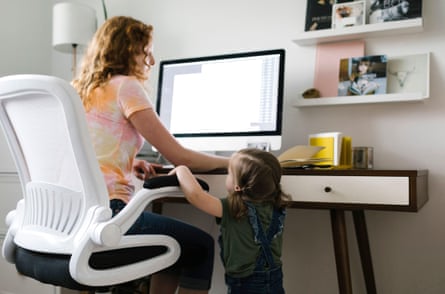
Eventually, the main thing that ChatGPT offered Katherine was sympathy and an unflinching mirror held up to her life.
“ChatGPT was like, ‘Oh, that’s interesting, what you just said is you’re not getting to parent the way that you always wanted to parent and … you’re limited and I think that that’s a really common experience.’”
The fact that a machine built to go out the furthest reaches of published human knowledge, synthesise all that information and return with diagnoses and a solutions could only offer her a blunt assessment of her life and no real answers broke her.
“I just sat there with tears in my eyes.
“It’s not that I want to be at home five days a week. I don’t want to be exactly like my mum was. But I want to pick them up from school and take them home and calmly wind down the day with them. There’s absolutely no way I can do that.”
A matter of time
While the rising economic cost of having children sits underneath everything like a great rotten foundation, for many Australians, it is just one part of the parenthood pinch. For many parents whose lives feel like a rubber band pulled so tight it is translucent, the stretch comes also in time and wellbeing.
According to a major study conducted by the Australian Bureau of Statistics, the most time-stressed group in the country were single mothers of children aged under 15, with 56% saying they were “always or often” rushed or pressed for time.
Having a partner scarcely seems to makes a difference to how extremely time-pressured mothers feel – 54.6% of women with children under 15 who have a partner report being time-stressed.
Men with young children have the highest rate of time stress (46.6%) of any group of men in the country. In couples with no children, the number of people feeling acutely pressed for time is about half of the number for their friends with children.
Because, despite the huge increase in women’s paid work over the last 60 years, today’s mothers are not doing less childcare. One of the findings that is repeated again and again across sociological research globally is that parents today – of both genders – spend more time caring for children than parents did midway through last century.
In one of the most comprehensive studies of the subject, researchers looked at data spanning 11 countries over nearly 50 years and found that in every single country the amount of time spent directly caring for children each day increased dramatically, on average doubling for mothers from 1965 to 2012 and tripling for fathers (though from a far lower base).
In Australia, men (and this data refers to all men, not just fathers) have increased the amount of time they spend caring – for children and disabled or elderly relatives – by half an hour a week over the last 20 years – 5.5 hours a week in 2022, up from five hours in 2002. But women still do nearly double the number of care hours as men, and have seen their care work increase too – spending 10.7 hours a week caring in 2022, compared with 10.1 hours in 2002.
Everyone’s workloads have gone up – women in the paid work sector, men’s at home, women’s at home – and there has been no counterbalancing drop in either men’s paid work or women’s care work.
‘The workplace is too greedy’
“It just feels to me like a lot of the Jenga pieces have been pulled out, one by one and the tower is tottering,” says Prof Lyn Craig, a leading researcher in gender dynamics and household labour at the University of Melbourne. “I think the pressures on young women particularly, but young people generally, are getting more and more.”
There is less economic give, which gives people fewer options to scale back paid work when care needs increase.
And while it’s more common for couples to assume that there will be a more equitable division of labour at home, the world has not changed to make that possible. “There hasn’t been enough attention paid, I think, in policy, as to how to lower the amount of time that is expected of households to be in the market now.”
after newsletter promotion
Craig says many people expected that as a result of women spending more hours in paid work, men would spend more time doing domestic labour. But while more than half of Australian women aged between 25 and 44 are now university educated, and volumes more are in paid work in ever more senior roles, that isn’t what has happened. The shifts at home have been far slower than the shifts in the workplace.
“I just think the workplace is too greedy,” Craig says.
Women are doing less housework than they used to but not less care work, even as they do more paid work.
“People just do more at the same time,” Craig says. ‘They just double up.”
This is because, as Craig writes in a paper from 2006: “Delegating the care of children is more potentially problematic than outsourcing other domestic tasks. Caregiving is a complicated mixture of work and love.
“Balancing the needs of children for nurture and the needs of women for independence without overloading women is the outstanding challenge of feminism.”
Twenty years after she wrote those words, I ask her, does she still see this as the outstanding, unmet challenge of feminism?
“I think it is,” she says.
‘Who designed that?’
In 1963, Betty Friedan identified “the problem that has no name” – a pervasive despair among white, middle-class US housewives who were trapped by expectations that their domestic lives would offer them total fulfilment. But 60 years on, the feminine mystique has flipped.
Millennial women, it seems, are not trapped by their homes but by an impossible expectation that they maintain everything – career, motherhood, partnership, self-care – simultaneously and without complaint.
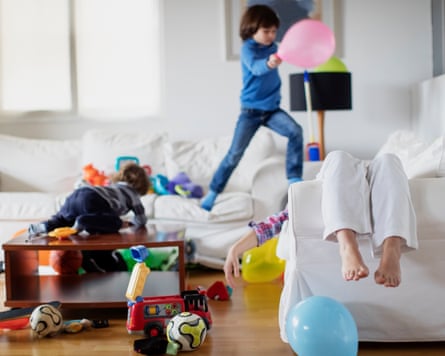
One of the hardest things about the problem for this generation of women is not that it has no name but that it feels like a problem with no solution.
A friend, who has a big job in government, a husband who frequently has to travel for work and a one-year-old who has been sick and not sleeping, texts me at 7.30pm one night to tell me that her five-year-old has been “one big giant meltdown this evening”.
I sympathise and ask if the five-year-old is now in bed and my friend can crash on the couch with ice-cream or wine and some trashy TV.
She writes back: “Seriously though – when do people do this? Teach me your secrets. I look around after bedtime and the house is absolutely trashed, and by the time we’ve dealt with it – definitely not CLEANED it or anything, literally just put away actual food items and spilled hazards, it’s time for bed!”
I respond with a picture of my living room, which looks as though someone has taken the contents of a laundry basket, a toy box and a nappy bag and Jackson Pollocked the floor with them.
“Current state of play,” I text back. “We have no secrets.”
“That’s the problem,” Katherine says as we wrap our poolside chat because a three-year-old who may or may not have urine trickling down a leg has emerged from the water and is shivering on the concrete in front of us.
“You’re just kind of making the same complaint to your friends over and over and no one has any idea how to navigate it aside from winning the lotto and then completely pissing off your career that you also care about.”
I have spent months collecting stories from mothers around the country and one thing that rings through all their stories is a common feeling of total overwhelm, of zero margin, that the house is made of cards and has been built too high and that the slightest gust could knock it all down.
“I’m now at a point professionally where I should be kind of at my maximum, like my peak professional moment,” says Annie (not her real name), a mother of two young children. “And I just feel jammed. I feel torn ... I can’t invest the time and the energy to deliver the professional product that I want to deliver and be the mum I want to be.
“It’s too much.”
As for how to solve the problem, for Annie, she says there is a need to correct what she calls “structural disasters”: the school hours that run from 9am until 3pm; the weeks of school holidays that dwarf any parent’s paid leave allowance.
“For crying out loud! Who designed that?” she asks. “Working men with stay-at-home wives designed that.”
Dent and her organisation The Parenthood propose policy solutions including longer paid parental leave and parental leave that men are incentivised to take alongside better access to affordable, quality childcare.
Annie says: “I actually think the other thing – which is much harder – is reducing the hours that people work and the expectations of what it means to be a good professional.”
In her industry, “success” is marked by a culture of long hours and visible busyness. Having a packed schedule and being busy beyond the telling of it. Maintaining a full but sustainable workload and doing your work well, but being home in the evenings for time with family, is not.
“I don’t know how you change that sort of cultural pressure.”
Despite the exhaustion, the financial pressure, the feeling that we are all furiously spinning our gears to keep our lives in motion the women I have spoken to do not hate their lives. They do not regret being mothers.
I am a millennial mother. I adore my children. If someone had been able to get me to feel the reality of what motherhood would be like before I ever became pregnant, I would choose to have these three delightful chaos agents again, without question.
Many millennial parents are living a life we dreamed of – with jobs and families we love and fought hard for. We are grateful for that but it is all far harder than we imagined.
Because equally, if, before I became pregnant, someone had been able to get me to feel the reality of what motherhood would be like, I would have said, surely we can do better than this.
KioskNews shows a cleaned-up reading view extracted from the publisher’s page — the original always lives on their site, not ours.