Chips, AI, and factories: Jaishankar’s blueprint to navigate unpredictable world
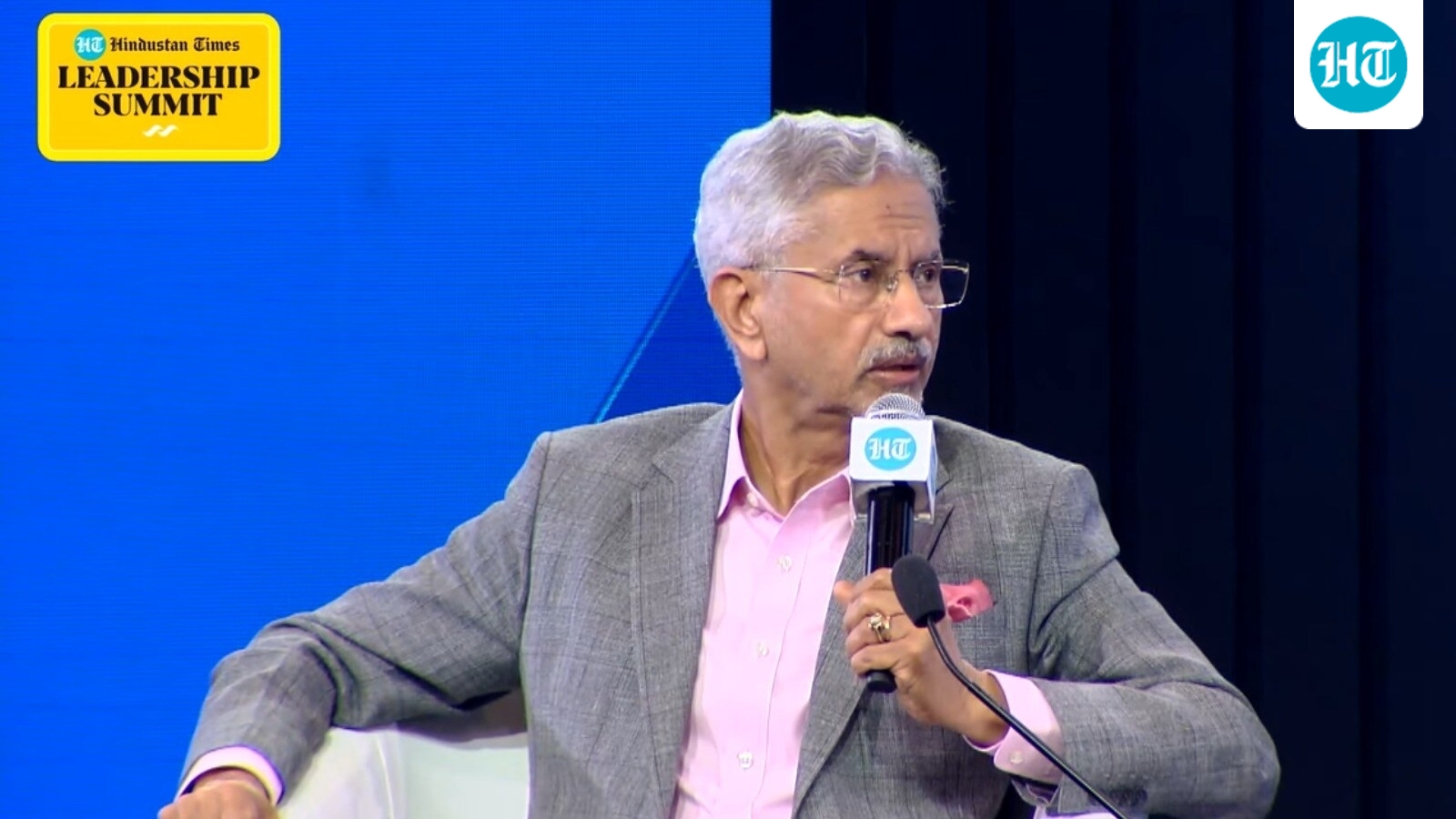
External Affairs Minister S Jaishankar on Saturday laid out a multi-tier blueprint for how India was navigating an increasingly fractured global order, asserting that India must make up for lost ground in traditional manufacturing while racing ahead in frontier technologies.
The minister said domestic economic initiatives such as Atmanirbhar Bharat, Make in India, were not merely economic policies, but "the building blocks of a foreign policy."
He was speaking to R Sukumar, Editor-in-Chief, Hindustan Times, at the 24th Hindustan Times Leadership Summit in New Delhi. The theme of this year's summit is "New Rules. New Realities."
Jaishankar said India had laid a very solid foundation over the last decade but stressed that it had "missed the manufacturing bus" in the past. Jaishankar pointed to the period from the 1960s to the 1990s as "lost decades," noting that even the 1991–92 reforms served only as a "partial correction."
To close that gap today, he highlighted the role of schemes such as the Production-Linked Incentive (PLI) in kickstarting neglected sectors and boosting small and medium enterprises (SMEs), backed by aggressive upgrades in physical infrastructure and logistics.
To remain competitive in the contemporary era, Jaishankar stressed that India must simultaneously invest in next-generation strategic pillars; scale up domestic capabilities in semiconductors, artificial intelligence (AI), and bio-life sciences, and expand educational institutions and vocational skilling to prepare the workforce for an AI-driven economy.
Speaking in the context of the shifting currents of global geopolitics, Jaishankar said, traditional alliances would become "less cohesive" and "more transactional," giving rise to a sharper, more self-centred competition among nations.
“It calls really for much stronger capacities at home. Which is why, for me, you know, when we speak of Atma Nirbhar Bharat or Make in India or, you know, innovate in India, these are for me the building blocks of a foreign policy because you cannot have an effective foreign policy in this era. I would argue in any era, but particularly in this era, without much stronger national capacities.
KioskNews shows a cleaned-up reading view extracted from the publisher’s page — the original always lives on their site, not ours.