‘Pak forgot we will meet again in final’: Mohit Ulva defends robust celebrations
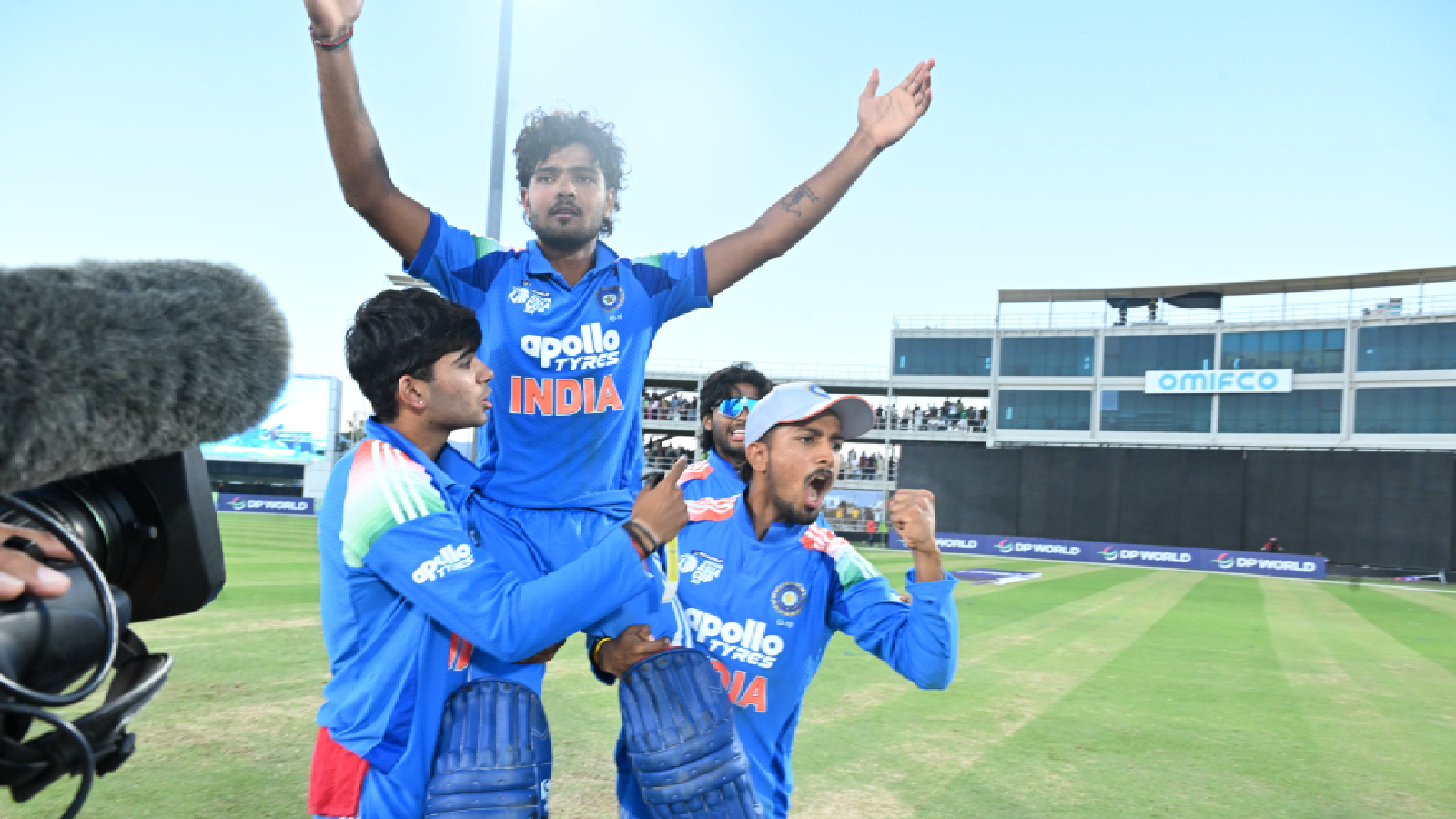
Mohit Ulva began as a bowler — first as an off-spinner, and then a seamer. When his coach Mahendrasinh Chauhan asked him to bat, the intention was to smoothen his path to the Indian side, given the paucity of seam-bowling all-rounders in the country. Mohit, however, had little interest in such elaborate career calculations.
“All I ever wanted is to bat like Virat Kohli. He is my idol,” he tells The Indian Express from Indore, where his domestic side Saurashtra are playing the Syed Mushtaq Ali T20 Trophy.
The 18-year-old was raised on Kohli’s silken cover drives and wristy flicks, his many centuries and, above all, the finest of his knocks reserved for improbable chases. On Saturday in Oman, the teenager produced one such knock of his own. Walking in at 252/8 in the U-19 Asia Cup final, with India needing 86 from 51 balls against Pakistan, Mohit’s unbeaten 49 from 26 took the team to a memorable victory.
The Indian players’ gestures after the win have been debated ever since. Some feel the theatrics crossed the threshold of sportsmanship. Others, among them Sharath Sridharan, a former chairman of the Junior Selection Committee, told this masthead that Pakistan cannot escape blame for their own provocative celebrations after the group-stage win over India.
Kohli, Mohit’s idol, had once offered a succinct philosophy on sporting rivalries: “If you give it, you gotta take it. Otherwise, don’t give it.” Was this, then, India ‘giving it back’ to Pakistan?
Mohit does not think so. “We did not mean to demean them at all. The celebrations were our way of expressing our happiness.”
For added context, one must go back to November 8, when Pakistan beat India by three wickets in the preliminary phase of the same tournament.
Story continues below this ad
“All of us were heartbroken after that defeat. It was a close game. Our bowling coach, VRV Singh, gathered us together and said, ‘The coaches have full confidence in you guys. We know the capability of our players, and we know that you are good enough to win the trophy.’ On that day, the entire team took a pledge: we would come to the same ground on the 14th, and on that occasion, we would return as champions.”
Speaking from the heart
In years to come, Mohit will master Swiss neutrality, with a measured stance and calculated soundbites. For now, his answers are unvarnished, his emotions still close to the surface.
“Obviously, there is heat in an India-Pakistan match. When they beat us earlier in the tournament, their celebrations were over the top. Perhaps they forgot that it was just a group-stage game and they had not won the trophy yet. Wo bhool gaye ki hum phir milenge (They forgot we would meet again). That defeat made us hungry for the trophy, so after realising the dream, the way we celebrated was completely natural.”
The target of 338 had looked insurmountable when Mohit walked in.
Story continues below this ad
“We never doubted our abilities. Even during the break, everyone was confident that we would chase it down. Our coach Yere Goud sir had said, ‘We bat till number 11 and the wicket is in our favour too, so we will be champions.’ Even when our number 11 Venkata came out to bat, I was never afraid of giving him the strike, because he bats at number six for his state,” he said.
“Actually, I believe Pakistan became overconfident after 337. They have a great bowling unit, so perhaps they thought there was no chance we would chase it down. But in our camp, we always knew what we could do it.”
Did the recent head-to-head record, with Pakistan winning five of the last seven youth ODIs, played on their minds?
“There wasn’t any pressure, but yes, Pakistan had an advantage. They had the edge going into the game not because of their record against us, but because they were a more experienced team. They had players who had already played in this competition.”
What, then, negated that advantage?
Story continues below this ad
“The belief that our coaches had in us, and the belief we had in God. Even when I went out to bat at 252 for eight, not a single player in the dugout thought the game was done. Goud sir told me before I walked in: ‘Back yourself and play your shots. I know you will do it,’
“Whenever I got balls in my range, I would hit them. My only focus was on timing the ball.”
India needed three to win off the final ball. Stepping out to leg-spinner Ahmed Hussain, Mohit’s boundary won India a ninth Under-19 Asia Cup.
“He was bowling quite fast, so I knew I had to step out to get elevation in my shots. I knew there would be one delivery in my range, and the last one was exactly that.”
KioskNews shows a cleaned-up reading view extracted from the publisher’s page — the original always lives on their site, not ours.