Max’s journey to the grave 113 years after death, via a doctor fleeing murder charges and an Australian museum
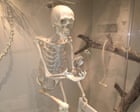
For almost 80 years, war hero Max Dreyssig’s skeleton was on display in a museum.
Pictures show him posed with one leg up on a small chair, a bird skeleton perched on his outstretched hand.
There’s a simple sign reading “Human: Homo sapiens” to mark him apart from the animal skeletons around him.
Earlier pictures show him sitting backwards on the chair, his arms draped jauntily over its back.
Generations of visitors to the South Australian Museum filed past this particular human, Johann David Max Dreyssig, a German immigrant who was finally buried on Saturday in Adelaide.
Dreysigg died of cancer, aged 62, in 1913 and gave his body to his eccentric doctor, Prof Archibald Watson. Watson had him reduced to a skeleton and sold him to the museum for £10 in 1920.
“We don’t know the conversations that Max had with Dr Watson on his deathbed in the North Adelaide hospital in 1913, but we do know what the laws were at that time, and we know that it wasn’t possible for people to donate their bodies to their doctors,” Anna Russo, the museum’s repatriation manager, said at his funeral.
Watson, the hospital and the museum would have known that, she said.
“Knowing Max’s story and that history, the museum had to think very deeply about what dignity and respect meant for Max.”
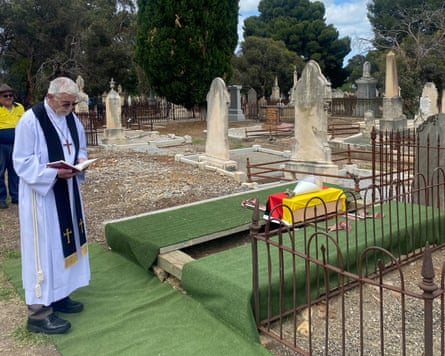
And so the museum and Adelaide’s German community worked together to tell Dreyssig’s story and to organise his burial at West Terrace Cemetery, in a small casket draped with the German flag.
A Lutheran pastor read the last rites before he was lowered into his grave.
That was followed by a wake at Adelaide’s German Club where a group of about 20 remembered his life, his death, and the long journey that came after that.
Dreyssig was awarded the Iron Cross for bravery after serving in the Franco Prussian War of 1870-71, and moved to Australia in 1885 where he became a crucial part of the German expat community.
“The deceased is one of the few surviving veterans who earned the Iron Cross … many will recall that he never failed to wear this decoration with great pride at patriotic celebrations in Adelaide,” his obituary read.
An article in the Journal of the Historical Society of South Australia in 1998 shows Dreyssig as a young man – author John Healey described him as a good-looking, slightly built man with dark, wavy hair.
Healey noted he was known for taking children on donkey rides on Brighton beach, that he had a grey mare called Marie, and that he once donated a dead penguin to the museum. Another time, he donated a locust.
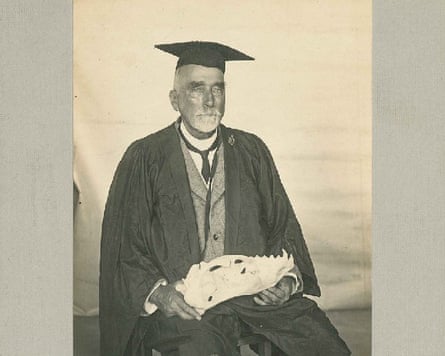
According to Healey’s account, he was suffering severe indigestion and lower back pain in 1913, and went to see Watson, who diagnosed him with stomach cancer.
Watson, a University of Adelaide anatomy professor, had been arrested for murder and blackbirding in the South Pacific, but slipped bail and went to Germany to study medicine.
“One of his particular passions was the collection of body parts from the operating theatre and post-mortem room, something he did not always do by the book,” Healey wrote.
He once replaced a torso with an umbrella to fool relatives at the viewing.
Healey speculates he carried out a “radical and untried” surgery on Dreyssig.
after newsletter promotion
Three weeks later, Dreyssig died.
Healey wrote that a museum taxidermist, Joe Rau, had “flensed” Max’s body and prepared the skeleton.
He quoted Rau’s son, Alan Rau, as saying that “Dreyssig sold – he donated [for] ten pounds – his body to professor [Archibald] Watson”.
“And when he did that, Watty brought it over to Dad and Dad made the skeleton.”
Russo and others worked with the SA German Association (SAGA) for months trying to find any relatives he might have left – there were none, and the family line had ended in 1960.
Max’s ‘rebirth’
Dr Ian Harmstorf, a historian and former SAGA president, told those gathered on Saturday that Dreyssig had had an “exciting life” and was quite successful in his work as an iron and steel merchant.
His skeleton was likely left in one of Watson’s cupboards as the first world war raged, Harmstorf said, then “sat unheeded” behind a curtain at the museum along with other bones, mostly from Aboriginal and Torres Strait Islander people.
“Next he appeared to have a rebirth,” he said.
“He was exhibited as a skeleton in a glass case. Later, he was moved and put in with the other skeletons and with other animals.”
Healey noted that Dreyssig was put on display in 1942, during the second world war, to teach students about human anatomy.
Then, in 2009, “Max almost caused a diplomatic insult” after a German visitor to the museum complained to the German government about the indignity Dreyssig’s remains had been subjected to, Harmstorf said.
Dreyssig was removed from display in 2019.
Dr Rob Saint, chair of the museum’s board, said the museum’s practices had fallen short “of the standards of respect and ethical responsibility to which we now adhere”.
“Sadly, and as a disturbing example of the different scientific attitudes and museum practices at the time [which were] not even legal, his remains were treated as a specimen, an object of scientific interest, as an addition to the museum collection,” he said.
“The story of Max Dreyssig reminds us that museums have a responsibility to consider not only our past actions, but more broadly … whose stories have been told and from what perspective, and how the people who feature in our stories have been treated.
“Max will now be remembered with a dignity he deserves. May Max now rest in peace.”
KioskNews shows a cleaned-up reading view extracted from the publisher’s page — the original always lives on their site, not ours.