Andy Burnham admits he would have liked more radical first budget
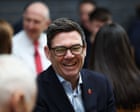
Andy Burnham has admitted his first budget as prime minister was not as radical as he would have liked because of the economic uncertainty facing the country.
He said he would have liked to have gone further with this week’s announcement – including with higher energy support payments – but felt hemmed in by external events such as the war in Iran, which has pushed up borrowing costs.
Burnham’s chancellor, John Healey, announced a range of relatively inexpensive measures on Wednesday, including a £100 payment for most households to help with energy bills this winter.
He has faced criticism for not doing enough on a range of issues including defence spending, welfare cuts and support for the cost of living.
Burnham told ITV: “The room for manoeuvre wasn’t what I would have hoped it to be. I guess then the question is, you know, radical within what we were able to do.
“It was quite a big call to ask the banks to repay the help they had off people 20 or so years ago. And a payment – OK, you’d like it to be more – but a payment to 20 million households is quite a significant step.”
Asked whether this was the budget he had wanted to deliver, he added: “I don’t think any prime minister and chancellor would say that, because a budget is by definition a very difficult thing.
“In the times that we’re currently in, I feel that the volatility of things means you just can’t necessarily deliver the budget that in an ideal world you would want to deliver.”
He said he wanted major changes to the benefits system that would prevent most young people having to claim benefits at all.
Burnham will spell out his plans for welfare reform in the coming months after two major reports on the system, one by the former minister Alan Milburn and one by the current minister Stephen Timms.
He told ITV on Friday the changes would not involve “brutal cuts” that would leave people in “absolute crisis”.
But he added: “I don’t actually want to see anyone in their 20s on benefits. I just don’t think that’s a good place to be, unless people can’t be in work for reasons due to disability or whatever else it might be.”
after newsletter promotion
Burnham came to office this year promising an end to “40 years of neoliberalism” and a plan for sweeping change of the economy, including higher taxes on wealth and nationalisation of major utilities.
So far, however, he has made a series of smaller announcements that he and Healey say are meant to give voters “breathing space” while the government works on more radical plans for the future.
They have included tax cuts on energy bills, lower bus fares and fines for people playing music out loud on their phones on public transport.
Kemi Badenoch, the Conservative leader, said on Wednesday: “Most people in the country, listening to that budget, will be thinking to themselves ‘is that it?’.”
Burnham told ITV he was limited not only by geopolitical crises but also by Labour’s 2024 manifesto, which helped propel the party to a landslide victory but ruled out major policy options such as raising income tax, national insurance or VAT.
“Obviously, when the time comes, I would seek my own mandate,” he said. “If you’re asking me a very direct question, if I had held the pen on the current Labour manifesto, would I have written it exactly like it is? Well, no is the answer to that question.”
KioskNews shows a cleaned-up reading view extracted from the publisher’s page — the original always lives on their site, not ours.