The 10 Most Powerful Anti-War Statements in Movies

Sign in to your Collider account
War is one of humanity's greatest tragedies and greatest failures. It's been a constant stain on our entire history, with conflicts being recorded for thousands upon thousands of years. Worse, it never seems to end, as humanity has yet to learn from its mistakes and continues waging war with itself, causing catastrophic and widespread death and destruction. It's, by far, our greatest irony, as we willingly create the thing that brings about our own demise, like a mouse inventing a mousetrap.
Since conflict has been so constant, many movies have tried to provide viewers with staunch anti-war messages, meant to show people the brutal realities of it by taking away the glamour that Hollywood often attaches to it. Sometimes, this falls flat, but others, it's so powerful that it can actually provoke a change in the viewer. These are the most powerful anti-war statements in cinema history.
'No Man's Land' (2001)

No Man's Land is a film set in the Yugoslav Wars during the 1990s. Specifically, it is set during the Bosnian War, during which the country of Bosnia and Herzegovina fought for independence from the now-dissolved nation of Yugoslavia. The war was one of the deadliest wars in Europe since World War II, with tensions running high between the three main ethnic groups comprising Bosnia and Herzegovina. In the trenches of the front, a Bosniak soldier is wounded and left for dead. Crawling his way through the mud and muck, he encounters an enemy soldier, a Serb fighting for Yugoslavia, who is also wounded. With their devastating wounds and no weapons, the soldiers form an unlikely alliance as they struggle to survive in the cramped conditions of the trenches.
The idea behind this movie is that we're really not so different: the only thing that divides us is imaginary borders and government administrations that tell us who the enemy is. At heart, war is a bunch of soldiers killing people that they don't personally hate. No Man's Land really emphasizes the senselessness of combat and how most wars are fought on behalf of corrupt politicians, not on behalf of the people actually doing the fighting.
'Waltz with Bashir' (2008)
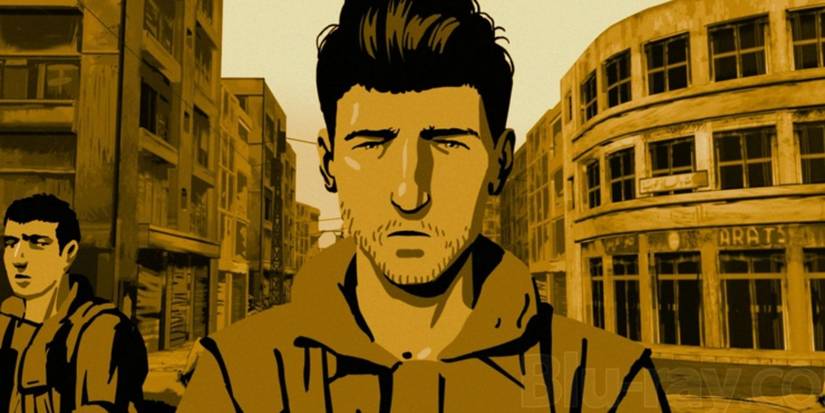
Waltz with Bashir is an animated documentary film directed by, written by, produced by, and starring Ari Folman, who served as a member of the Israeli military during the 1982 Lebanon War, an experience that left him immensely shocked and traumatized. In particular, he witnessed the Sabra and Shatila massacre, in which Israeli forces and Lebanese sympathizers slaughtered thousands of Lebanese and Palestinian civilians.
Folman speaks about the effect war had on him, how images of the massacre haunt him to this day, and how he became disillusioned with his country and its cause. He speaks about how he had to go through extensive therapy, yet the scars persist. The message here is not only that military forces commit injustice against civilians during war, but that people who fight in war can lose their sense of self and purpose, and rarely emerge from combat as the same person they were prior to their enlistment.
'Johnny Got His Gun' (1971)

Johnny Got His Gun opens up with Joe (Timothy Bottoms), an American soldier who wakes up in a hospital during World War I, having been struck by an artillery shell and blown to pieces. He has lost all four of his limbs, along with his eyes, ears, nose, and mouth. Despite the catastrophic external damage, his psyche remains intact. This means he is effectively a prisoner in his own body, unable to scream, express how he feels, see, hear, or even feel pleasure ever again.
Joe spends his days walking on the border between fantasy and reality, imagining how his life could have been if this stupid war hadn't ever happened in the first place, as well as what it was like prior to his conscription. Johnny Got His Gun shows how war can't just change a person psychologically, but physically, too, and makes the grim point that sometimes, dying in war is much easier than surviving.
'When the Wind Blows' (1986)

When the Wind Blows is an animated war movie that takes place in the United Kingdom. The movie revolves around an elderly couple living in the isolated English countryside, who begin to hear news that a nuclear exchange might be on the way. They do everything in their power to prepare for a potential attack, yet when the inevitable happens, they find that all their work isn't nearly enough to protect them. Alone and with no support system, they are more vulnerable than ever before.
The elderly are already a vulnerable demographic, and nuclear war only makes their situation so much worse. The worst part about this film is the earth-shattering silence: radio and phone lines are down, and the couple has no one to talk to but each other. When the Wind Blows displays how war only inflicts suffering upon those who do not deserve it, and how nuclear devastation can completely cut people off from the world, waiting in their homes for help that will never come.
'Grave of the Fireflies' (1988)

Studio Ghibli's Grave of the Fireflies is a deeply depressing animated movie that doesn't pull any punches. The movie stars two Japanese children, Seita and Setsuko, whose hometown is firebombed by American forces during World War II. Their mother is killed in the attack, and with their father away at war, they have nowhere else to go. They are forced to fend for themselves, having to deal with food shortages, malnutrition, and disease.
The siblings help from other people but receive none, as others are already stretched thin for resources as it is; they cannot afford to share what little they have with strangers. This movie actually covers the end of the war, too, and demonstrates how food shortages continued well after the conflict's conclusion, deeply impacting Japanese society and causing immeasurable tragedy. Grave of the Firefly's message is pretty moving, as it stresses how the innocent are always the ones who suffer the most during conflict, especially children.
'Beasts of No Nation' (2015)

Beasts of No Nation takes place at an unspecified time in an unspecified West African country entering a brutal civil war, with a child named Agu (Abraham Attah) stuck in the middle of it all. When his whole family is killed by the military, Agu is scooped up by a revolutionary group, since he has nowhere to go. The group makes him into a child soldier, leading him to witness things that no child should. There isn't much action in the film, as it's largely focused on Agu's journey and the abuse he receives from his Commandant (Idris Elba).
When Agu returns from the war and begins seeing humanitarian workers for therapy, he is hostile and angry; a sharp contrast to the kind and gentle boy at the beginning of the film. Beasts of No Nation tells viewers that no one will ever really know what it's like to be a soldier until they've been there themselves. On top of that, the movie doesn't specify which civil war it follows, because this remains a problem that is still going on. Child soldiers still exist, and it's an injustice no matter where or when it happens. It's a disheartening movie, to put it mildly.
'All Quiet on the Western Front' (2022)

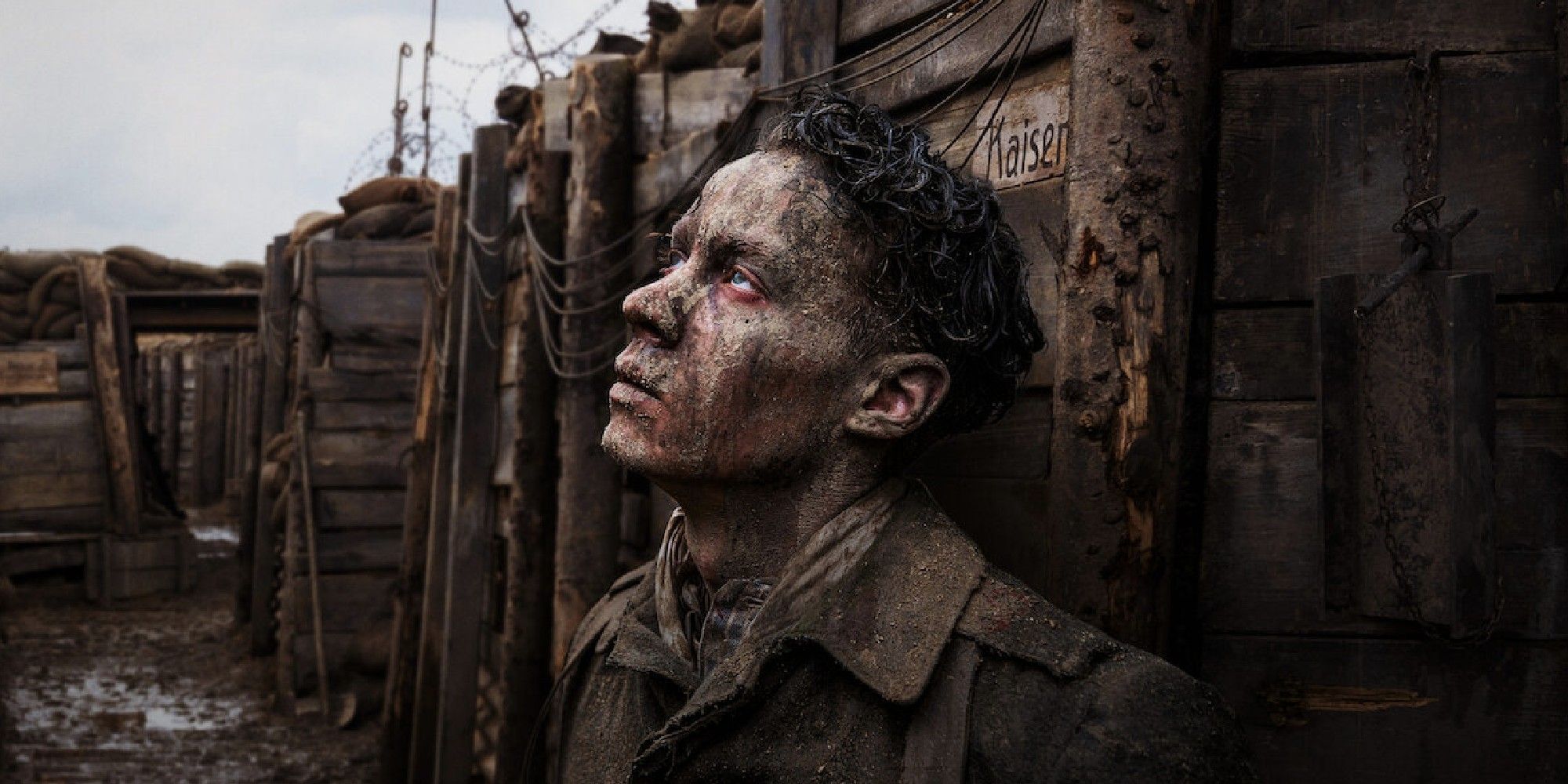
Netflix's All Quiet on the Western Front is the third film adaptation of Erich Maria Remarque's novel of the same name, which was based on the author's experiences serving in World War I. The movie stars Paul Bäumer (Felix Kammerer), a German youth who is fooled by wartime propaganda, volunteering for the war with his friends from school. When he arrives on the Western Front, he is greeted not with a great crusade or hero's welcome, but with torrential downpour, biting cold, and filthy living conditions. And that's just the tip of the iceberg, as he hasn't even seen live combat yet.
Paul gradually evolves from a bright adolescent with stars in his eyes to a traumatized veteran desperate for a way out. He is reduced to a statistic, and isn't even seen as a living, breathing human by his superiors. He is forced to abandon his innocence to commit terrible acts of violence, as well as watch the people he cares about die in front of him. Worst of all, the film's tragically ironic ending basically states that all the deaths that occur in the war are utterly meaningless. Most of the unfortunate victims of conflict died for no reason, while those who survived are psychologically damaged beyond repair.
'Come and See' (1985)

Come and See follows a Belarusian teenager named Flyora (Aleksei Kravchenko) as he witnesses the Nazis invade the Soviet Union during World War II. He desperately wants to join the partisans, against the wishes of his mother. Once he joins up, he is not treated as a soldier, but as a servant, which really disappoints him. But that's hardly comparable to the horror Flyora has to witness in the near future.
As he watches the Nazis invade his home, he witnesses them burn down villages, execute civilians, and commit unspeakable acts against a young mother. Flyora watches his village get ransacked and bombed, and he witnesses his comrades fall to German machine gun fire. Worst of all, the movie ends with Flyora walking away with his squad, like it's just another day in hell. Come and See became infamous for how it so accurately portrayed the horrors of war, showing a really ugly side of it that most movies refuse to.
'Salò, or the 120 Days of Sodom' (1975)

Salò, or the 120 Days of Sodom borrows the second part of its title from a book written by the Marquis de Sade, known for being extremely sexually disturbed, to the point that "sadism" was actually named after him. That alone tells people what they're in for. The film is set during the Italian Civil War, a smaller conflict that occurred concurrently with World War II.
Benito Mussolini's fascist dictatorship is in place and is violently suppressing all resistance. Among them is a group of 18 teenagers who endure despicable torture at the hands of four perverted but powerful men; the details of the ordeal cannot be spoken about here. The film is so distressing that it was banned in several countries and deemed to be "torture porn." However, it does have a distinct anti-war stance that shows what kind of wretched misdeeds innocent people endure during a war. It's not something that many films ever dare to speak about, which is what makes Salò that much more powerful.
'Threads' (1984)
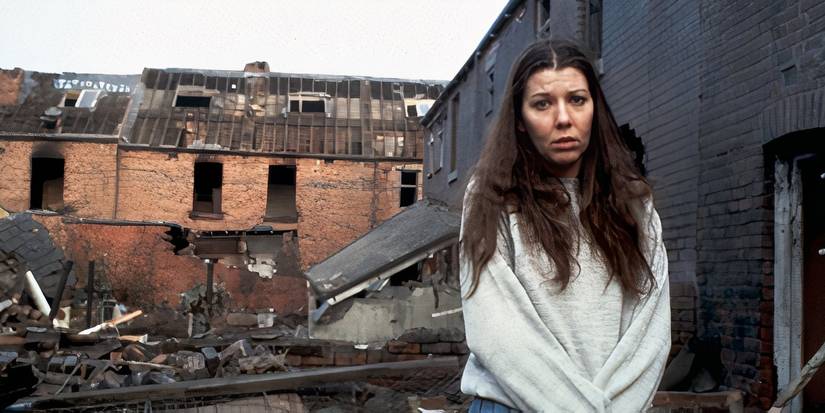
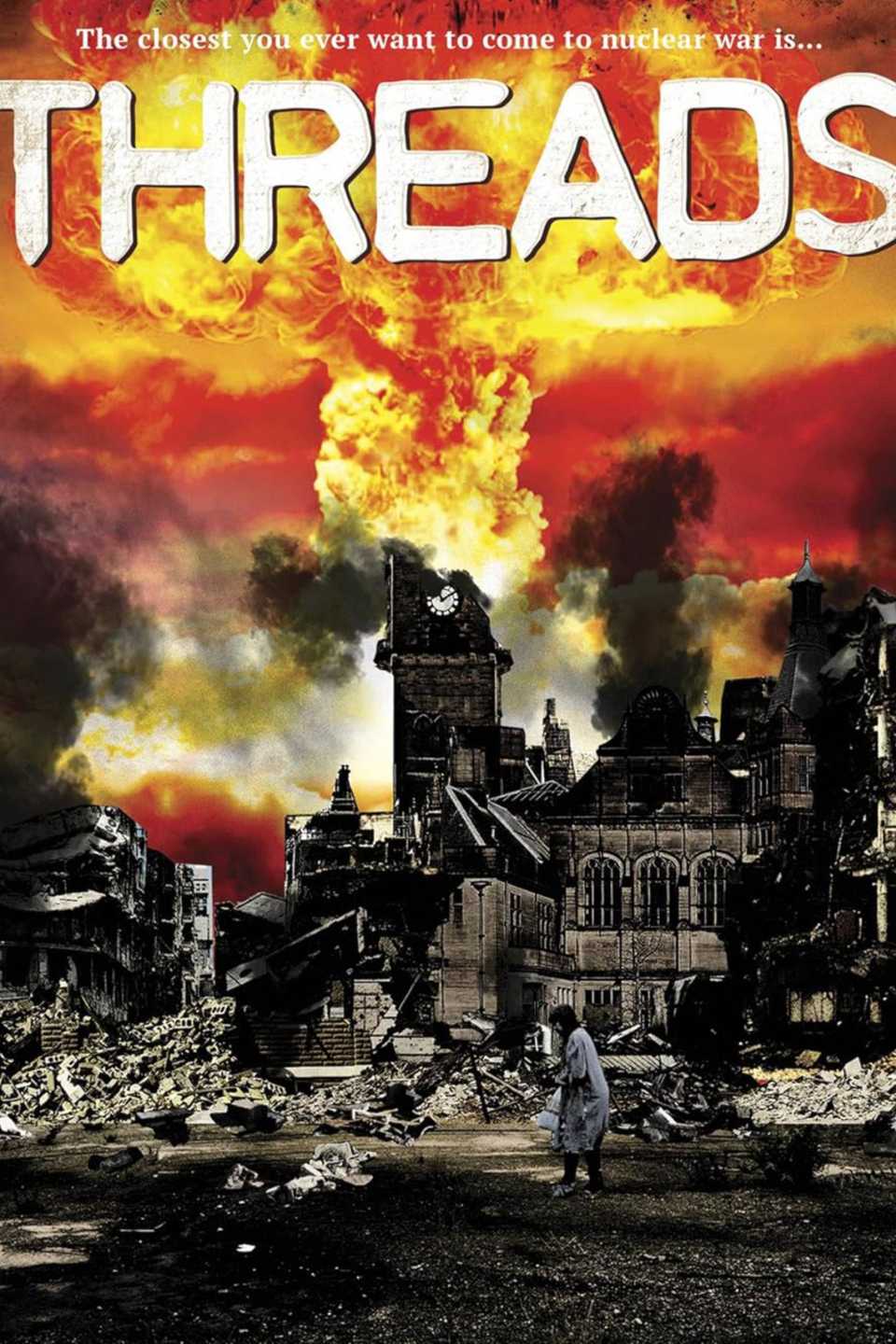
September 23, 1984, was the day Threads premiered on the BBC. It was also known as "the night Britain didn't sleep," because of how profoundly terrifying this movie is. The movie came out during the Cold War and showed what would happen if the conflict actually resulted in a nuclear exchange. The lens is focused on the city of Sheffield, England, where a young couple is caught right in the middle of the devastation.
Threads not only shows the immediate aftermath of the nuclear war, but the effects decades down the line: how language and culture are lost, how there is a desperate struggle for non-contaminated food, made even more difficult by the nuclear winter, and how society completely crumbles. The movie ends on an immensely depressing note, along with a message beseeching the world powers to disarm their nuclear arsenals. It makes the point that after a nuclear war, there is no hope for the future: it will be the end of us all. As bleak as it sounds, Threads implies that the lucky ones during the conflict were the ones who got vaporized in the blasts. It's a deeply disturbing film that will scar even the most steadfast viewers; its message is that powerful.
Threads
- Release Date
- September 23, 1984
- Cast
- Karen Meagher, Reece Dinsdale, David Brierly, Rita May, Nicholas Lane, Jane Hazlegrove, Henry Moxon, June Broughton
- Runtime
- 112 Minutes
- Director
- Mick Jackson
- Writers
- Barry Hines
- Main Genre
- Thriller
KioskNews shows a cleaned-up reading view extracted from the publisher’s page — the original always lives on their site, not ours.