Business sentiment cautious: TIER
VISIBILITY SUBDUED: The more cautious sentiment does not necessarily signal deterioration in growth, an economist said, urging investors to wait and see
By Crystal Hsu / Staff reporter


Taiwanese business sentiment turned slightly more cautious about the economic outlook as uncertainty over US politics and the prospect of US Federal Reserve rate hikes clouded expectations for export orders and investment next year, despite robust demand for artificial intelligence (AI), the Taiwan Institute of Economic Research (TIER, 台灣經濟研究院) said yesterday.
The institute’s composite index for the manufacturing sector fell 2.85 points to 98.94 last month, and that for the service sector dropped 2.09 points to 90.13, while the construction index edged up to 109.39, highlighting diverging conditions across sectors.
“Uncertainty over US policies following the midterm elections and financial market pressure from further Federal Reserve rate increases are the two biggest concerns,” TIER economist Gordon Sun (孫明德) told a news conference in Taipei.
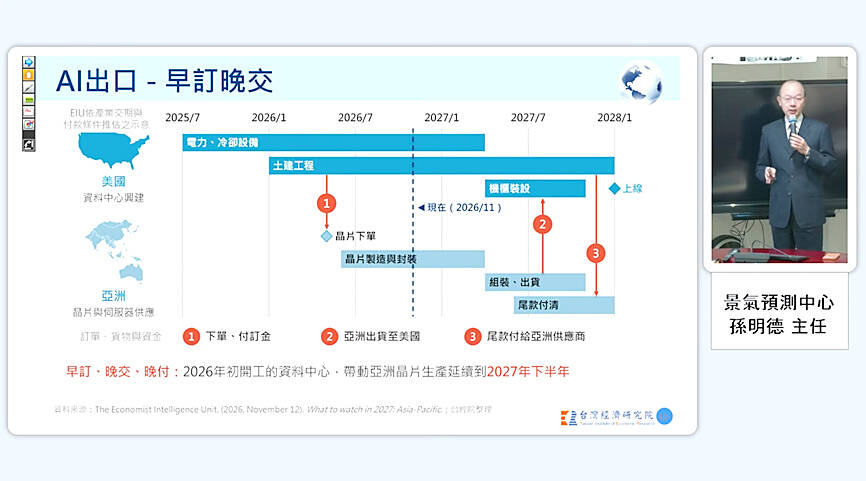
A screen grab from the Web site of the Taiwan Institute of Economic Research shows economist Gordon Sun speaking at a news conference in Taipei yesterday.
Photo courtesy of the Taiwan Institute of Economic Research
Businesses are watching whether export orders can sustain their strong momentum and whether political developments in the US would disrupt investment in AI infrastructure, Sun said.
The more cautious sentiment does not necessarily signal deterioration in economic growth prospects, he said, urging businesses and investors to adopt a wait-and-see approach rather than becoming overly concerned.
Manufacturing sentiment remains supported by robust global demand for AI computing power, Sun said.
Although tighter reviews of data-center projects by some US states could slow the development of new facilities, most projects scheduled to begin operations next year are already in the construction phase, the TIER said.
That should sustain near-term demand for AI hardware and keep capacity utilization high at Taiwanese wafer foundries, advanced packaging facilities and high-end testing providers, the institute said.
Meanwhile, the service sector faces a different mix of pressures, it said, adding that department store anniversary sales and holiday spending provided support for retailers, but financial market volatility weighed on financial services providers.
Expectations of further US rate increases, concerns over rising debt among cloud service providers and a sharp technology stock selloff contributed to a decline in the TAIEX last month. The downturn in the stock market also pushed securities firms’ proprietary trading operations into losses, the TIER said.
Construction businesses remained relatively optimistic about the six-month outlook, supported by technology-related factory projects and higher government infrastructure spending planned for next year, despite labor shortages and elevated costs for building materials and earthwork disposal, TIER Taiwan Industry Economics Database director Arisa Liu (劉佩真) said.
However, the residential property market is expected to remain subdued, as Taiwan’s central bank is unlikely to broadly relax credit restrictions, while mortgage rates remain elevated, and banks continue to face competing demands for lending funds, she said.
Housing demand next year is likely to be driven mainly by owner-occupiers, with the market expected to go through a period of consolidation before staging a modest recovery, she added.
KioskNews shows a cleaned-up reading view extracted from the publisher’s page — the original always lives on their site, not ours.