Riding wild animals and selling crafts at a prison rodeo
For most of the year, Kevin "Country" Gildhouse and Travis "Buckethead" Johnson are prison inmates serving a life sentence without parole. But sometimes, they don cowboy hats and spurs for a rodeo dubbed "the wildest show in the South"
Through good behavior, around 1,000 incarcerated men at Louisiana State Penitentiary, the largest maximum security prison in the country, earn the right to several privileges, including the option to participate in the Angola Prison Rodeo. Outside the prison walls, the rodeo has elicited charges of exploitation. But inside, the incarcerated men say it's a chance at a fleeting moment of freedom during their life sentences.
"You're free. You're not in prison. You're just out here competing"
Gildhouse remembers being scared to death when he was taken to the Louisiana State Penitentiary nearly two decades ago.
"I'm about to go to the place they say I'm gonna die in," he said.
Gildhouse grew up in what he described as a broken family. He was in foster care and "bounced through probably about 72 homes throughout my childhood."
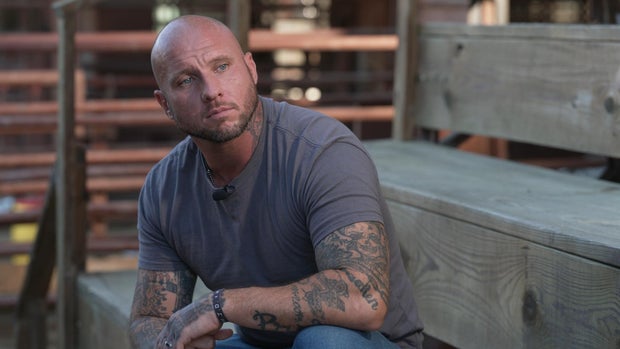
At 19, he was sentenced to life without parole after he was convicted of killing a cab driver in a botched robbery. To this day, Gildhouse thinks about the man he killed, and while he feels he could never ask for forgiveness from the man's family, he does believe he's been forgiven by God.
His life today is very different — especially during the Angola Prison Rodeo, held each year during one weekend in April and on Sundays in October. Gildhouse and other incarcerated me ride wild horses and bulls in front of thousands of spectators.
"Those few hours that you're out here, you're free. You're not in prison. You're just out here competing," he said. "You're out here with other guys who are gettin' in the mud with you and bleedin' with you. And we love it. We're not forced to do anything here."
Inmate John Corley, editor of an award-winning prison magazine called "The Angolite," said the rodeo helps incarcerated men find purpose so they can endure.
"You take a guy who has no real chance of getting out and no hope, give him something to do," Corley said. "Make him feel like he's somebody and is accomplishing something, and you've got a whole different guy."
Johnson: The man to beat
Johnson, the reigning champ, is the man to beat. He grew up in rural Louisiana, but became addicted to drugs after his family moved to the city of Thibodaux, about 55 miles southwest of New Orleans. Johnson has two first-degree murder convictions from almost three decades ago.
To this day, he feels he is unable to talk about what happened.
"Cause it's somethin' that you cannot change," he said.
Yet he's brave enough to get on the back of a wild horse or bull.
"It's that moment of accomplishment," he said. "It's a moment of bein' almost weightless."
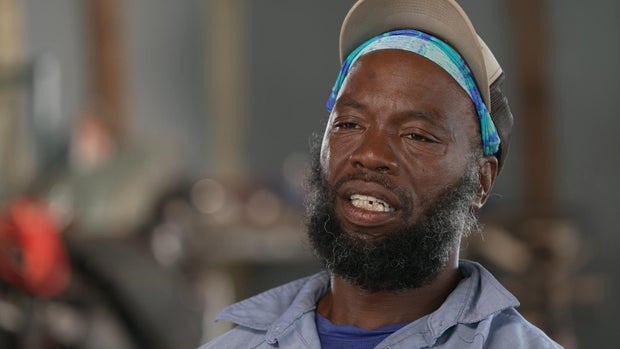
Johnson remembers a rodeo spectator asking him why he was doing "all that crazy stuff."
"'I know how you might see it right now, but it's a whole lot better than how I used to get my money,'" he remembers saying. "'Right or wrong, when I go out there nobody's family's cryin'. I'm not takin' from anybody to get what I earn.'"
During an October rodeo, Johnson snatched a poker chip worth $500 from between the horns of a bull. Afterwards, he leapt onto the stands, radiant, waving to the crowd.
"I've been rodeoin' a long time, and I know that these people are just as happy as I am that I actually pulled it off," he said. "I did it, but we did it."
Palmer calls riders "constructively insane," sticks to selling crafts at rodeo
Riding bulls and horses isn't for everyone. Kenny "300" Palmer, serving life without parole after being convicted of killing a man in a drug deal almost 20 years ago, sits out the competition.
"Me, I call 'em constructively insane. But I tilt my hat to 'em, not I," he said. "But, I mean, some dudes, they was raised for that, you know? And it's good for a lot of people, you know, 'cause everybody needs some type of, you know, way to vent in here, man."
Instead of riding, he makes chessboards and beaded necklaces to sell to visitors at the rodeo.
"It gives you a chance to be creative. It gives you a chance to make money," Palmer said." Like my mama said. 'Find something to occupy your mind.'"
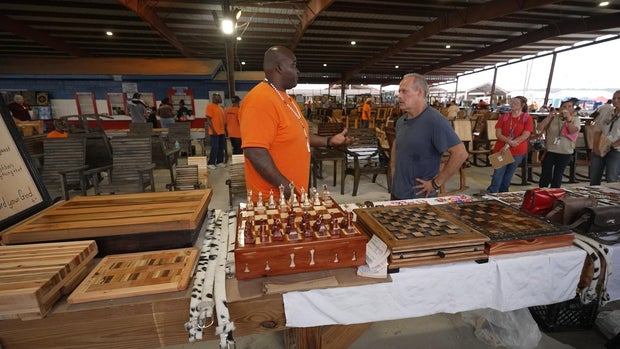
He made $87 on the day 60 Minutes visited. Some men stood at their tables all day long and sold nothing. While riders keep every dollar they win, craftsmen pay 11% to the prison.
Once he earns enough, Palmer plans to send the money to his niece and get her to open a brokerage account so she can learn about financial literacy.
For Palmer, one of the best parts of the rodeo is that family can visit and sit with him for the day.
Some of the incarcerated men find new family in the visitors.
"You got guys that met wives, out here," Palmer said. "They done married, you know?"
How Palmer explains it? "You get blessed, man. God work in mysterious ways."
KioskNews shows a cleaned-up reading view extracted from the publisher’s page — the original always lives on their site, not ours.