‘Big business’: little-known court system in Louisiana churns out thousands of evictions – and millions in fees for judges

When she arrived at the justice of the peace court on a rain-soaked morning, Marchana Watts hoped she could fight off her landlord’s push to evict her and her five children from their trailer home on the outskirts of Baton Rouge.
Watts, a careful record keeper who earned $20 an hour as an insurance analyst, came to Justice Tracy Batieste’s small courtroom with receipts. They showed she had paid her $950 monthly rent for the past year and a half, she said.
But when her case was called, Watts said in a complaint to the state judiciary commission, her evidence was “COMPLETELY IGNORED by the ‘judge’. She did not print out all of my documents and didn’t allow me to properly present them.”
Within a few minutes, Watts recalled in a later interview, Batieste moved to the issue of a court fee, instructing the manager of her trailer park to pay up.
He handed the justice a folded bundle of cash with a hundred-dollar bill on top, Watts said. “She stuck it in her robe … And then she was like: ‘You have 24 hours to move.’”
Watts had been evicted from her home by a little-noticed judicial system that orders thousands of evictions in Louisiana each year.

Inside Louisiana’s justice of the peace courts, evictions often move swiftly, landlords rack up wins, some judges earn outsized incomes – and housing advocates say tenants’ fundamental rights are at risk.
The state’s 390 justices of the peace work part-time – ruling on evictions, small claims and wage garnishments as well as, in happier moments, performing weddings. They are required to have only a high school diploma and their courts do not need to keep detailed records or follow standard rules of evidence. They are paid directly by the fees their court charges, including court costs in eviction cases that can total $150 or more.
In court documents and interviews, tenant advocates and legal experts say the interplay between fees and justices’ personal income creates conflicts of interest that can incentivize them to evict tenants and win the favor of landlords who bring in cases and fees.
“Why would landlords prefer to go to a justice of the peace court?” said Bradley Benton, a former legal aid attorney who has defended Louisiana tenants in eviction cases. “It’s faster. It’s cheaper. And it’s easier to evict.”
Eviction fees helped the justice of the peace in one part-time suburban court earn more compensation last year – over $400,000 – than the chief justice of the US supreme court earns.
That justice of the peace is one of five who earned more than $220,000 in a single year from filing fees, much of it derived from eviction cases. Renters are frequently compelled by their leases to pay court costs back to a landlord following evictions.
One longtime justice of the peace calls some of these courts “big business”. A clerk for another justice told a tenant’s lawyer that “we are a for-profit court”. A legal expert described a justice of the peace court in a New Orleans suburb as an “eviction mill”.
The Guardian’s nine-month investigation draws on analysis of more than 11,000 pages of eviction records and 3,400 financial disclosure forms as well as deposition testimony, recently unsealed investigative evidence and documents released under public records requests. The reporting also draws on dozens of interviews with justices, tenants and housing attorneys, and the observation of eviction hearings at five justice of the peace courts in the Baton Rouge and New Orleans metro areas and in St Tammany parish.
“I believe this system is blatantly unconstitutional,” said Lisa Foster, a retired California appeals judge and the former director of the office for access to justice at the US Department of Justice. She pointed to a more than century-old US supreme court precedent, which found that a defendant’s rights were violated if their case was heard before a judge with a direct financial interest in the outcome. “Without question, the Louisiana justice of the peace system has failed its citizens, yet no one seems to be taking action.”
This scrutiny comes as Louisiana’s state government has quietly backed this court system with new laws that expand these justices’ authority, while at the same time passing a law that carries possible jail sentences for homeless people.
In Louisiana and across the US, millions of tenants are struggling as the overall cost of living continues to soar – and rents and junk fees charged on top of rents have surged amid shortages of affordable housing. Roughly one out of every 13 renter households faced eviction filings in 2025, according to research by Princeton University’s eviction lab covering 10 states and dozens of metro areas.
When landlords seek eviction, renters are often at a disadvantage because of their limited finances, lack of understanding of the eviction system and, frequently, lack of legal representation. Studies around the country often show that less than 5% of tenants have lawyers to fight for them in eviction cases, while more than 80% of landlords typically have attorneys on their side.
Uneven playing fields in the eviction process can put additional strains on renters already struggling to get by – piling on court fees, moving charges and other costs and, studies show, harming families’ mental and physical health.
Louisiana, one of the poorest states in the US, offers some of the weakest legal protection for renters in the nation. A first-of-its-kind data analysis conducted by the Guardian found that the eviction filing rate within the jurisdiction of the busiest justice of the peace court was nearly three times the national average. The rate of legal representation for tenants in this court, according to documents reviewed by the Guardian, could be as low as 1%.
The Louisiana Justices of the Peace & Constables Association and the state attorney general’s office did not answer a series of detailed questions from the Guardian for this story.
In a recent public statement, the Louisiana attorney general, Liz Murrill, said the state’s justices of the peace “play a vital role in serving our communities and upholding the rule of law” and “providing access to justice close to home”.
Praying for strength
After the short hearing in Justice Batieste’s court concluded in July 2024, Watts left in tears.
She had moved into the three-bedroom trailer home after the death of her sister to be closer to her only remaining sibling. It was cramped and damp. But it was a stable place to live.
The eviction order, tacked to her door earlier in the month, had come as a shock. She had tried to find free legal representation, but Louisiana’s eviction process – which generally requires just 72 hours notice before an eviction case can be heard in court – was so fast she did not have enough time.
Black women, like Watts and the majority of renters interviewed for this series, face greater risk of eviction than any other demographic group, according to numerous studies.
Watts said she suspected her eviction was an act of retaliation. Her property manager, who had stood before her in court that day, had made continued, unwanted sexual advances via explicit images sent over text message and knocks at the door past midnight, according to Watts and records seen by the Guardian. In her written complaint – which was part of a tranche of recently unsealed records obtained by the Guardian – she told the state judiciary commission that the manager had “emotionally and mentally abused me”.
There was no chance to discuss that in court.
Batieste did not respond to multiple requests for comment from the Guardian. In an interview with the judiciary commission in February 2025, she asserted that when she ruled on Watts’s case there were “some materials that were missing that kind of had a question mark on them”.
Under state law, Watts had 24 hours to vacate her home. She borrowed money to book a removal van and rent a storage unit to keep her possessions. She found a place for her boys to stay, moving 50 miles south to the rural town of Donaldsonville, which sits on a stretch of the Mississippi River and is surrounded by chemical plants.
For the next four weeks she slept in her car, parked nearby in the driveway of her late grandmother’s abandoned home. She prayed for strength each night before falling asleep in the back seat.
“It was a lot,” she recalled. “But I had to stay strong for my sons.”
Swift justice
Justice Chuck Cusimano II’s courtroom sits off a tight corridor on the sixth floor of a tall government building in the New Orleans suburb of Harahan. A slight man with wavy gray hair, he has been the elected justice of the peace for Jefferson parish’s fifth district for almost 20 years. He previously served as a district court judge and a state legislator.
Eviction hearings begin promptly at 9.30am on Tuesdays and Thursdays, usually wrapping up before midday. A large clock adorns the left-side wall of the courtroom and wooden public benches are separated by sheets of hard plastic.

On a recent June morning, as the clock ticked a few minutes before 9.30am, a cluster of landlords and property managers lined the benches, waiting to appear before the judge.
“He’ll be done with this whole docket in 30 minutes,” quipped one representative for a local leasing company. “He’s fast!”
“I love that!” replied a property manager, also awaiting her turn.
The Guardian observed five separate eviction dockets at Cusimano’s court throughout June and July, witnessing the speed with which cases were heard, almost always resulting in a judgment ordering a tenant to vacate their home within 24 hours.
On that morning in June, Cusimano ran through 11 cases in 14 minutes. Two days later, on 18 June, the morning after a tropical storm hit New Orleans, flooding parts of the city and downing trees across roadways, he heard 86 cases in 36 minutes. All but one resulted in a judgment of eviction.
Over the sessions observed by the Guardian, the tenants ordered to leave their homes included single moms, cashiers, healthcare workers and law enforcement professionals. Some had fallen behind on rent because they had been laid off from their job or missed time from work because of illness.
The majority of the cases, though, resulted in default rulings in favor of the landlord after a tenant did not appear in court. Louisiana, like nine other states, allows landlords to issue leases that waive a tenant’s right to a notice period following a missed rent payment, meaning an eviction summons can be filed almost as soon as someone falls behind. In contrast, Washington DC requires 30 days’ notice and Vermont 14 days – providing tenants more time to find legal representation, scrape together additional funds or negotiate payment plans with their landlords.
After Cusimano had issued several judgments at a hearing on 2 June, he joked with the landlords in the public benches: “No more tenants? Then we’re winning!”
The small group of renters who showed up at Cusimano’s court on the morning of 18 June included Leroyalnika Pierre, a 24-year-old single mother who works at a Waffle House and as a part-time hair stylist. She sat in the waiting area, holding her two-year-old son, waiting for Cusimano to call her name. It was her first time facing eviction and she did not know what to expect.
As she heard her name called, amid the flurry of activity, the case began before she had even made it to the judge’s bench.
“Did you pay your rent?” Cusimano asked, after the court heard from a property manager at a rental company named 1st Lake Properties, who said she owed $1,395.


“No,” she replied, her voice barely audible. “I was waiting on them to fix my place.”
Justice Cusimano immediately ordered the eviction, informing Pierre she could not withhold payment over the conditions of her apartment, but could sue 1st Lake, one of Louisiana’s largest rental firms, separately over the issue. Pierre, like almost all others that day, had no attorney. Her hearing lasted less than a minute.
“He wasn’t even trying to hear the reason why I hadn’t paid,” she said later. Her apartment was infested with termites, she claimed in a brief interview after the hearing.
During an interview, Cusimano acknowledged the speed of his hearings but said he always allows tenants to articulate a defense.
“I don’t think I’ve ever told anyone they couldn’t be heard,” Cusimano said. “I do stop them when the stories go off on a tangent that has nothing to with the eviction, including … when they start to tell me that they were laid off. I’m not trying to be rude to them, but being laid off has nothing to do with their contract.”
He added that Louisiana law does not allow a tenant to simply stop paying rent if they have a termite infestation or other maintenance problems. If the landlord doesn’t fix things after they have been informed in writing, he noted, the renter can hire someone to make the repairs and withhold part of the rent to cover those costs.
When Louisiana’s current governor, Jeff Landry, was attorney general in 2020, his office released a document that lauded justice of the peace courts for “providing constituents with an often faster and less expensive avenue to justice”.
‘A very good living’
The volume and speed of eviction cases heard by Cusimano help explain how, in 2025, his court raised revenue of just under $1m in fees, of which Cusimano directly retained $380,929, records show. That amounted to over $63,000 more than US chief justice John Roberts earned in salary last year. Cusimano has earned more money in fees alone than the nation’s chief justice in six of the last 10 years. He is also paid an additional $21,600 in parish salary, taking his earnings to more than $400,000 in 2025.
“I made a very good living last year,” Cusimano, whose court’s jurisdiction spans just over 25 sq miles, acknowledged in a recent interview.
“I am not embarrassed for the work I do,” he said. “And I think that I do the exact same work as every other justice of the peace in this state for each case. I happen to have more.”
“It’s my location. It’s the numbers,” he explained. “… I have a lot of apartments in this district.”
Cusimano’s court charges at least $150 for filing an eviction – the maximum allowed by statute for justice of the peace courts that employ a clerk. Like other justices of the peace, he is entitled to keep roughly half of that amount. In some cases the court also charges an additional $60 fee for a writ of ejection, a separate order allowing the court’s constable to physically evict a tenant and their belongings from premises. A justice and their constable – an elected official who enforces the court’s decisions and also keeps a portion of filing fees – are entitled to an even split of the ejection fee.
Because justice of the peace courts are not courts of record, there is no digital record of case dockets or proceedings, making the sheer volume of eviction cases, their outcomes and who brings them almost impossible to track.
To do so, the Guardian spent three weeks inside his courtroom, and manually scanned more than 11,000 pages of eviction records from June 2025 to May 2026, to understand how these cases are handled. The records were kept individually stapled inside stacked document boxes at the side of the justice’s bench.

Data analysis by the Guardian revealed that Cusimano’s district had an eviction filing rate of almost one in five renter households per year, which would rank third out of the states and cities tracked by Princeton’s eviction lab. In the 12-month period ending this May, Cusimano’s court ruled on nearly 3,300 eviction cases. Some were handled by his son and daughter, who occasionally serve as “ad hoc” justices, records show.
The analysis also found that eviction fees were responsible for the majority of Cusimano’s salary and that 98% of the eviction filings in his court were for nonpayment of rent.
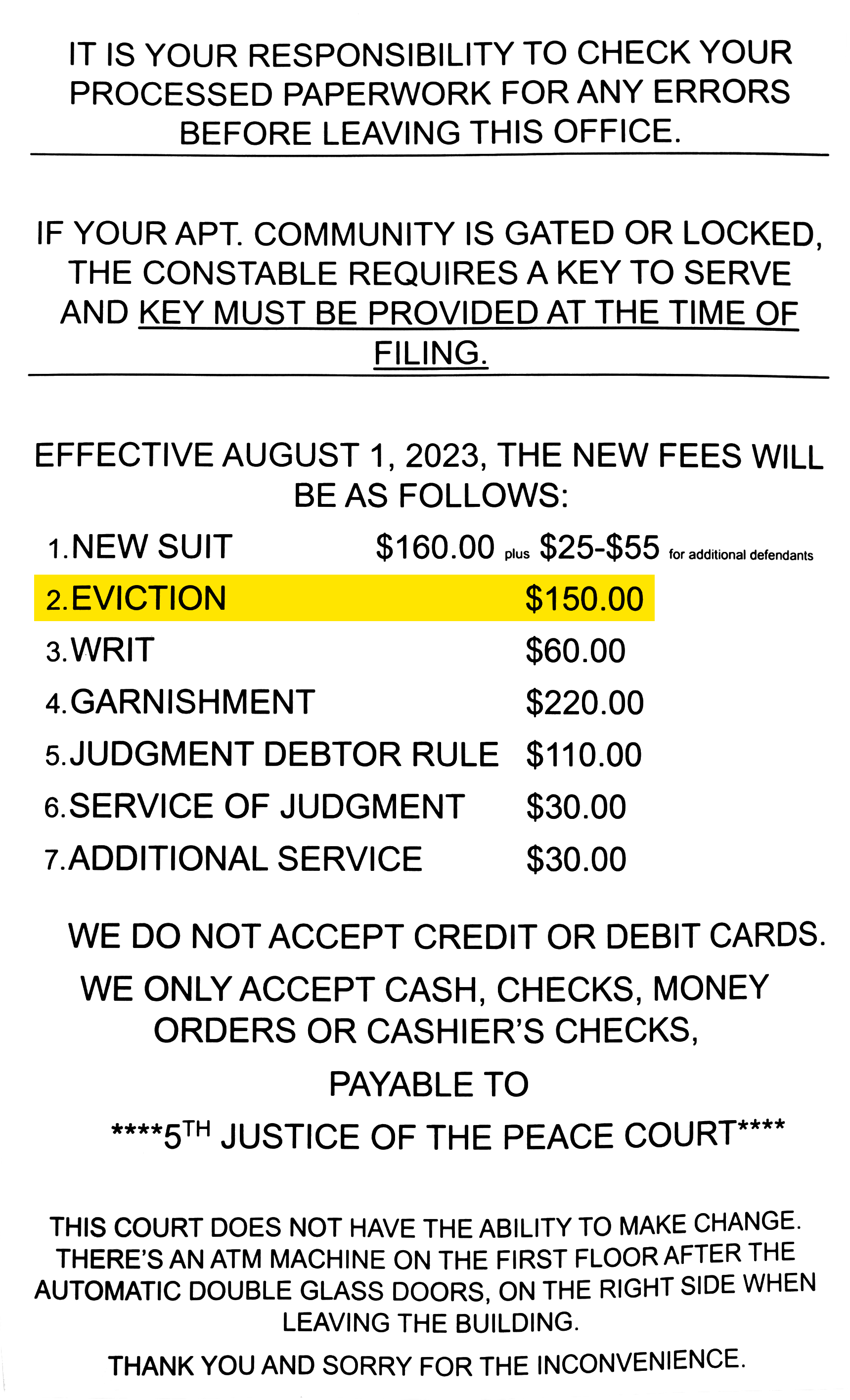
It costs at least $150 to file an eviction in the fifth justice court.
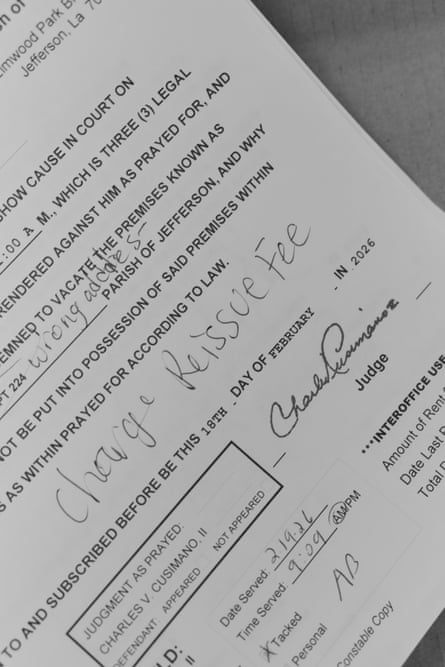
Landlords pay to file an eviction and a justice issues an order, summoning the tenants to court. Each order lists the plaintiffs, the defendants and the date. Many had handwritten notes about the outcome. Filing fees are frequently billed back to tenants.
The Guardian found more than 5,500 eviction cases over a 12-month period. The fifth justice court in Jefferson, with about 30,000 renter households, has one of the highest eviction filing rates in the United States.
Eviction orders end in a judgment when a tenant loses in court.
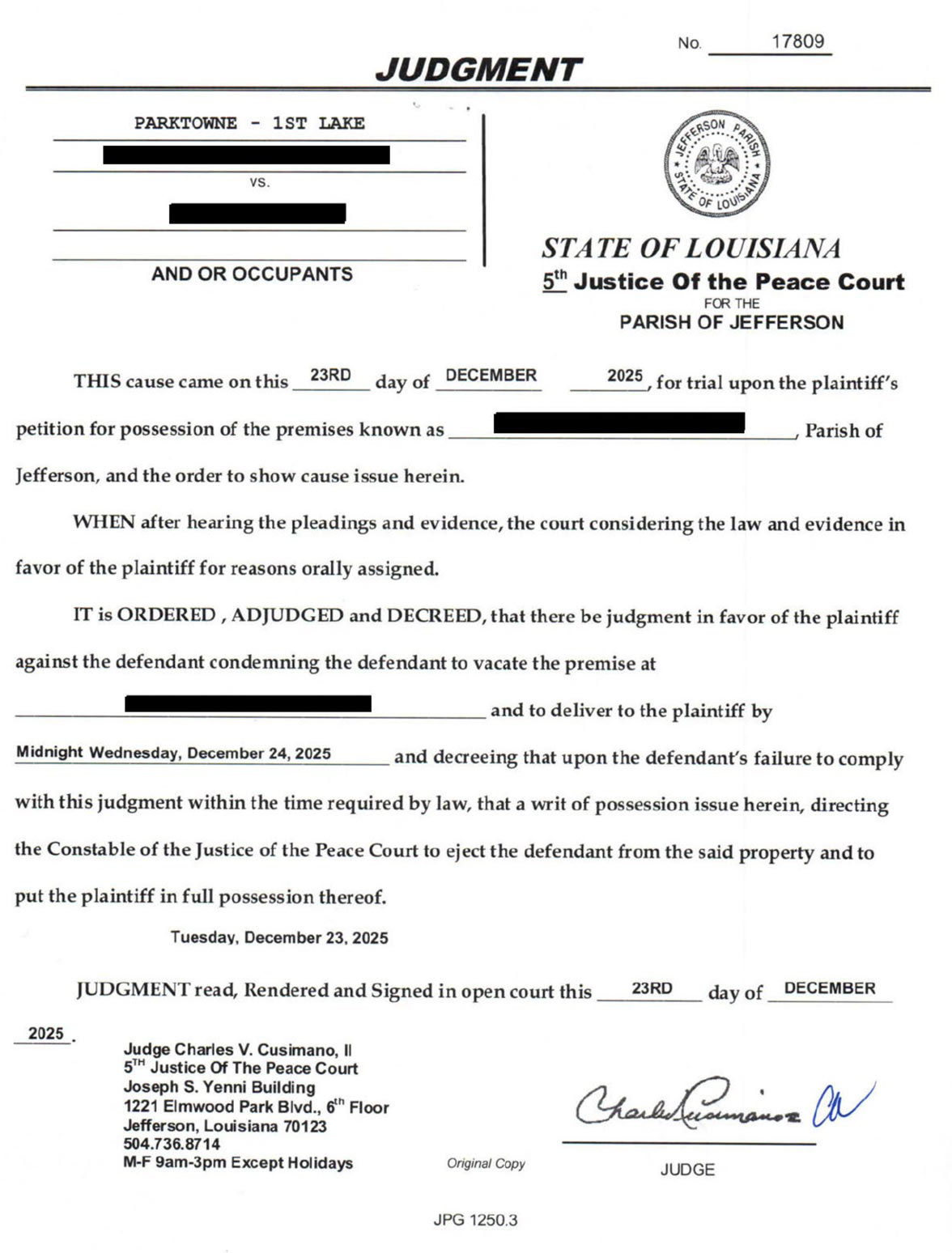
The Guardian found nearly 3,300 eviction judgments. A judgment can be set aside if a landlord accepts late payment but it stays on the tenant’s record.
Not every eviction filing ends in a judgment. More than 2,000 were canceled, usually because the tenant paid their late rent and any additional fees. These cases were not heard in court but the court was still paid filing fees and the tenant avoided eviction.
We could not determine the outcomes in 71 cases, either because the documents had no information or the handwriting was illegible.
A very small number of tenants won their case in court. 88 eviction orders were denied because the landlord failed to show up in court …
… and only 53 cases – less than 1% of the total eviction filings– ended in the tenant winning the case for other reasons. The records indicated only 26 tenants had a lawyer.
The data showed that one landlord – 1st Lake Properties – was responsible for over 60% of Justice Cusimano’s entire eviction docket. 1st Lake won 1,974 eviction judgments in Cusimano’s court from June 2025 to May 2026. Nineteen eviction orders were denied because 1st Lake representatives failed to show in court. Just three evictions filed by 1st Lake were denied for other reasons.
The company, which has “developed, acquired and managed” more than 10,000 rental units in Louisiana, also charges its tenants “any and all fees, including attorneys fees, and costs associated with eviction”, according to a review of 1st Lake leases and interviews with attorneys who have represented their tenants in court.
Foster, the former US justice department official, said the Guardian’s findings indicated the court was functioning as “an eviction mill and a ‘company court’”.
“When a single landlord accounts for the majority of cases in the court, when virtually all of the cases result in judgments for the landlord, when the tenants are paying for the cost of their own evictions, there is something fundamentally wrong,” said Foster, who is a co-founder of the Fines and Fees Justice Center, a non-profit group that fights against what it sees as unfair fees and fines.
During an interview, Cusimano forcefully denied that landlords repeatedly paying fees to file eviction cases in his court might represent a built-in conflict of interest.
“I don’t see a conflict at all,” he said. “It’s fee based, and they pay upfront to us, irrespective of the outcome.”
Asked about any appearance of a conflict of interest, Cusimano responded: “I don’t know. I can’t do anything about appearance.”
1st Lake was co-founded by Henry Shane Jr, a local businessman and Republican party donor. According to a 2015 media profile, Shane had used his fortune to collect more than 160 vintage cars and personally commission a recreation of the Nottoway mansion, one of the largest plantation homes built during the era of slavery.

The Guardian’s analysis of a year of Justice Cusimano’s eviction records found that 1st Lake filed an eviction claim against one out of every 10 renter households in the district, nearly all of which were for unpaid rent.
1st Lake Properties did not respond to repeated requests for comment.
‘Like the wild west’
Cusimano’s court has consistently yielded the highest revenue from fees among Louisiana’s justice of the peace courts, according to a Guardian analysis of more than 3,400 annual financial filings, which are mostly handwritten and document the self-reported earnings of each justice of the peace over the past decade. The analysis revealed that the 10 justice of the peace courts in the state with the highest revenue brought in nearly $31m in fees over the past 10 years.
It also revealed that the justices in those 10 courts earned nearly $12m from their court fees over that decade and received an additional $1.2m in salaries paid by their parishes. The rest of the fees were used to compensate their constables and other staff as well as pay for office expenses and training.
Hannah Adams, a senior attorney at the National Housing Law Project, said the findings highlight the “massive amount of money that is flowing through the system”. The non-profit, alongside the Southern Poverty Law Center, is pursuing a class-action lawsuit in federal court in Louisiana that claims the state’s justice of the peace system is unconstitutional.
“The fact that it is flowing directly into the pockets of independent judges, combined with a lack of oversight over these courts, means it is like the wild west,” she said. “There is no other state in the country that retains a system like this.”
Justice Steven Sanders, in the fifth district of East Baton Rouge, is the state’s second-highest-paid justice. His small courtroom sits on the south-eastern outskirts of the state’s capital, surrounded by low-rise housing units and next to a moving company. He holds court on a foldout table draped in black cloth.
In 2024, his court generated more than $753,000 in fees. Roughly 90% of that came from evictions, Sanders has said.
Combined with his parish salary, the part-time justice earned more than $299,000, a salary that is almost equal to what an associate justice of the US supreme court earns. Sanders, like other justices in high-revenue courts, hires a part-time clerk funded by an additional filing fee. She was paid more than $145,000 in 2024. She is also his wife.
Sanders estimated during deposition testimony in August that his court hears 300 to 400 evictions a month.
Sanders, who has served in the same role for 30 years, is the defendant in the class-action lawsuit, which was filed last year.
“Like all justices of the peace in Louisiana, Defendant Sanders’s dependence on filing fees to pay his salary and the court’s operating expenses creates an incentive for him to maximize the number of eviction cases filed in his court by ruling in favor of landlords, who select where to file a petition for eviction,” the suit claims, adding that additional fees for ejection writs “creates an incentive for him to enter judgments of eviction against tenants”.
In September, a federal judge rejected the Louisiana attorney general’s office’s attempt to have the case thrown out of court, marking a significant victory in the case.
Sanders declined to respond to written questions from the Guardian, citing ongoing litigation.

Landlords in Louisiana typically have a choice of which type of court to file eviction cases in. The state’s district and city courts also have the authority to handle eviction claims. Judges in these two more formal court systems must hold law licenses.
Litigants in justice of the peace courts also have more limited appeal rights. If tenants want to challenge a justice of the peace’s ruling, they must seek an entirely new trial in a district court. These appeals generally must be filed within 24 hours to avoid eviction, and likely mean payment of a security bond that can equal one month’s rent. They are nearly impossible to navigate without an attorney.
Cash App
Established during the era of colonization, justice of the peace courts were once a mainstay of the American legal landscape.
By the 20th century, they faced closer scrutiny. In a groundbreaking 1919 American legal text, Justice and the Poor, Reginald Heber Smith argued that justice of the peace courts had formed “unholy alliances with collection agencies” and “very generally became actually corrupt”. Thanks to lack of oversight and justices’ dependence on fees, he wrote, “JP came to mean ‘judgement for the plaintiff’”.
During the last decades of the 20th century, many states moved to abolish justice of the peace courts or limit their powers. In Mississippi, the justice court was reformed following a federal appeals court decision in 1981 that found the fee system to be unconstitutional and “a malignancy weakening the administration of justice”. Now, only seven states grant these courts judicial powers, and even fewer allow their justices of the peace to handle eviction hearings, according to a review of state laws. Louisiana is the only state where justices of the peace reap income directly from the court fees they charge.
A century after Justice and the Poor was published, concerns about the system’s vulnerability to misconduct remain.
In 2019, a justice of the peace in Jefferson parish was sentenced to three years in prison for diverting money from his court to satiate a gambling addiction. In 2020, a justice of the peace in rural Morehouse parish was removed from office over a series of allegations including overcharging eviction fees. In 2021, a justice of the peace in Ascension parish resigned after local news revealed he had heard cases outside his territorial jurisdiction, which was described as a “money grab”.
In December 2025, Justice Tracy Batieste, the East Baton Rouge justice who evicted Marchana Watts, resigned from office after being temporarily disqualified by the state’s supreme court subsequent to the judiciary commission finding “substantial, credible evidence” establishing probable cause that she was charging unlawful and excessive court fees during eviction proceedings.
Batieste’s court raised more than $120,000 in revenue in 2024, according to her latest self-declared financial disclosure, ranking 10th in fees gathered by the state’s justice of the peace courts.
Recently unsealed evidence reviewed by the Guardian revealed that the justice faced sustained complaints from landlords who came before her court. One told the judiciary commission that there seemed to be “an incredible increase in fees over the past few months”.



Another indicated to the commission that Batieste’s preferred method of receiving payment was via the mobile payment service Cash App. A photograph obtained by the Guardian shows a large printout of the Cash App account pinned to a noticeboard in her courtroom.

Batieste acknowledged some of these unlawful charges, which included a “Covid fee” and additional service fees and copying fees, in unsealed sworn testimony. She also acknowledged owing her constable thousands of dollars in fees.
Beyond his limits
Tyja Jackson fell behind on rent after tragedy enveloped her life.
In March, her son Kyion, a seven-year-old with dimples and a deep smile, was killed in a car crash.
Four months later, Jackson, 27, found herself before the justice of the peace Mark Miley in East Baton Rouge, facing an eviction summons from her landlord. Jackson, who had no attorney, explained to Miley, who holds court in the boardroom of his private law office, that she had been unable to return to her job as a cashier at a local Wendy’s due to overwhelming grief.
“I attempted to go back. I just couldn’t,” she told the court. “It’s all just falling apart.”
Kyion’s funeral had cost $12,000, she later told the Guardian. Along with her overdue rent, Jackson said, she was now being charged $360 in late fees and court costs. The company was not responding to messages or maintenance requests, she said, meaning she was living without air conditioning. She had to send her infant daughter to live with relatives due to the sweltering heat.
She hoped to be heard in court.
Miley has held office since 2009. In 2025, his court, which hears eviction cases only once a week, generated $524,726 in fees, of which he retained $296,215 in compensation. At multiple instances during the Guardian’s visit he referred to the “big business” of justice of the peace courts around the parish. On a separate visit later in July, Miley offered a photographer for the Guardian a payment of two folded $20 bills alongside a small note that contained his phone number, telling them that they could spend it on “coffee”. He expressed surprise when they said they could not accept the payment.

In February of this year, Miley signed a deferred discipline agreement with the state judiciary commission after admitting that he had “regularly and knowingly” ruled over eviction cases that fell outside the geographical boundaries of his jurisdiction.
The agreement acknowledged that Miley’s conduct “gave the appearance that he was improperly presiding over the matters due to the direct financial benefit he received from the filing fees” and bound him to stop the practice.
Benton, the former legal aid attorney, said he defended about 100 eviction cases in Miley’s court between 2022 and 2024. He estimated that all but three had been improperly filed.
Less than a month after Miley signed his reprimand, the state legislature took action.
A Republican lawmaker introduced a bill to expand the borders of Miley’s district along with other justices in East Baton Rouge, across the entire territory of city court. It had the wholesale support of local landlords.
“Essentially, the way my court operates is if you file an eviction by Friday, we have court the following Thursday,” Miley told lawmakers during a legislative hearing, describing the value of expanding the boundaries of his power. “You can pull up to my office and you can get in and get out. It’s easy to access. It’s good for tenants and good for landlords, in my opinion.”
The bill was quietly passed by the state legislature – with no media coverage – and became law in June.
It had been in effect for nine days by the time Jackson appeared in Miley’s court. He listened as she told her story. She had just been able to return to work, and had taken on two jobs: one at an Amazon delivery warehouse and another for an events security company. But still, she was behind on rent.
Miley granted her an extra couple of days to find the funds, but issued a judgment of eviction nonetheless. He counseled her to contact a charity to look for financial support, and suggested his judgment against her might actually help.
“Sometimes, I’ve heard if you let a charity know you’ve got a judgment against you, it helps expedite” them offering funds, he told Jackson as he handed her a copy of the ruling against her. She appreciated the suggestion, Jackson said after the hearing.
The eviction judgment, later reviewed by the Guardian, revealed that despite the judiciary commission’s reprimand and the new law expanding his jurisdiction, Miley had still unlawfully evicted Jackson. Her rental unit was located outside his newly enlarged legal domain.
“Unlike in other states where these judges would have to remit all of their filing fees, and then be paid by fixed salary, either set by the county or the state, these justices have a literal financial incentive to break the rules,” said Adams, the National Housing Law Project attorney. “The more cases they take, if they stretch the boundaries of their jurisdiction just a few blocks further, they’re going to make more money.”
Miley did not respond to detailed questions from the Guardian.
‘No refunds’
Justice Mark Spears of Jefferson parish’s second justice of the peace court holds his eviction hearings in a small office suite next to a noisy highway in the New Orleans suburb of Marrero. A crinkled US flag is tacked to the wall behind his desk.
A notice stuck to the clerk’s window reads:
NO REFUNDS
YOU ARE RESPONSIBLE OR [sic] MAKING SURE YOU ARE FILING IN THE RIGHT COURT
THERE WILL BE ABSOLUTELY NO REFUNDS
In May this year he appeared at a rare public hearing in front of the state judiciary commission, accused of engaging in “willful misconduct” by lending “the prestige of your judicial office to advance your private interest”. Specifically, the commission admonished him for using an Instagram account named “judge.markspears” to promote himself not only as a justice but also as a private practice attorney and an NFL sports agent.

He apologized multiple times during the hearing. He acknowledged to the commissioners that he now understood that “I can’t put out to the public that I’m a justice of the peace and that I have private stuff, that I’m an attorney also. Because people would think of the prestigiousness of a judge and maybe, you know, use me as an attorney.”
Two weeks later, before an eviction docket hearing on 4 June, the court’s constable, Kendall Bussey, touted Spears’ work as a private attorney and a justice in a speech to landlords and tenants waiting for their eviction cases to be heard.
“Judge Spears is very good at what he does. He’s not only a judge, he’s also a lawyer,” Bussey said during a mass swearing-in, which took place in a cramped corridor outside the justice’s earshot “Part of what he do is tenant-eviction law. He understands the law.”
Bussey acknowledged that tenants have a right to appeal the judge’s decisions, but added: “I will be open and honest, if Judge Spears gives you an order, 99.9% it’s not going to be overturned.” He then claimed that due to Spears’ expertise “the higher judges actually call him for advice when it comes to Louisiana tenant law”.
In response to questions from the Guardian, Spears distanced himself from Bussey’s remarks. “Constable Bussey is an independently elected constitutional officer. He is not my employee, I do not supervise him, and he does not speak for me or for this court.” The justice said he has never instructed Bussey or anyone else to make those kinds of statements.

“I do not hold myself out as a housing attorney,” he said. “In 20 years of practicing law, I have handled two eviction matters, and I handled both pro bono.” He added that he had never received calls from “higher judges” for advice on housing law and that he always informed litigants of their right to seek a new trial in parish court.
Spears, a former parish councilman, was first elected justice of the peace in 2019 and is running unopposed this November. His court – which is located on the west bank of the Mississippi River across from New Orleans – has brought in more than $600,000 in fee revenue since 2020, according to his financial statements.
A 2022 recording obtained by the Guardian documents a clerk in Spears’ court explaining to an attorney why it would not be possible waive court fees for a low-income tenant: “We are a for-profit court and we have to collect those fees.”
Spears said he “will not respond to a characterization of a four-year-old conversation to which I was not a party”.
“My court is not a ‘for-profit court’,” he said. “… If a clerk used the phrase you attribute, that was that clerk’s phrasing, not the policy of this court, and I repudiate it.”
Louisiana’s supreme court is currently considering the judiciary commission’s recommendation that Spears be suspended for six months without pay, with all but 30 days suspended. Its recommendation of discipline stated his actions had “harmed the public’s confidence in and respect for the integrity and impartiality of the judiciary”.
Spears declined to comment on the disciplinary case.
Legacies
Marchana Watts is still fighting to recover from eviction two years on.
She lost her job around a year ago and started taking antidepressants. She developed diabetes and Cushing’s disease, she said, which can be triggered by stress.
She found shelter at a relative’s home but was sleeping with four of her sons in a single bedroom. Her eldest was forced to move out.
The cost of a storage unit became unmanageable and so she sold almost all her possessions.
“Everything is still about my children,” she said. “I didn’t want them to see me go through it. That was the hardest part for me.” Over the summer she launched a GoFundMe drive to help pay for school supplies for her sons. To date, it has received no funds.
At the Jefferson parish fifth justice of the peace court one recent morning, Justice Cusimano showed journalists from the Guardian a small wad of cash, held together by a clip, that he kept inside the back of a drawer in his private office. It was around $120, he later said, adding it was held in reserve for especially “sad” eviction cases where he might offer to personally help.
But he added: “You can’t change the law with your compassion.”
In August, as the Guardian was reporting this story, Justice Cusimano announced his retirement at the end of this year, leaving the bench as perhaps the highest-paid judge in the nation.
The position will be filled without a competitive election because just one candidate is running to replace him. His name is Chuck Cusimano III.
He is the son of the justice of the peace.
Additional reporting Melissa Segura, Rachel Shur, Mariama Eversley, Sophie Sullivan
Additional data reporting Tom Richards, Cameron Armstrong, Mahesh Makani, Georges Lebreton, Izzy Kiff, Frederick O’Brien, Aliya Uteuova
Graphics Ana Lucia Gonzalez, Pablo Gutierrez, Andrew Witherspoon
KioskNews shows a cleaned-up reading view extracted from the publisher’s page — the original always lives on their site, not ours.