Knesset advances bills to form Oct. 7 state commission of inquiry, establish PM term limits
More than three years after the October 7, 2023, Hamas-led onslaught, the Knesset gave an initial nod Wednesday to legislation to establish a state commission of inquiry into the failures surrounding the attack and the ensuing war, as well as a separate bill imposing term limits on prime ministers and barring lawmakers under criminal indictment from forming a government, dealing a double political setback to Prime Minister Benjamin Netanyahu.
The preliminary votes marked a new front in the political battle between Netanyahu and the bloc seeking to replace him, led by Yashar party chairman Gadi Eisenkot. Having begun dismantling key elements of Netanyahu’s judicial overhaul last week, the bloc moved Wednesday to advance legislation that could prevent the longtime premier from returning to power in the next Knesset and compel the establishment of an independent inquiry into the worst security disaster in Israel’s history, which Netanyahu has long resisted.
Lawmakers also advanced legislation repealing a controversial law that increased political control over investigations into police misconduct, while defeating bills sponsored by members of Netanyahu’s outgoing coalition seeking to freeze arrests of military draft evaders and to restrict the use of loudspeakers at mosques.
0:00 / 0:00
Promoted: Wondering Jews, Angela Buchdahl

The measures were all central campaign pledges of Eisenkot’s bloc ahead of the October 27 election. Having secured a parliamentary majority with the support of Arab-majority parties, the bloc is now in the unusual position of being able to advance its legislative agenda even as Netanyahu, who lost his majority in last month’s election, remains in office as caretaker prime minister until — and unless — the Eisenkot-led bloc can form a government.
Eisenkot’s four-party bloc holds 48 seats and commands a parliamentary majority with the backing of the Arab-majority Ra’am and Joint List parties, which together hold another 19 seats. However, the Yashar leader has yet to translate that majority into a governing coalition and is engaged in parallel negotiations with the ultra-Orthodox United Torah Judaism party and Netanyahu’s Likud.
Get The Times of Israel's Daily Edition by email and never miss our top stories
By signing up, you agree to the terms
The window for advancing Eisenkot’s legislative agenda may be limited, however. The bills must undergo committee review and pass three additional readings before becoming law, while the Yashar leader’s mandate to form a government is set to expire at the end of December. Should he fail to assemble a coalition, the mandate could pass to Netanyahu, giving the caretaker premier control over the Knesset Arrangements Committee and, with it, significant influence over the legislative process.
October 7 state commission of inquiry
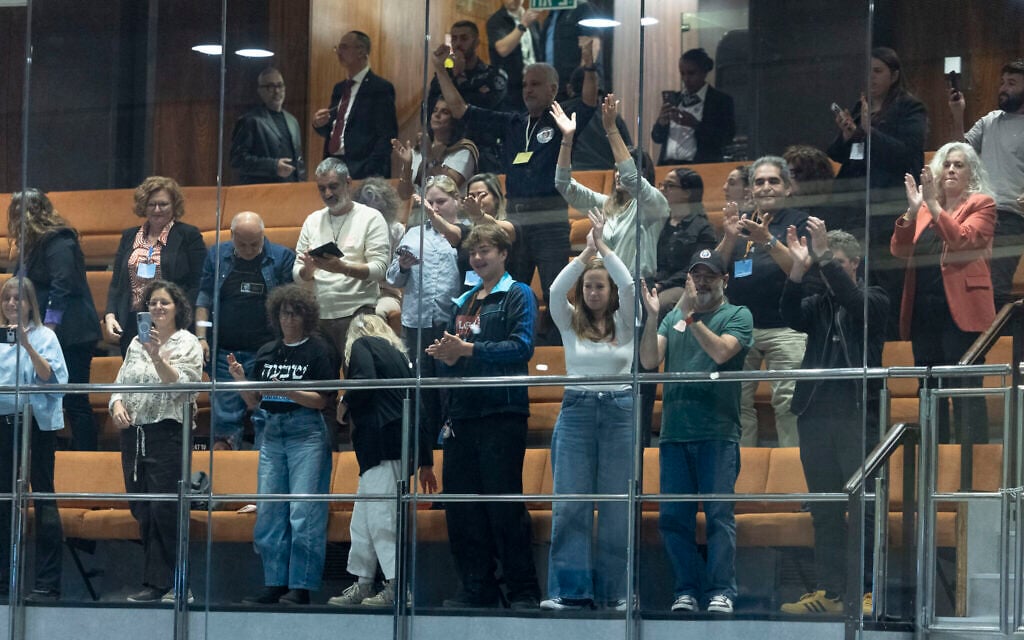
The Knesset voted 65-50 in favor of a preliminary reading to establish a five-member state commission of inquiry into the failures surrounding the October 7, 2023, Hamas-led onslaught and the ensuing war, as bereaved family members, including representatives of the October Council group, cheered from the gallery.
“We’ve waited so long for this moment!” said Gil Dickmann, cousin of slain Hamas hostage Carmel Gat. “The bill to establish a state commission of inquiry into October 7 passed its preliminary reading in the Knesset. A giant step toward change. Now, just form a government.”
כמה חיכינו לרגע הזה! רעות, הילה, רפי, איל, עפרי מנשה ויורם וכל מובילי מועצת אוקטובר – סוף סוף יכולים לחייך. ועדת חקירה ממלכתית ל-7/10 עברה בקריאה טרומית בכנסת. צעד ענק בדרך לשינוי. עכשיו רק תקימו ממשלה. @OctoberCouncil @Avigdorii @Rafielroei @ESHEL2003 pic.twitter.com/hZZ0w0uVqJ
— Gil Dickmann | גיל דיקמן (@gildickmann) November 25, 2026
“Three years of fighting, and finally we can see the light at the end of the tunnel,” said Eyal Eshel, whose daughter Roni was among 16 surveillance soldiers killed at the IDF’s Nahal Oz base on October 7, 2023.
Addressing his daughter, Eshel wrote: “I swore to you that I would fight until the last drop of my blood, and I will keep my promise, my little girl.”
A state commission of inquiry is Israel’s highest investigative authority, with unique power to investigate national disasters, subpoena witnesses and issue personal recommendations that can end political careers. It is established by government decision, but acts independently of the government, and comprises experts selected by the judiciary.
“Today, we are doing what a government worthy of the public’s trust should have done in a single cabinet meeting,” said Yashar MK Orit Farkash-Hacohen, who sponsored the legislation. “This is the beginning of a process of making things right for all Israeli citizens. We must ensure that what happened on that terrible day never happens again.”
Arab lawmakers, whom members of Netanyahu’s bloc have repeatedly accused of supporting terrorism, voted in favor of the legislation, which explicitly identifies Hamas as a terrorist organization, with Joint List MK Ahmad Tibi and Ra’am MK Waleed Alhawashla also co-sponsoring one of the bills to establish such an inquiry.
Speaking against the bill — which would include in the inquiry the question of whether Israel’s policies during the war in Gaza upheld its commitments under international law — Transportation Minister Miri Regev claimed it would target “our brave and heroic soldiers. They do not want to get to the truth.”
The commission would investigate events from the conclusion of the 2014 Gaza war through the return of the remains of the last hostage in January 2026 and would be required to publish an interim report within a year of its establishment. The bill asks for an initial NIS 7 million ($2 million) for the commission’s operations.
Establishing a state commission of inquiry has been a central demand of many of the victims’ families since the massacre and enjoys overwhelming public support according to opinion polls. Netanyahu, who has never accepted direct responsibility for the attacks, has refused to establish such an inquiry, arguing that it wouldn’t get the public’s trust since it would be formed by a judiciary he says is biased against him.
Instead, his government sought to advance a controversial politically appointed probe that would give the coalition and opposition the power to each appoint half of the commission’s members, and — if the opposition refused to cooperate, as it vowed it would — would have given the government that was in power when the attacks took place the authority to unilaterally appoint the body investigating its own conduct. Opposition lawmakers argued that it was intended to shield the government from accountability.
However, even that commission was not formed by Netanyahu’s government for over three years.
Forming a state commission of inquiry was a key campaign pledge of Eisenkot’s bloc, which some bereaved families have recently criticized for failing to prioritize the inquiry bill since gaining a parliamentary majority in last month’s election. The delay is understood to stem in part from the need to establish the commission through legislation rather than a government decision, since Eisenkot has yet to form a government.
PM term limits and restrictions
In a separate 65-48 vote, the Knesset advanced in a preliminary reading a bill imposing term limits on prime ministers, barring lawmakers indicted on criminal charges from forming a government, and establishing a mechanism for removing sitting premiers facing such charges.
The proposed amendment to Basic Law: The Government, sponsored by Yisrael Beytenu MK Oded Forer on behalf of the parties in Eisenkot’s bloc, would impose an eight-year consecutive term limit followed by an eight-year cooling-off period outside the government; bar lawmakers indicted on criminal charges from forming a government, unless the Central Elections Committee chairman determined that the alleged offenses did not involve moral turpitude; and enable the removal of sitting premiers facing such charges, subject to a Supreme Court determination.
It would also repeal a 2023 law restricting the circumstances under which a premier can be declared incapacitated, which was widely seen as designed to shield Netanyahu from removal over his ongoing corruption trial. The High Court of Justice ruled that the law had been enacted for the personal benefit of Netanyahu, who is facing a corruption trial, and delayed its implementation until the formation of a new government.
The new legislation is aimed squarely at Netanyahu, Israel’s longest-serving prime minister, who has held the office for a cumulative total of more than 19 years. He has been on trial for more than six years on charges of bribery, fraud and breach of trust, all of which he denies.
The proposed restrictions would take effect in the next Knesset but apply to previous consecutive terms and pending indictments, raising questions over whether the legislation would withstand High Court scrutiny given its retroactive and apparently personal nature.
The bill will now be sent to the Arrangements Committee and is expected to be assigned to a special committee headed by Democrats MK Naama Lazimi to prepare it for the three additional readings required to become law.
The bill advanced shortly after the Jerusalem District Court stated its position that there is little chance for a conviction in two of the three cases against Netanyahu, dealing prosecutors a major blow.
Bill canceling politicization of cop-probing unit advances
Continuing its efforts to reverse elements of the Netanyahu government’s judicial overhaul, Eisenkot’s bloc also advanced, in a 62-48 vote, a bill repealing a controversial law passed by Netanyahu’s government giving the justice minister control over the Department for Internal Police Investigations.
The law, passed in June, removed the department from the authority of professional prosecutors and placed it within the Justice Ministry, while giving the justice minister control over the appointment of a majority of members of the five-member committee tasked with selecting the department’s director, previously appointed by a professional Civil Service Commission committee.
Justice Ministry officials, Knesset legal advisers and opposition lawmakers warned that the changes would compromise the department’s independence and politicize criminal investigations into police misconduct. The High Court has since frozen key provisions of the law.
The explanatory notes accompanying the repeal bill say the law raises “serious constitutional and institutional concerns” by linking appointment and tenure mechanisms to the political leadership, thereby undermining the department’s independence and impartiality.
Netanyahu bloc-proposed bills defeated
Meanwhile, the Knesset voted 63-49 against two bills sponsored by ultra-Orthodox lawmakers and backed by Netanyahu’s bloc seeking to freeze arrests of military draft evaders.
One bill, sponsored by United Torah Judaism MKs Meir Porush and Eliakim Stark, would have frozen arrests, investigations and enforcement proceedings against yeshiva students for a year, including for offenses involving draft evasion, desertion and fraudulently obtaining military service exemptions or deferments.
The second, sponsored by Shas MK Yinon Azoulay and other lawmakers, would suspend arrests of all prospective military recruits who fail to report for service until the formation of a new government.
The legislation was widely seen as an attempt by Netanyahu’s bloc to drive a wedge between Eisenkot’s bloc and the ultra-Orthodox parties amid ongoing coalition negotiations between them.
In June 2024, the High Court of Justice unanimously ruled that there was no legal basis for exempting ultra-Orthodox yeshiva students from military service and that the state was obligated to draft eligible men. The ultra-Orthodox parties have since sought legislation preserving military service exemptions for yeshiva students while opposing enforcement measures against draft evaders.
In July, ahead of last month’s election, the outgoing coalition passed a law barring the arrest of ultra-Orthodox draft evaders for seven months, which the High Court froze the following day.
The Knesset also voted 63-45 on Wednesday against a bill sponsored by far-right Otzma Yehudit lawmakers to restrict the use of loudspeakers at mosques for the Muslim call to prayer. Parties in Eisenkot’s bloc voted against the legislation, while most Haredi lawmakers were absent from the vote, having opposed previous versions of the so-called muezzin bill over the past decade.
Long championed by National Security Minister Itamar Ben Gvir’s far-right party, the bill would have required mosques to obtain a permit from the environmental protection minister to operate loudspeakers, authorize police to shut down the systems and confiscate equipment, and impose fines of up to NIS 50,000 ($15,000) for violations.
Arab lawmakers have denounced the bill as an attempt to persecute the country’s Muslim minority by a minister they regard as openly hostile toward the community.
In a statement following the vote, Otzma Yehudit accused the parties that opposed the bill of “joining forces with terror supporters,” referring to the Arab-majority Ra’am and Joint List parties. It singled out Yisrael Beytenu chairman Avigdor Liberman for hypocrisy, given his party’s support for identical legislation in the previous Knesset.
During the heated debate preceding the vote, Ben Gvir was ordered to leave the plenum after calling Deputy Knesset Speaker Eitan Ginzburg, a B’Yachad MK, an “idiot” for intervening in a shouting match during which the minister yelled at Arab lawmakers: “You get out, your families get out, terror supporters get out.”
KioskNews shows a cleaned-up reading view extracted from the publisher’s page — the original always lives on their site, not ours.