Canada could become first ‘associate member’ of the EU, von der Leyen suggests – Europe live
von der Leyen warns against anti-European ultranationalists and Russia who 'despise our values'
'We are now dealing with an openly hostile world,' EU's von der Leyen warns
EU 'the strongest' but 'most precarious' it has even been, von der Leyen says
Watch von der Leyen's SOTU live - video
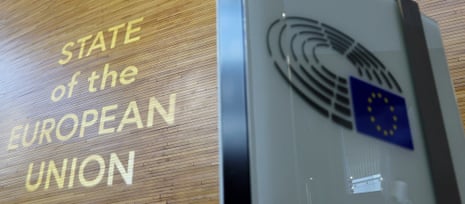
Morning opening: The state of the European Union
Von der Leyen also talks about the need to reform Europe’s energy market.
She says “Europe cannot remain an industrial powerhouse if its energy prices are structurally too high.”
She says the bloc successfully pivoted towards homegrown cleaner energies in the aftermath of Russia’s full-scale invasion on Ukraine, but it still “bitterly felt the cost” of the strait of Hormuz closing later.
“We need to double down on our affordable and home-grown clean energy. Be it renewables or nuclear, be it biomethane or others. Technologically neutral. But these energies must give us independence and drive down energy prices.”
She says “we need to electrify Europe,” and cut the fossil fuel import bill.
She says lots of renewable capacity is waiting to be connected, and the EU needs to speed up grid connections.
She then turns to trade.
Von der Leyen says “kickstarting Europe’s economy is our number one priority,” as Europe needs to tap into its huge market, world class industries and services.
She says its single market remains too fragmented and needs to reform further, with the aim of completing it by the end of next year.
“In today’s economy, speed is of the essence. A permanent permit or a form, a grid connection of financing decision – all of this can determine where an investment is made and where jobs are created. We need to move much faster,” she says.
Von der Leyen also talks about the need to simplify its rules.
Von der Leyen frames it as a choice between “independent Europe that stands up for its values in this world,” or “letting divisions and dependencies hold us back.”
“Do we want to rally around our European idea that together we can decide our own destiny? Or do we let our democracies be undermined by the proxies and puppets of authoritarians?
Whether it is the ultra nationalist or the anti-European, whether it’s Russian interference or disinformation, the names may be different, but their goal is the same.
They despise our values and they want to shatter our European unity. So let’s not only fight back against that, but let’s fight together for our European ideal.”
Von der Leyen warns that “we are now dealing with an openly hostile world,” in which “old assumptions and relationships have frayed.”
She talks about “a territorial war of aggression” in Ukraine, “a fight for industrial capacities” and “narratives,” and “the dizzying speech of change and technology” impacting people’s lives.
“We see this in the rise of the extreme and the decline of nuance, even in the way that we relate to each other. These real concerns are being weaponised to drive a wedge between us, sometimes from the outside, but too often from the inside.
But our path is clear. Building an independent Europe that has the power to act. Nothing can divert us from this. Because in this world, the fate of Europe must remain in the hands of Europeans.”
Von der Leyen begins her speech.
She quotes Charles Dickens’s description of the days of the French Revolution, “it was the best of times; it was the worst of times.”
“It is also a fair description of the world we live in,” she says, as she adds “the speed of change is incredible.”
“I would say the state of our union is the strongest it has ever been. The state of our union can also feel as precarious as it has ever been. These two statements may seem incompatible, but they are both true and they reflect these exceptional times.”
She says Europe “has chosen to forge its own path” as it navigates “the complex age of … great possibilities and … great perils.”
Europe is “breaking free from the toxic dependency on Russian fossil fuels,” better prepared to defend itself than ever before, and standing for its values with Ukraine and Greenland, she says.
“In the cold fragility of today’s world, only Europe can provide true sovereignty for Europeans,” she says.
EP’s Metsola sets out what people expect from Europe:
“Our union has always moved forward because people were willing to take a leap where the moment demanded it and turned uncertainty into possibility.
People expect a union that does more to protect them, more to support them, and more to fight their corner.
They want answers on security, on competitiveness, on affordable homes, on quality jobs, on climate, on borders. They want us to stand up for a Europe of values …”
She goes on, also pointedly mentioning the need to continue supporting Ukraine.
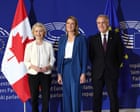
Opening the session, the European parliament president Roberta Metsola welcomes Canada’s Carney, who gets long and warm applause from EU lawmakers.
“They haven’t heard you giving your speech yet,” laughs Metsola.
We are about to start.
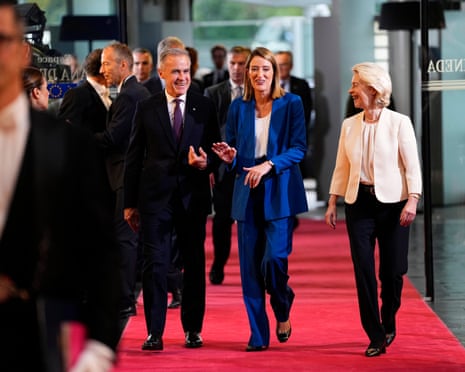
It’s also worth noting that this year’s SOTU will see a special guests in attendance: Canada’s prime minister Mark Carney.
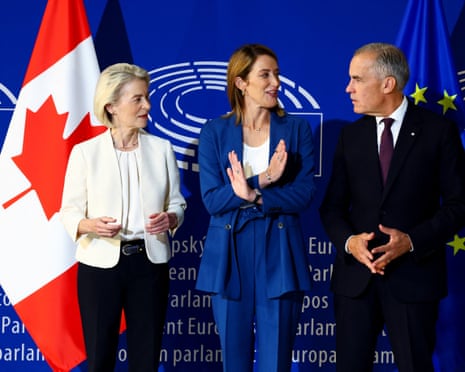
He will listen to von der Leyen’s speech as Canada seeks closer ties with the EU – particularly on defence, digital regulation and trade - amid growing tensions with and outright repeated threats from US president Donald Trump.
Carney will also address the European parliament on Thursday.
The speech is expected to start in the next 10-15 minutes, so you can watch as the European Parliament’s Hemicycle in Strasbourg is filling up ahead of the speech.
Here’s our live stream for today:
The European Commission president Ursula von der Leyen is about to speak at the European parliament to discuss “the state of the Union” in her annual speech about the EU’s place in the ever more complicated world.
Her speech in Strasbourg comes as the list of challenges facing the bloc grows ever longer – not least an increasingly aggressive Russia following incidents involving Denmark, Lithuania, and Poland this week. Security is set to be a key theme.
We are also likely to hear about Europe’s competitiveness and its standing in a global race dominated by superpowers like China and the US, as well as the rise of nationalism and populism across the continent and beyond.
Expect updates on other major priorities, too: digital regulation (with a sharp focus on online safety), migration (following the Ceuta crisis in late July), and climate and energy in the wake of another record-breaking summer.
Plenty to cover. I will bring you all the key lines here.
It’s Wednesday, 16 September 2026, it’s Jakub Krupa here, and this is Europe Live.
KioskNews shows a cleaned-up reading view extracted from the publisher’s page — the original always lives on their site, not ours.