Xi likely to press for US Asia withdrawal: official
EYE ON ARMS: The Chinese leader’s top priority is to slow approval of US arms packages to Taiwan, but Washington is aware of Beijing’s strategy, the official said
By Chen Yun and Jonathan Chin / Staff reporter, with staff writer


Chinese President Xi Jinping (習近平) will try to pressure US President Donald Trump to postpone arms sales to Taiwan and roll back deployments of US forces in the Indo-Pacific region, a senior Taiwanese official said yesterday.
Xi was expected to arrive in the US after press time last night and meet with Trump in Washington during his three-day visit, then possibly again on the sidelines of the APEC summit in China on Nov. 18 or 19.
Xi’s highest priority is to slow Trump’s approval of arms packages to Taiwan at the meetings, a national security official with knowledge of the matter said on condition of anonymity.
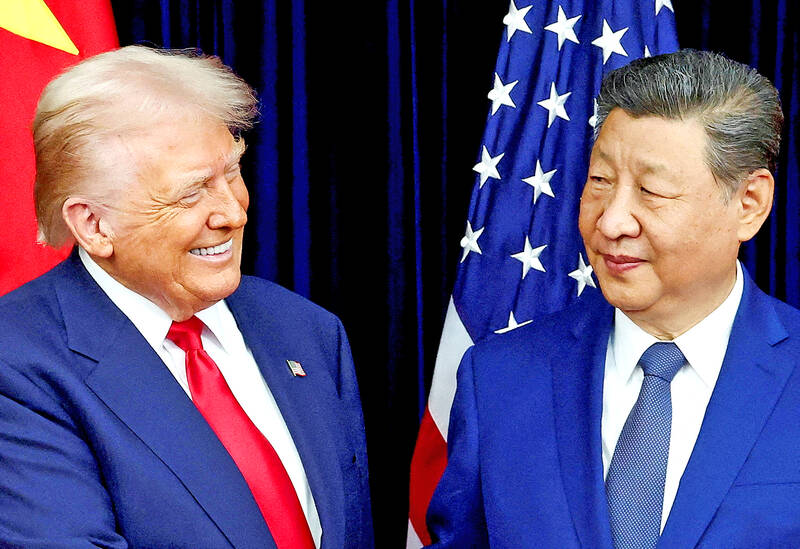
US President Donald Trump, left, and Chinese President Xi Jinping interact at an event at Gimhae International Airport in Busan, South Korea, on Oct. 30 last year.
Photo: Reuters
Xi is sure to demand that the US postpone Taiwan-bound arms sales until the APEC summit in November, when he would again press Trump to delay authorizing the weapon packages until Christmas, the official said.
Belated delivery of US weapon systems would disrupt Taiwan’s force-building efforts, which would boost the Chinese People’s Liberation Army’s ability to threaten the First Island Chain, they said.
That would facilitate China’s aims to push the US out of the First Island Chain and force unilateral changes to the “status quo” in the Taiwan Strait, the official said.
Part of China’s strategy involves promoting the narrative that US military presence in the region is to blame for heightened tensions and that Washington can make peace by withdrawing, they said.
Should the US lower its presence in the Indo-Pacific region, it would create a strategic vacuum beneficial to China’s ambitions, they said.
Beijing is likely to exploit the distraction caused by the US-Iran conflict, the Russia-Ukraine war and US midterm elections by using a combination of coercion and incentives on the Trump administration, they said.
China, Russia, Iran and North Korea have formed an authoritarian regime bloc that Beijing could coordinate to raise regional tensions and dump exports to exert pressure on the US, the official said.
Beijing’s strategy is to dangle empty promises of buying US soybeans, offering cheap supplies of liquefied natural gas, easing tensions in the Middle East, and halting support to Iran and Russia, they said.
In exchange, Xi would ask Trump to reduce US forces and security guarantees along the First Island Chain, remove restrictions on exports of technology to China, resume use of Chinese supply chains and ease international trade blocks on China, they said.
A US-based think tank on Sept. 10 published a document recommending that Washington declare a policy of non-interference regarding a potential Chinese invasion of Taiwan, recall US military advisers from the nation and relocate US forces to the Second Island Chain, the official said.
Da Wei (達巍), director of the Beijing-based Center for International Security and Strategy, in an essay in Foreign Affairs on Sept. 7 called for the US and China to build a “constructive relationship of strategic stability,” the official said.
There is a Beijing-directed campaign designed to make a strategic retreat from Asia palatable in mainstream political circles in the US, they said.
However, Xi’s chances of realizing the goals are not high, owing to the strategic value of the First Island Chain to the US and Washington’s vocal objections to China’s trade dumping, they said.
US Secretary of the Treasury Scott Bessent earlier this month spoke against the economic effects of overproduction by Chinese manufacturing at the G20 summit, the official said.
Similarly, US Secretary of State Marco Rubio in a joint statement with the foreign ministers of Japan and South Korea underscored the importance of maintaining peace and stability in the Taiwan Strait and cooperation in supply chains, as well as countering economic coercion, they said.
Those signal that Washington is aware of Beijing’s strategy and considers its interests incompatible with China’s, the official said.
KioskNews shows a cleaned-up reading view extracted from the publisher’s page — the original always lives on their site, not ours.