The Guardian view on Cop31: a just transition needs more than fine words | Editorial
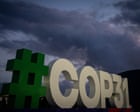
In a negotiation the maxim is usually that no deal is better than a bad deal. But the failure of Cop31 in Turkey to get a climate pact – the first time this has happened in 17 years – should not be an excuse for leaving the planet with the damaging status quo. A hard bargain needs a credible route to agreement: by making commitments, seeking concessions and getting others to reciprocate. This did not happen at the weekend.
Responsibility for the breakdown lay principally with petrostates resisting a transition away from fossil fuels and wealthy nations that are unwilling to finance it properly. With the US absent, the EU was foremost among the latter. European governments’ objection to fossil-fuel backsliding by a Saudi-Russian coalition was right, but they were wrong to rule out fresh EU funding for developing countries’ climate action. Despite their reservations, others – notably China and the African group – were prepared to accept a flawed package to keep multilateralism alive.
While the failure to agree Cop31’s “cover decision” dominated the summit’s headlines, other decisions did pass. The work on a just transition will continue for three years, but the mechanism to make it operational is missing. There was progress on how to assess adaptation needs for developing nations, but not on how to pay for it. Such gaps highlight the unresolved political conflicts at the heart of the UN talks.

An agreement to transition away from fossil fuels was made in 2023. A tripling of adaptation finance was promised in 2025. Yet the Australian-Turkish joint presidency diverted attention away from delivering these commitments towards a cover decision promoting controversial technologies and electrification without tying this to renewable energy. The latter has an energy-security rationale: disruption from the US-Israel war on Iran strengthens the case for replacing imported fossil fuels with homegrown electricity. But how that electricity is generated matters – and poorer countries need support to fund the switch.
Wealthy nations don’t have much of a moral pedestal upon which to lecture them. The UK government is spending less on climate finance per year over the next three years than it did over the last five and is expected to give a nod to Rosebank – the biggest undeveloped oilfield in UK waters – by the end of 2026. More egregiously, Sweden’s environment minister, Romina Pourmokhtari, who led the EU’s finance group at Cop31, publicly backed a weakening of the country’s emissions rules that lay behind its 7% greenhouse gas increase in 2024.
The UN process remains the only forum where every country has a voice and an opportunity to shape outcomes. Before the next Cop, in Ethiopia, trust between parties must be repaired through a transparent negotiating process. Strenuous efforts must also be made to avoid last-minute wrangling over a text that displaces the original agreed agenda by making progress on turning finance pledges into action.
This year brought glacier collapses, record European heat and wildfires across Asia. The world must do much more to confront a human-made catastrophe. It is unarguable that fossil fuels are the primary cause of global heating. What is required is a fair and equitable transition on a global scale to cleaner energy. “The climate crisis will not wait for governments to find common ground. Neither can we,” said UN secretary general António Guterres. It is impossible to disagree.
Year-end fundraiser
$0 of $2,000,000 goal
This is just the beginning …
We hope you appreciated this article. Before you close this tab, can we ask you to support the Guardian at this crucial time for democracy in the US? With Black Friday approaching, our most impactful monthly support option is just $7.50 a month for six months.
For two years, Americans have witnessed a largely unchecked assault on the foundations of US democracy. While enriching themselves through flagrant corruption, the president and his allies have launched aggressive attacks on press freedom, voting rights, due process and many other fundamental civil rights. And they have shown a troubling disregard for the truth.
On election day, America’s embattled democracy came roaring back to life: from Texas to Ohio to South Carolina, a majority of Americans rejected this path at the ballot box. The voting public claimed its right to hold power to account, and millions are now looking at politics with a new and unfamiliar feeling of hope.
The past two years demonstrated just how fragile our fundamental freedoms are, when precious few powerful institutions are willing to stand up for them. Major law firms and universities capitulated to a bullying president’s threats and intimidation. Some corporate news outlets bowed to his pressure, too.
In this atmosphere of fear, the independent press stood out as one of the only forces for accountability, dedicated to uncovering the truth – and to making sure the public understood what was at stake in the election.
A free press has an essential role to play in a robust democracy, shedding light on hidden schemes and revealing the whole picture of our flawed world. Yet these are challenging times for press freedom: Trump’s crackdown on the press shows no signs of letting up; consolidated ownership means fewer options and less diversity of perspective; and the AI industry has threatened the entire business model of journalism, resulting in extreme staff layoffs that have gutted newsrooms.
We will need a free press in 2027 as much as we relied on one in 2025 and 2026. The Guardian is fortunate to have no billionaire owner, no corporate bosses who put profit over mission. We’re accountable to the facts and to our readers. And the Guardian is fortunate to have readers who are willing to support – and commit month after month – to help sustain our independence.
From reporting on the ground to fending off legal risks and keeping our reporters safe, journalism is incredibly expensive to do well. To help fund our work in 2027, we are looking to raise $2,000,000 by the end of the year. All gifts are gratefully received, but for the next several days only, our most impactful monthly support option is $7.50 a month for the first six months. We need to know we have the resources to report on the final throes of Trump’s presidency in what may be a tumultuous year ahead.
KioskNews shows a cleaned-up reading view extracted from the publisher’s page — the original always lives on their site, not ours.